

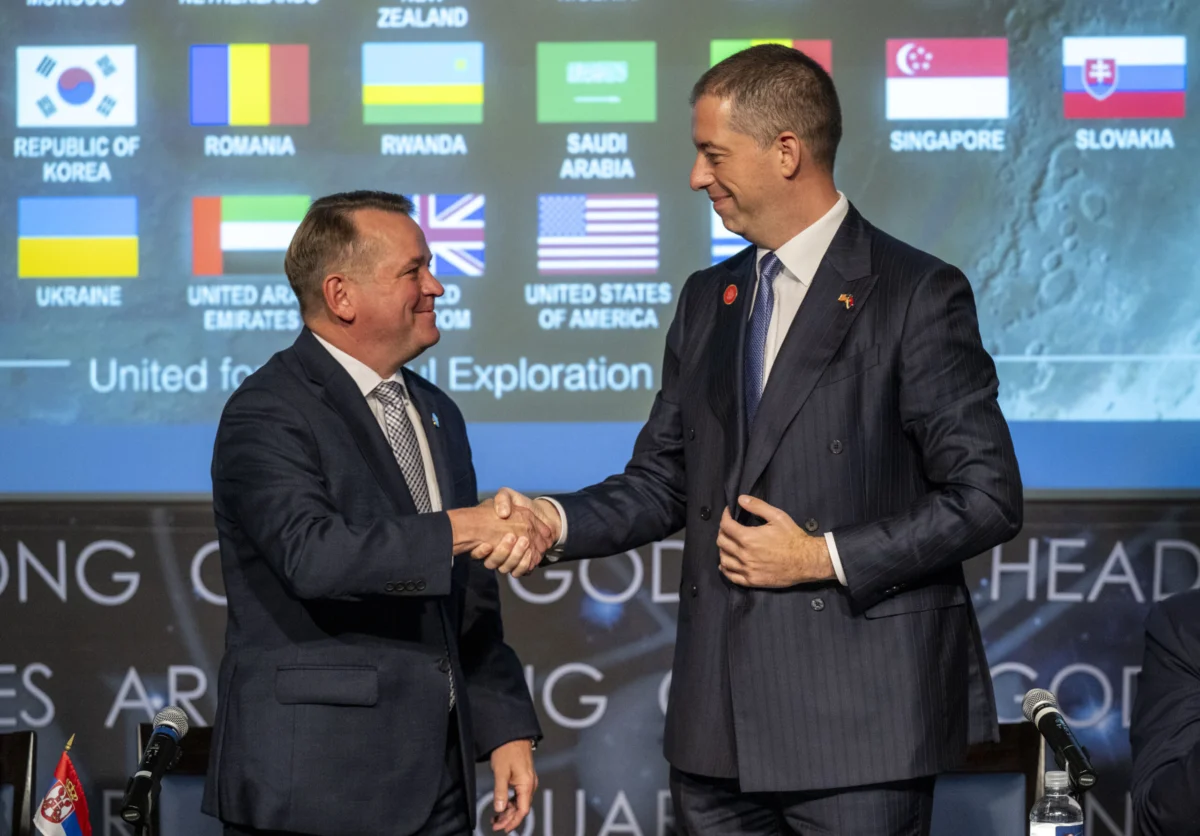
The Republic of Serbia formally aligned itself with a burgeoning international community committed to the principles of peaceful, transparent, and responsible space exploration by signing the Artemis Accords on Thursday. The momentous ceremony, hosted by NASA at its Headquarters in Washington D.C., marked Serbia as the 69th nation to endorse this critical framework for lunar and deep-space activities, signaling a renewed commitment to global cooperation in humanity’s next great extraterrestrial endeavors.
A Historic Connection Reaffirmed
The signing ceremony was more than a mere diplomatic formality; it was a powerful acknowledgement of Serbia’s profound, albeit often unsung, historical contributions to space exploration. NASA Deputy Administrator Matt Anderson underscored this enduring legacy, remarking, “Serbia’s connection to NASA reaches back to the Apollo program, when the work of Serbian engineers helped make some of humanity’s greatest achievements in space possible.” Anderson specifically highlighted the extraordinary efforts of Milojko “Mike” Vučelić, an engineer whose critical role in safely returning the Apollo 13 crew earned him the Presidential Medal of Freedom. Vučelić’s story, Anderson noted, serves as a poignant reminder that “the greatest achievements in space are made possible by talented people working together.”
Indeed, the tapestry of the Apollo era is woven with the ingenuity of a broader team of Serbian American engineers. These pioneers were instrumental across a spectrum of crucial disciplines, including systems engineering, propulsion, power systems, spacecraft docking mechanisms, electronics reliability, and complex mission coordination. Their collective expertise was indispensable, underpinning critical functions ranging from the intricate analysis required for lunar landings to the development of safe and reliable spacecraft docking procedures. This rich history provides a compelling backdrop for Serbia’s modern engagement with the Artemis program, demonstrating a continuity of vision and capability that spans generations.
The Artemis Accords: Shaping the Future of Space Governance
The Artemis Accords represent a landmark international agreement, establishing a set of practical principles to guide safe and sustainable civil space exploration. Launched in 2020 by NASA and the U.S. Department of State alongside seven other founding nations, the Accords were a direct response to the escalating global interest in lunar activities, driven by both governmental space agencies and a rapidly expanding private sector. Their core objective is to mitigate risks, prevent conflict, and foster cooperation as humanity ventures further into the solar system, specifically targeting the Moon, Mars, and beyond.
Key tenets of the Artemis Accords include:
- Peaceful Purposes: All activities are exclusively for peaceful purposes, in accordance with international law.
- Transparency: Signatories agree to conduct their activities transparently, sharing information about policies and plans.
- Interoperability: Promoting the development of common standards and systems for enhanced collaboration.
- Emergency Assistance: Committing to providing assistance to personnel in distress in outer space.
- Registration of Space Objects: Maintaining a public register of space objects to promote safety and transparency.
- Release of Scientific Data: Timely and open sharing of scientific data to ensure all humanity benefits from exploration.
- Protecting Heritage Sites: Preserving sites and artifacts of historical value on celestial bodies.
- Space Resources: Acknowledging that the extraction and utilization of space resources can be conducted in a safe and sustainable manner, in accordance with the Outer Space Treaty.
- De-Confliction of Activities: Implementing measures to prevent harmful interference between activities of different nations.
- Orbital Debris: Mitigating the generation of harmful orbital debris and minimizing its impact.
The Accords, while non-binding, derive their strength from the consensus and commitment of their signatories. With Serbia’s accession, the number of nations endorsing these principles has swelled to 69, representing a diverse cross-section of global economies and scientific capabilities. This growing coalition underscores a shared understanding that as space becomes more accessible and crowded, a common set of behavioral norms is essential for long-term sustainability and peaceful coexistence.
Serbia’s Vision: From Ancient Wisdom to New Frontiers
Representing Serbia at the signing, Minister of Foreign Affairs Marko Đurić articulated a vision that seamlessly blended historical inspiration with future aspirations. “The great beyond has always inspired humanity to achieve its greatest feats – from the Roman ‘per aspera ad astra’ to Norman Vincent Peale’s belief that if we aim for the Moon, we will at least land among the stars,” Đurić stated. He emphasized the profound resonance of these sentiments in the current moment, connecting them directly to Serbia’s rich intellectual heritage.
Đurić invoked the names of scientific giants like Nikola Tesla, the visionary inventor whose contributions to electrical engineering fundamentally reshaped the modern world, and Milutin Milanković, the astrophysicist whose theories on Earth’s long-term climate cycles are foundational to paleoclimatology. He also paid tribute to David Vujic, one of the pioneers of the Apollo missions and a prominent member of the "Serbian Seven," whose collective genius significantly contributed to the success of the Moon landing. "In that spirit," Đurić declared, "we owe it to both our brave ancestors and our children to keep pushing toward new frontiers – to explore, to inspire one another, and to dare even greater things."
The presence of other high-ranking Serbian officials at the ceremony further highlighted the national significance of this step. Ambassador of the Republic of Serbia to the United States Dragan Đutanovac and State Secretary for Serbia’s Ministry of Science, Technological Development and Innovation Marija Gnjatović were in attendance, signaling a comprehensive governmental commitment to space sector development and international collaboration. Their participation underscores Serbia’s strategic intent to integrate into the global space economy and scientific community.
The Artemis Program: A Collaborative Journey Back to the Moon
By signing the Artemis Accords, nations like Serbia open the door to a multitude of opportunities for future lunar exploration alongside NASA and its partners. The Accords are intrinsically linked to the broader Artemis Program, NASA’s ambitious initiative to return humans to the Moon, establish a sustained lunar presence, and ultimately prepare for human missions to Mars.
The Artemis Program is structured in several phases:
- Artemis I (2022): An uncrewed test flight of the Space Launch System (SLS) rocket and Orion spacecraft, successfully orbiting the Moon and returning to Earth, demonstrating the foundational capabilities.
- Artemis II (Target 2025): The first crewed test flight, sending astronauts on a lunar flyby, further validating the spacecraft’s systems with human occupants.
- Artemis III (Target 2026): The historic mission to land humans, including the first woman and first person of color, on the Moon’s South Pole, a region believed to harbor water ice and other valuable resources.
Beyond these initial missions, the Artemis Program envisions the construction of a sustained lunar outpost, referred to as the "Moon Base," and the development of the Gateway, a small space station orbiting the Moon. These infrastructure projects will serve as staging points for lunar surface missions, scientific research, and eventually, as stepping stones for journeys to Mars.
For signatory nations, these opportunities are tangible. They can include providing scientific and technological payloads for the U.S.-led Moon Base, contributing CubeSats for upcoming Artemis missions, and participating in joint research initiatives. Such collaborations are vital for advancing humanity’s return to the Moon and are integral to shaping what many envision as a "Golden Age" of space exploration and innovation. The synergistic relationship between the Accords’ principles and the Artemis Program’s objectives ensures that these endeavors are pursued with shared values and a collective sense of purpose.
Implications for Serbia: Charting a Course for Growth and Innovation
Serbia’s accession to the Artemis Accords carries significant implications across scientific, technological, economic, and diplomatic spheres. Scientifically, it provides Serbian researchers and institutions with direct pathways to engage in cutting-edge lunar science. This could involve developing specialized sensors, experiments, or even small robotic landers (CubeSats) to contribute to lunar data collection and analysis. Such participation not only elevates Serbia’s scientific profile but also fosters domestic expertise in space-related fields.
Technologically, the Accords could stimulate growth in Serbia’s nascent space industry and related high-tech sectors. Collaborative projects often involve technology transfer, capacity building, and the development of specialized skills in areas like advanced materials, robotics, data analytics, and aerospace engineering. This can lead to the creation of new jobs, attract foreign investment, and foster an ecosystem of innovation within the country. While Serbia does not currently possess an indigenous orbital launch capability, its strong engineering and IT sectors position it well for ground segment support, data processing, and component manufacturing.
Economically, becoming part of the Artemis framework can open doors to international tenders and partnerships within the burgeoning global space economy, projected to exceed $1 trillion by 2040. Serbian companies could find niches in supplying components, software, or services to larger space contractors or even directly to NASA and its partners. This integration into global supply chains can provide long-term economic benefits and diversification.
Diplomatically, signing the Accords aligns Serbia with a significant bloc of nations committed to a specific vision of space governance. This strengthens its ties with the United States and other signatory countries, enhancing its standing in international scientific and technological forums. It also signals Serbia’s commitment to multilateralism and its embrace of internationally recognized norms for responsible behavior in outer space. The participation of U.S. Department of State Assistant Secretary for Oceans and International Environmental and Scientific Affairs Wesley Brooks in the signing ceremony underscored the diplomatic weight and significance that the U.S. places on these international partnerships.
The Broader Geopolitical Landscape of Space
The establishment and expansion of the Artemis Accords must also be viewed within the broader geopolitical context of space. As multiple nations and private entities pursue lunar and Martian ambitions, the question of how space will be governed becomes increasingly critical. The Accords represent a U.S.-led initiative to define these norms, emphasizing principles that largely align with the 1967 Outer Space Treaty but provide more specific guidelines for practical operations in the new era of exploration.
This approach contrasts with other emerging models of space cooperation, such as the China-Russia International Lunar Research Station (ILRS) initiative, which operates under a different set of guiding principles and largely excludes nations aligned with the U.S. The growth of the Artemis Accords community demonstrates a preference among many nations for a framework built on transparency, peaceful use, and open data sharing, rather than one that might be perceived as more exclusive or less transparent. The continuous expansion of the Accords, with more countries expected to join in the months and years ahead, reinforces NASA’s and the Department of State’s work to establish a safe, peaceful, and prosperous future in space for all participants.
Ultimately, the vision articulated in President Donald J. Trump’s National Space Policy, which directed NASA to establish a sustained lunar outpost, is now being put into practice through the Moon Base initiative. By inviting every signatory of the Artemis Accords to take part in this endeavor, NASA is demonstrating that the principles enshrined in the Accords are not merely theoretical but are foundational to tangible, collaborative projects. Serbia’s entry into this fold not only honors a proud legacy of scientific and engineering achievement but also positions the nation to play an active role in shaping humanity’s next chapter beyond Earth.