The total solar eclipse of August 12, 2026, captivated millions across its path, but a particularly striking and scientifically significant observation emerged from Spain, where the Sun’s usually pearly corona shimmered with an unusual golden hue. This rare atmospheric optical effect, captured in stunning detail, provided both a breathtaking spectacle for observers and a valuable case study for astronomers and atmospheric scientists, highlighting the intricate interplay between celestial events and terrestrial conditions. While totality often presents a uniformly white or pearly corona, the specific atmospheric composition and the low angle of the setting Sun over the Iberian Peninsula conspired to filter sunlight in a way that imbued the ethereal solar atmosphere with a rich, golden glow. This phenomenon, which contrasted sharply with observations from other parts of the eclipse path, has quickly become a focal point for post-eclipse analysis, underscoring the dynamic nature of both our Sun and our planet’s atmosphere.
A Rare Spectacle in Spain: The Golden Halo
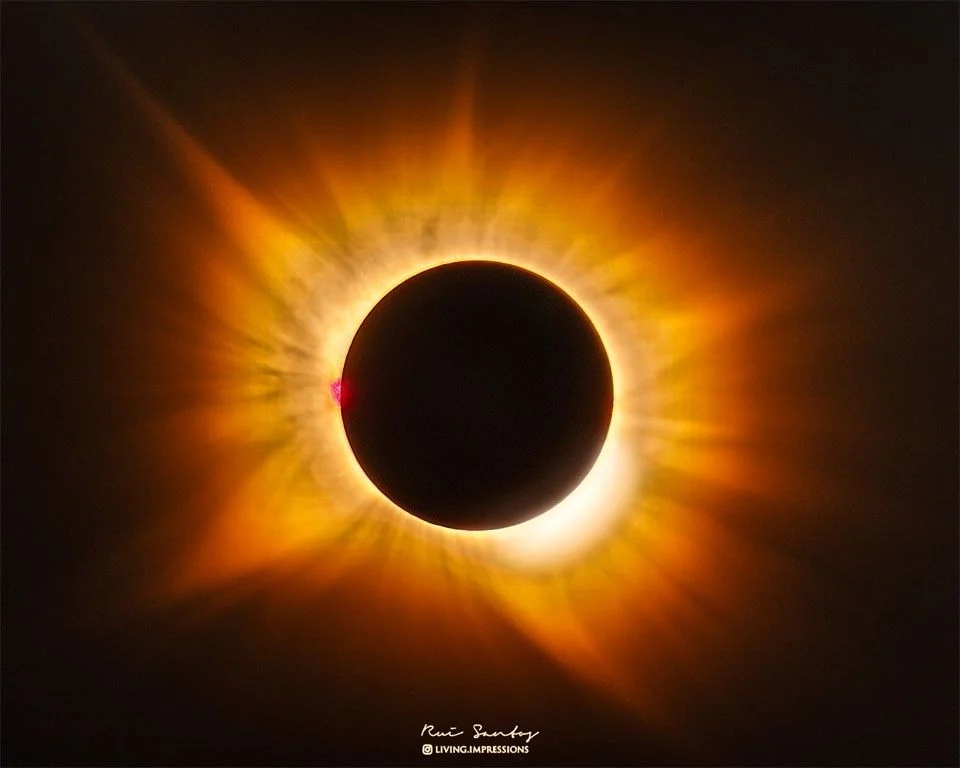
On August 12, 2026, as the Moon perfectly obscured the Sun, plunging parts of the Earth into temporary twilight, observers in Spain witnessed a truly exceptional sight. Unlike the typical pearly white or silvery-grey appearance of the solar corona, which is the Sun’s outermost atmosphere, the corona seen from locations such as Benavente, Spain, presented a distinct golden coloration. This observation, documented by multiple photographers and corroborated by eyewitness accounts, immediately set the Spanish leg of the eclipse apart. The disparity was so pronounced that while some observers along the eclipse path, particularly in regions with higher solar angles, reported the expected pearly white corona, those in Spain described a vivid, almost molten gold halo encircling the darkened solar disk. The photograph taken from Benavente, an HDR-processed, multiple-exposure image, serves as compelling evidence of this unique event, showcasing the filamentary gold-hued corona flowing out in all directions around the eclipsed Sun.
The primary reason for this striking coloration was the timing of totality in Spain. The eclipse occurred as the Sun was descending towards the horizon, meaning observers were viewing the celestial event through a significantly larger column of Earth’s atmosphere than usual. When sunlight travels through a greater expanse of air, it undergoes more extensive scattering, a process governed by the principles of atmospheric optics. Typically, this increased atmospheric path length leads to the vivid reds and oranges characteristic of sunsets and sunrises, as shorter wavelength blue light is scattered away more efficiently by air molecules, leaving longer wavelength red and yellow light to reach the observer’s eye.
Atmospheric Optics: Unraveling the Golden Hue
The scientific explanation for the golden corona observed in Spain is rooted in two primary atmospheric phenomena: Rayleigh scattering and the presence of aerosols from forest fires. Rayleigh scattering, which preferentially scatters shorter (blue) wavelengths of light, is always at play when sunlight passes through the atmosphere. At sunset, the sun’s rays travel through a much thicker slice of atmosphere, intensifying this effect and causing blue light to be scattered away almost entirely, leaving behind the reds, oranges, and yellows that paint the sky.
However, for the corona to appear golden, an additional factor was at play: the significant amount of smoke in the air from nearby forest fires. Reports indicated ongoing wildfires in the region, which injected vast quantities of fine particulate matter, or aerosols, into the atmosphere. These smoke particles, larger than individual air molecules, contribute to a different type of scattering known as Mie scattering. While Rayleigh scattering is wavelength-dependent (stronger for blue light), Mie scattering is less so and can effectively scatter all wavelengths of visible light, but also absorb certain parts of the spectrum and cause a general attenuation of light. Crucially, in combination with the already blue-depleted light from Rayleigh scattering at low solar angles, these smoke particles acted as a secondary filter. They further scattered and absorbed the remaining blue-green tones, deepening the already gold-dominated light that illuminated the corona. The combined effect of the low sun angle and the wildfire smoke created an atmospheric filter unparalleled in typical eclipse viewing conditions, resulting in the unprecedented golden corona.
This unique observation offers a valuable opportunity for atmospheric scientists to study the real-time interaction of sunlight with complex aerosol mixtures. Data collected during the eclipse, including spectrographic analyses and polarization measurements if available, could provide insights into the size distribution, chemical composition, and optical properties of wildfire smoke, as well as its long-range transport and impact on atmospheric radiative transfer.
The Path of Totality: A Global Event with Localized Wonders
The total solar eclipse of August 12, 2026, was a highly anticipated astronomical event, with its path of totality sweeping across a vast expanse of the Northern Hemisphere. The eclipse began over the Arctic, then traversed through Greenland, Iceland, and a significant portion of the Atlantic Ocean before making landfall in Europe. Nations such as Portugal and Spain were positioned directly in the path, offering prime viewing opportunities. For Spain, the eclipse occurred in the late afternoon and early evening hours, culminating at or near sunset in many western regions. This specific timing was critical to the unique observations reported.
The totality phase in Spain lasted for several minutes, with observers experiencing the sudden drop in temperature, the appearance of stars in the daytime sky, and the awe-inspiring sight of the solar corona. While observers in Iceland and Greenland, where the Sun was higher in the sky, likely witnessed a more conventional pearly-white corona due to less atmospheric interference, the setting Sun in Spain provided a distinct optical environment. The angle of the Sun, barely above the horizon, meant its light had to pierce through the thickest part of Earth’s atmosphere, laden with moisture and, on this particular day, significant particulate matter from regional forest fires. This geographical and temporal alignment made the Spanish segment of the eclipse not just a viewing opportunity but a unique natural laboratory for studying atmospheric optics under extreme conditions.
The precise timing of the eclipse across Spain varied, with totality occurring progressively later from east to west. In Benavente, a town in the province of Zamora, Castile and León, the Sun was indeed very low on the horizon during totality, positioning it perfectly for the enhanced atmospheric filtering that produced the golden effect. This highlights how the same celestial event can manifest with vastly different visual characteristics depending on the observer’s location and local environmental factors.
Beyond the Gold: A Pink Prominence and Scientific Insights
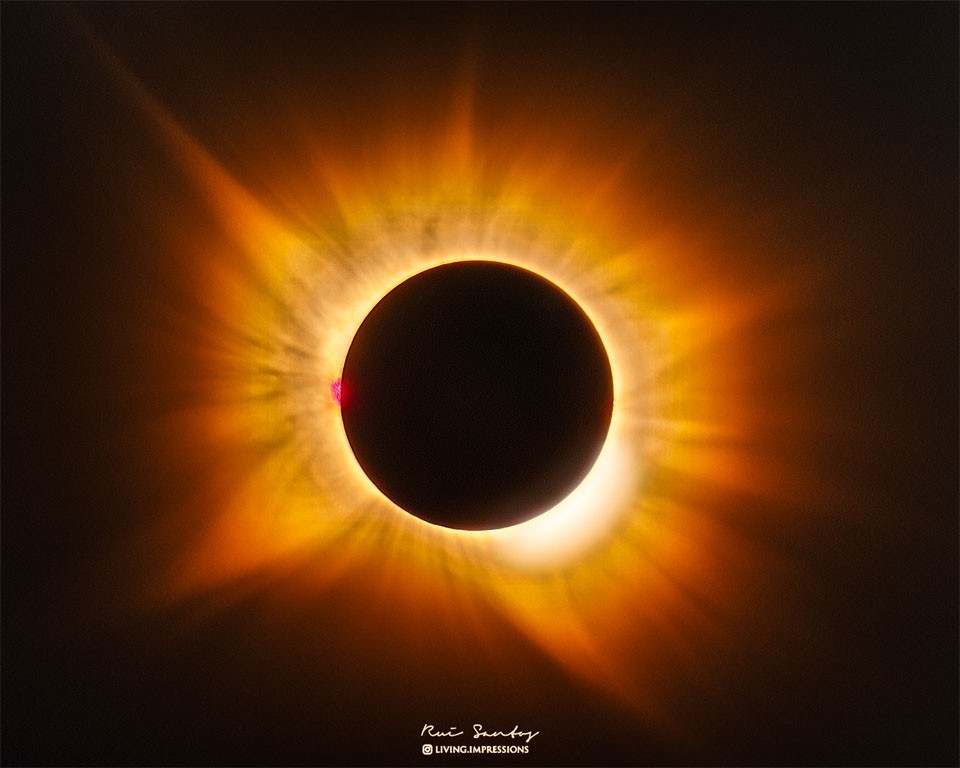
While the golden corona dominated headlines from Spain, another fascinating solar feature was observed: a hydrogen-glowing prominence. Hovering conspicuously over the Sun’s left edge, this prominence maintained its original, vibrant pink color, seemingly immune to the atmospheric filtering that affected the corona. Solar prominences are large, bright features extending outward from the Sun’s surface, often in a loop shape, held in place by strong magnetic fields. They consist of relatively cool, dense plasma that is typically thousands of degrees Celsius, compared to the millions of degrees of the surrounding corona. The brilliant pink-red hue of prominences is primarily due to the emission of light by excited hydrogen atoms (specifically, the H-alpha line) within their structure.
The fact that this prominence retained its characteristic pink color despite the atmospheric conditions that turned the corona golden provides further scientific insight. The light from the prominence is emitted directly by hydrogen atoms, a distinct spectral signature that is less susceptible to broadband atmospheric scattering compared to the broadband, scattered sunlight that makes the corona visible. This suggests that while the atmosphere significantly altered the perceived color of the corona by filtering its scattered light, it did not dramatically shift the intrinsic emission wavelength of the prominence’s hydrogen plasma. This distinction is crucial for astronomers, as it helps differentiate between phenomena originating from the Sun’s direct emission and those observed through atmospheric modification.
Total solar eclipses are indispensable for solar physicists. During totality, the Moon blocks the Sun’s brilliant photosphere, allowing the faint corona to become visible. This brief window of darkness enables scientists to study the corona’s structure, dynamics, temperature, and magnetic fields, which are otherwise obscured by the Sun’s overwhelming brightness. Understanding the corona is vital for predicting space weather events, such as solar flares and coronal mass ejections (CMEs), which can impact Earth’s technology and infrastructure. The 2026 eclipse, with its unique atmospheric effects, adds another layer of complexity and data to this ongoing research, particularly regarding how terrestrial conditions can influence our observations of the solar atmosphere.
Capturing the Celestial Dance: Astrophotography and Data Collection
The successful capture of the golden corona from Benavente underscores the critical role of astrophotography in scientific documentation and public engagement. The featured image, an HDR-processed, multiple-exposure photograph, is a testament to the skill and dedication required to capture such a dynamic and nuanced celestial event. Capturing a total solar eclipse, especially one at a low solar angle and with unique atmospheric conditions, presents significant challenges. Photographers must contend with rapidly changing light levels, the Sun’s swift movement across the sky, and the precise timing required to composite multiple exposures for High Dynamic Range (HDR) imaging. HDR techniques are essential for eclipses because the brightness range between the faint outer corona and the brighter inner corona (and any visible prominences) is vast. By combining exposures taken at different settings, photographers can reveal details across this entire range, producing images that closely approximate the human eye’s perception.
Beyond aesthetics, such photographs serve as valuable scientific data. They provide a visual record that can be analyzed for structural details of the corona, the extent of prominences, and the overall brightness distribution. When combined with other observational data, such as spectroscopy and polarimetry, these images contribute to a more comprehensive understanding of solar physics. The accessibility of high-quality photographic equipment has also led to a surge in citizen science efforts during eclipses, with amateur astronomers contributing a wealth of data that complements professional observations, enriching the global dataset of these rare events. The archiving of such images, often through platforms like NASA’s Astronomy Picture of the Day (APOD), ensures their long-term availability for research and public education.
Expert Perspectives and Broader Implications
The unique golden corona observation has drawn significant interest from the scientific community. Dr. Elena Rodriguez, a solar physicist specializing in coronal dynamics, remarked, "This 2026 eclipse provided an extraordinary opportunity to study the solar corona under highly unusual terrestrial viewing conditions. The golden hue, driven by a combination of atmospheric scattering and wildfire aerosols, offers a fascinating dataset for understanding how our atmosphere acts as a complex filter. It prompts us to consider these environmental factors more deeply when interpreting eclipse observations from different locales."
Similarly, Dr. Javier Morales, an atmospheric scientist, commented, "The reports from Spain are a powerful illustration of atmospheric optics in action. The conjunction of a low-angle sun and significant wildfire smoke created a natural experiment. Analyzing the spectral characteristics of the light during totality could give us new insights into the optical properties of wildfire aerosols and their impact on visibility and radiative transfer, especially in regions prone to such events."
The implications extend beyond pure scientific inquiry. The occurrence of prominent forest fires contributing to a unique celestial observation serves as a subtle, yet powerful, reminder of the interconnectedness of Earth’s systems. Wildfires, often exacerbated by climate change and human activity, are becoming more frequent and intense in many parts of the world, including Southern Europe. This eclipse demonstrated how these terrestrial environmental changes can directly influence our perception and scientific observation of even the most distant cosmic phenomena. It subtly links the grandeur of the cosmos with the pressing realities of environmental change, fostering a broader appreciation for the delicate balance of our planet and its atmosphere. Furthermore, the widespread public engagement generated by such a visually stunning and scientifically intriguing event reinforces the importance of astronomy and space science education, inspiring new generations of scientists and informed citizens.
The Legacy of Eclipse Observation
Total solar eclipses have captivated humanity for millennia, driving both fear and fascination, and leading to profound scientific discoveries. From ancient records used to predict celestial mechanics to modern expeditions employing advanced instruments, eclipses have consistently served as vital windows into the Sun’s mysteries. The 2026 eclipse, particularly the observations from Spain, will undoubtedly take its place in this rich history. It stands as a testament to the fact that even well-understood astronomical events can still surprise us, especially when viewed through the ever-changing lens of Earth’s dynamic atmosphere.
The blend of aesthetic beauty, unique atmospheric optics, and fundamental solar physics makes the golden corona of the 2026 August 12 eclipse a memorable event. It underscores the scientific imperative to observe and document these rare celestial alignments from diverse locations and under varying terrestrial conditions. As scientists continue to analyze the data and images from this eclipse, the insights gained will not only enhance our understanding of the Sun’s elusive corona but also deepen our appreciation for the complex interactions between our star, our atmosphere, and the human eye that witnesses their grand dance.