


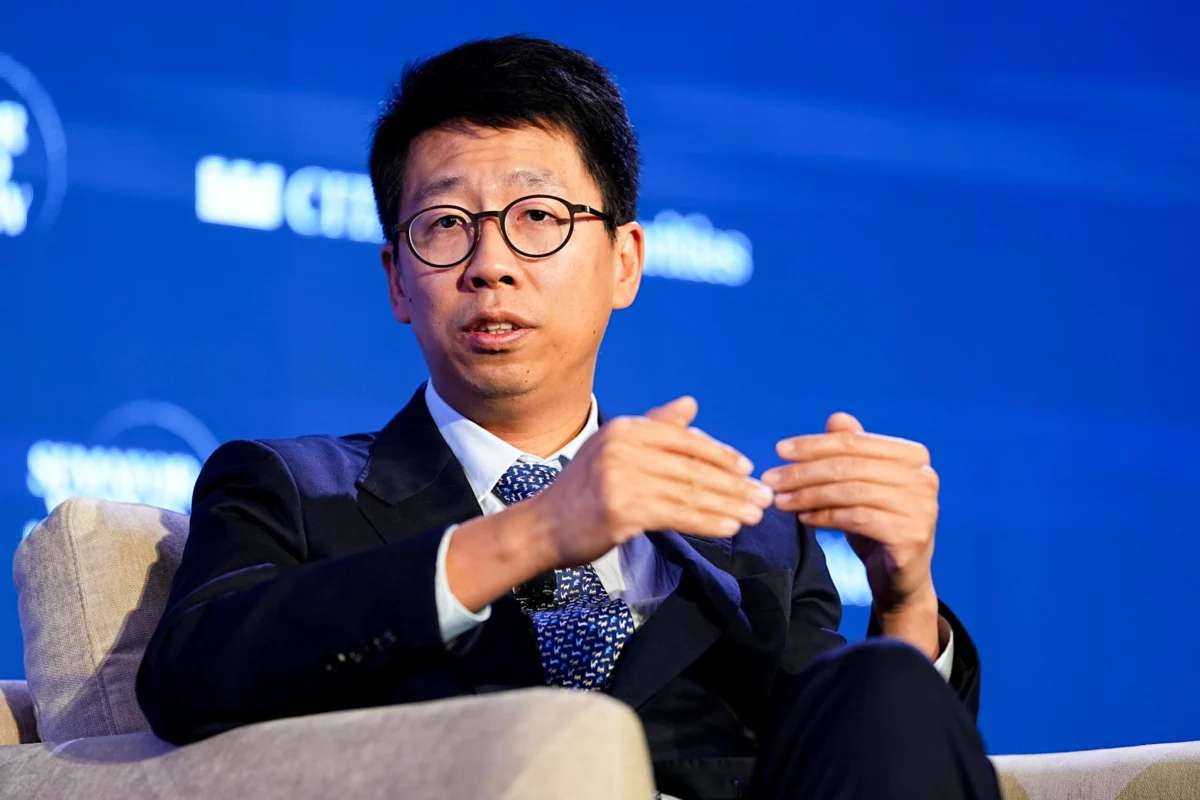
In a pivotal moment that could define an era in global financial technology, a 34-year-old Jack Zhang, co-founder of the then-nascent startup Airwallex, found himself at a crossroads. It was 2018, just three and a half years into his entrepreneurial journey, when he received an invitation to the San Francisco home of Michael Moritz, a titan of venture capital from Sequoia. The setting, recalled by Zhang, was impressive: a multi-story residence with an unobstructed panorama of the iconic Golden Gate Bridge, a fitting backdrop for a proposition of monumental scale. Moritz, representing the formidable Stripe, extended an offer to acquire Airwallex for a staggering $1.2 billion.
At the time, the Melbourne-based Airwallex was a promising but still early-stage venture, generating approximately $2 million in annualized revenue. The financial terms of the proposed acquisition were, by conventional metrics, almost irresistibly compelling: a revenue multiple approaching 600 times. Moritz passionately articulated the vision, portraying Stripe’s co-founder Patrick Collison as a generational talent and arguing that a merger would create an extraordinary compounding effect. Zhang listened intently, absorbing the weight of the opportunity. For two weeks, he grappled with the decision, pacing the streets of San Francisco, his mind in a restless blur. In a moment of profound pressure, he initially agreed to the acquisition.
The Entrepreneur’s Unwavering Vision
Yet, the decision gnawed at him. Upon returning home, a journey of nearly 8,000 miles, Zhang embarked on a period of intense introspection. Speaking from overseas, he later recounted, "I really went deep on what motivates me to build Airwallex." He reflected on the preceding three and a half years, a period where the business had experienced explosive growth, multiplying its operations 100-fold in 2018 alone. This rapid ascent had given him his first true taste of entrepreneurship, a dream he had long harbored. "That’s what I’d been dreaming about," he emphasized, underscoring a deep-seated desire that transcended mere financial gain.
Crucially, his resolve was bolstered by his co-founders; two of the three had voted against the acquisition, signaling a shared belief in their independent path. However, the clearest affirmation, Zhang noted, came from the whiteboard in his own office. Scrawled there was the audacious, yet unfinished, vision: to construct the foundational financial infrastructure enabling any business, anywhere in the world, to operate as seamlessly as a local entity. This unwavering commitment to a grander purpose ultimately led him to reverse his initial acceptance and reject Stripe’s offer – a decision that, with the benefit of hindsight, appears increasingly prescient.
A Path Forged in Hardship: Zhang’s Journey to Airwallex
Zhang’s entrepreneurial drive and resilience are deeply rooted in his personal history. Born and raised in Qingdao, a bustling port city in northeastern China, he moved to Melbourne at the tender age of 15, navigating a new country and culture with a rudimentary grasp of English, living with a host family and separated from his parents. This early experience of displacement and independence forged a formidable character. Later, when his family faced severe financial difficulties, Zhang exhibited remarkable grit, juggling four jobs simultaneously to finance his computer science degree at the University of Melbourne. These roles – bartending, washing dishes, graveyard shifts at a petrol station, and the arduous task of picking lemons on a farm during school holidays, which he vividly described as the hardest job he ever had – instilled in him an unparalleled work ethic and a profound understanding of struggle.
After university, he spent years immersed in the high-stakes world of investment banking, writing trading code from the front office of an Australian institution. While financially rewarding, the work lacked the profound sense of purpose he craved. It was "never deeply fulfilling," he admitted, hinting at a restlessness for something more impactful. Prior to Airwallex, Zhang had already demonstrated an insatiable entrepreneurial spirit, launching approximately ten diverse businesses, starting with a magazine at age 14. His ventures spanned real estate development, import-export operations moving wine and olive oil from Australia to Asia and textiles in the reverse direction, and even a burger chain. Each endeavor, regardless of its outcome, served as a crucible, refining his business acumen and deepening his understanding of market dynamics.
The genesis of Airwallex itself emerged from a practical problem encountered during one of his businesses – a Melbourne coffee shop. His co-founder, Max Li, frequently struggled with international payments to coffee bean suppliers in Brazil, Indonesia, and Guatemala. These payments often vanished into the labyrinthine correspondent banking systems, flagged and frozen by American intermediary banks enforcing OFAC sanctions, sometimes bouncing back weeks later. This frustrating inefficiency sparked a critical inquiry. "That pushed me to really look at how correspondent banking works," Zhang explained, "how SWIFT works, and how we could build our own global money movement network." This real-world pain point, experienced firsthand, became the fertile ground for Airwallex’s foundational concept.
Building Global Infrastructure: The "Path of Maximum Resistance"
This foundational idea, born from the frustrations of traditional cross-border payments, has since scaled dramatically. Airwallex’s strategic differentiator lies in its commitment to building proprietary, deeply integrated financial infrastructure – a philosophy Zhang terms the "path of maximum resistance." This approach stands in stark contrast to many fintech companies that leverage existing third-party systems. Today, Airwallex boasts an impressive portfolio of nearly 90 financial licenses across 50 markets, a figure Zhang estimates to be roughly double that of Stripe’s operational reach.
The acquisition of these licenses is not merely a regulatory formality; it is a strategic moat, incredibly time-consuming and capital-intensive. The process in Japan alone, for instance, took a grueling seven years. In some emerging markets, Airwallex had to navigate complex regulatory landscapes by acquiring dormant shell companies whose essential licenses were no longer being issued by central banks, then painstakingly rebuilding the underlying technology from the ground up. This granular, hands-on approach is exemplified by Zhang’s vivid description of integrating with national financial systems: "You can’t really vibe-code an integration with Mexico’s central bank," he stated, adding, "We have to have a secure room – you have to do a biometric scan just to walk in to access the central bank integration." Such anecdotes underscore the sheer complexity and rigor involved in their infrastructure build-out.
The operational advantages derived from owning these licenses are substantial. In Japan, for example, while competitors like Stripe and Square can process payments, they are typically mandated to immediately transfer funds to the merchant’s bank account. Airwallex, armed with its fund transfer operator license, can hold these funds within its proprietary ecosystem. This capability empowers customers to issue local bank accounts, issue cards, and manage spending directly within the Airwallex platform, without funds ever needing to leave. The foreign exchange economics alone represent a significant benefit. A U.S. merchant settling transactions in Australian dollars, for instance, avoids the typical 2% to 3% conversion fees charged by processors like Stripe to repatriate funds to U.S. dollars. Instead, they can utilize those local balances to pay local vendors, run payroll, and cover digital marketing expenses, all at interbank rates, which are significantly more favorable. This fundamentally alters how businesses operate globally: "You don’t really operate like a U.S. company anymore," Zhang elaborated. "You operate like a company with entities around the world, but without needing to physically set up those entities."
This slow, deliberate, and arduous build-out has been intentional, creating layers of competitive advantage that are incredibly difficult to replicate. Zhang highlights the tangible results: "It took us six and a half years to get to $100 million in annual recurring revenue," he noted. "But after that, it took just over three years to get to a billion." This exponential acceleration underscores the power of foundational infrastructure. The competitive logic, as Zhang explains, boils down to the fundamental difference between owning infrastructure and merely renting it. Without end-to-end control over the payment workflow, companies lack the ability to access underlying data to diagnose issues for customers or seamlessly extend new products atop a third-party stack. Building on others’ infrastructure, he asserts, "is simply not scalable."
Navigating the Competitive Landscape: Airwallex vs. Stripe
For much of their respective histories, Airwallex and Stripe have largely operated in different geographic territories and catered to distinct customer segments. Airwallex established a strong foothold in Australia and Southeast Asia, primarily targeting the CFO’s office – finance directors and treasury teams – positioning its sales motion differently from Stripe. Stripe’s growth, conversely, has been significantly driven by U.S. developers who instinctively choose it as a default payment solution for new companies. Over 90% of Airwallex’s customers initially engage with a business account product, with payments and spend management solutions following. More than half of its customer base now utilizes multiple Airwallex products, indicating successful cross-selling and deepening customer relationships.
However, this market segmentation is rapidly eroding. As Stripe intensifies its push into international markets, and Airwallex makes its inaugural significant moves into the United States, the competitive overlap is expanding. This convergence brings forth new challenges for Airwallex, which Zhang candidly acknowledges. The most prominent hurdle is Stripe’s entrenched position as Silicon Valley’s "golden child," a privately held company whose shares have minted millionaires across the tech industry, imbuing it with a powerful brand cachet. This translates into a significant brand gap for Airwallex. The company needs to embed itself into the collective consciousness of engineers and developers, not just finance teams, so that founders instinctively reach for Airwallex. "Our brand is just not there yet," Zhang conceded, recognizing that "that’s a harder competition to win."
This evolving rivalry is being closely observed by a variety of stakeholders. Interestingly, Sequoia, the venture capital firm whose partner Michael Moritz extended the initial acquisition offer, was also an early backer of Airwallex, albeit through its Sequoia Capital China arm (now rebranded as Hongshan). Sequoia remains one of Airwallex’s largest shareholders. Furthermore, Greenoaks Capital, another prominent investment firm, holds stakes in both companies. Zhang, however, dismisses any suggestion of awkwardness stemming from these overlapping cap tables, noting that investors are ultimately betting on the vast potential of a large and expanding market.
The Valuation Equation: Closing the Gap
The competitive dynamic inevitably brings the spotlight onto valuation. In February, Stripe was valued at an astonishing $159 billion in a tender offer, representing a 74% increase from the previous year, after processing a colossal $1.9 trillion in total payment volume in 2025. Airwallex, by contrast, secured an $8 billion valuation in December, roughly a twentieth of Stripe’s. While the valuation gap appears vast, Zhang offers a crucial perspective. He points out that Stripe’s payment volume is approximately six times Airwallex’s approaching $300 billion in annualized transaction volume, not twenty times. With an impressive 85% year-over-year growth and projections of reaching $2 billion in annual revenue within the next year, Airwallex is closing the revenue gap at a pace that belies the current valuation disparity.
Whether the broader market eventually recognizes and re-rates Airwallex accordingly remains a central question. An initial public offering (IPO), which Zhang indicates is at least three to five years away, would force this valuation discrepancy into the open and provide a definitive market assessment.
The Horizon Ahead: AI, Expansion, and Market Leadership
In the interim, Zhang’s focus remains squarely on ambitious longer-horizon targets. By 2030, Airwallex aims to serve a million customers and achieve an astounding $20 billion in annual revenue. The company also intends to significantly increase its average revenue per customer, from approximately $12,000-$13,000 today to roughly $20,000. A cornerstone of this future growth strategy is the imminent rollout of a suite of AI-powered autonomous finance products. These intelligent agents are designed to move beyond merely surfacing data, actively executing transactions and automating complex financial workflows. Zhang posits that Airwallex’s decade-long accumulation of proprietary financial data across the entire corporate finance stack – encompassing revenue collection, treasury management, vendor payments, and expense management – has created an unparalleled training dataset. This data advantage, he suggests, is a strategic asset that no competitor can replicate overnight.
The Silent Rivalry
The unfolding competition between Airwallex and Stripe is not just a battle for market share; it’s a narrative of divergent strategies and entrepreneurial conviction. While Zhang and Collison were never close friends, they maintained a friendly rapport during the merger talks years ago. However, the intensification of their rivalry has subtly altered this dynamic. Last year, both founders attended Greenoaks Capital’s annual gathering, a shared investor event. They didn’t speak, a quiet acknowledgment of the escalating stakes. As Airwallex continues its aggressive expansion, fueled by its "path of maximum resistance" and a relentless focus on proprietary infrastructure, the fintech world watches keenly to see if Zhang’s audacious rejection of a billion-dollar offer will ultimately carve out a dominant, enduring legacy in the global financial landscape. The competition, for now, plays out at a distance, but the strategic maneuvers suggest an inevitable and impactful collision course.