



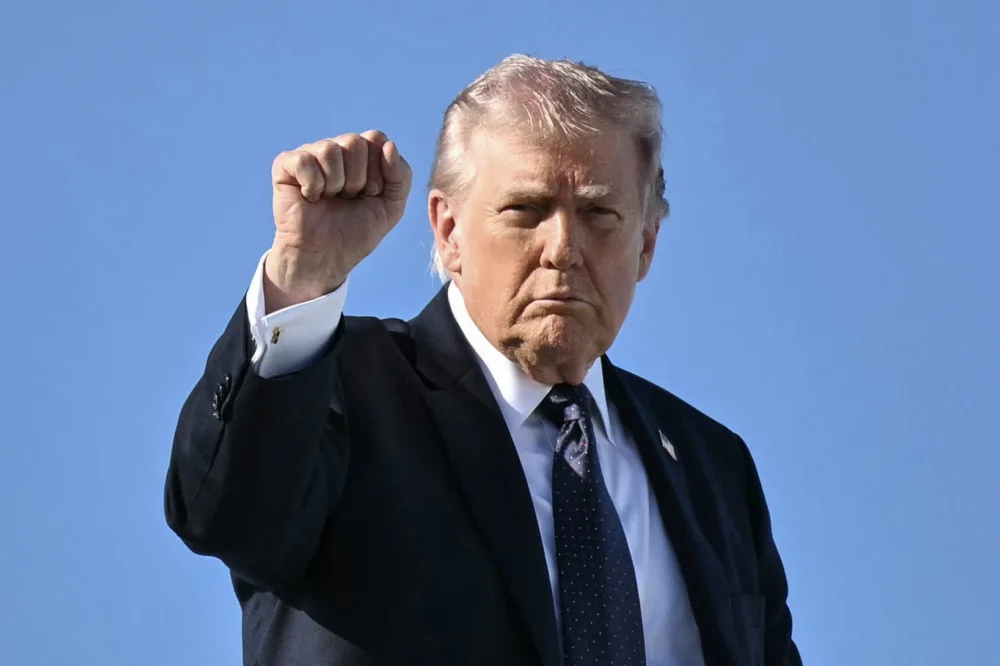
In a significant intervention poised to reshape the legislative landscape for digital assets, former U.S. President Donald Trump has unequivocally thrown his weight behind the burgeoning cryptocurrency industry in its heated dispute with traditional banks over the ability to offer interest-like returns on stablecoins. The dramatic endorsement, delivered via a social media post late Tuesday, March 1, 2026, has ratcheted up immense pressure on financial institutions and sent ripples through both the crypto and traditional financial markets, as the contentious issue threatens to derail critical bipartisan legislation aimed at regulating stablecoins. The former president’s move, made from Palm Beach International Airport before departing for Washington, D.C., signals a renewed focus on digital assets within his political agenda and raises profound questions about the future of financial innovation in the United States.
The President’s Bold Stance and Immediate Market Impact
President Trump’s declaration arrived with characteristic force, targeting banks for what he described as undermining progress for the American people. "The Genius Act is being threatened and undermined by the Banks, and that is unacceptable," Trump asserted in his post, referencing a landmark piece of crypto legislation approved just last year. He continued, urging, "They need to make a good deal with the Crypto Industry because that’s what’s in best interest of the American People." His rationale centered on empowering consumers: "Americans should earn money on their money. This industry cannot be taken from the People of America when it is so close to becoming truly successful."
The immediate market reaction underscored the gravity of his statement. Shares of Coinbase, the largest U.S. crypto platform and a prominent proponent of stablecoin yields, surged by as much as 15% in midday trading Wednesday. Conversely, stocks of major banking institutions, including JPMorgan Chase and Bank of America, experienced minor declines, falling less than 1%, reflecting investor apprehension about potential shifts in the regulatory and competitive environment. This divergence in market performance highlights the high stakes involved in the ongoing battle for control over a potentially lucrative segment of the financial market.
The Legislative Crossroads: Clarity Act and Genius Act
At the heart of this dispute lies the stalled passage of the "Clarity Act," a proposed companion bill to the "Genius Act" that was successfully enacted in 2025. The Genius Act established a foundational framework for regulated stablecoins, aiming to provide much-needed legal certainty and foster innovation within a defined regulatory perimeter. However, its full implementation and the broader regulatory environment for stablecoins remain incomplete without the Clarity Act.
The Clarity Act is designed to elaborate on key aspects of stablecoin regulation, particularly addressing the contentious issue of whether crypto firms can offer yields on stablecoin holdings. Lawmakers had anticipated a relatively smooth path for the Clarity Act, building on the momentum of its predecessor. However, the intense lobbying efforts and fundamental disagreements between the banking and crypto sectors have created a legislative quagmire, stalling progress in a GOP-led Congress that is otherwise keen on fostering technological innovation. President Trump’s intervention is seen by many as an attempt to break this deadlock, leveraging his influence within the Republican Party to push the bill forward.
The Core Contention: Stablecoin Yields and the $6.6 Trillion Threat
The central point of friction revolves around the offering of interest-like returns on stablecoins. Stablecoins are cryptocurrencies designed to maintain a stable value, typically pegged to a fiat currency like the U.S. dollar or backed by reserves. They are increasingly used for transactions, remittances, and as a bridge between traditional finance and the decentralized crypto ecosystem. Crypto firms argue that allowing consumers to earn yields on stablecoins is a natural evolution of financial services, offering a consumer-friendly innovation that enables individuals to earn passive income on their otherwise idle digital assets. They contend that this mirrors traditional savings accounts and money market funds, providing a competitive alternative.
Traditional banks, however, view stablecoin yields as an existential threat. Executives from America’s largest lenders, including JPMorgan and Bank of America, have repeatedly voiced grave concerns, citing a comprehensive Treasury study from the second quarter of 2025. This study, commissioned to assess emerging risks in the digital asset space, reportedly indicated that banks could face a catastrophic loss of up to $6.6 trillion in deposits if stablecoins were widely adopted and offered competitive yields. This staggering figure represents a substantial portion of the U.S. banking system’s deposit base, which is crucial for funding loans to businesses and consumers across the country.
Jamie Dimon, CEO of JPMorgan Chase, has been a vocal critic of what he perceives as an uneven playing field. "It can’t be, you have these people doing one thing without any regulation, and these people doing another," Dimon stated in a recent interview, emphasizing the need for regulatory parity. Banks argue that allowing less-regulated crypto entities to effectively operate as "quasi-banks" by taking deposits (in the form of stablecoins) and offering yields would heighten systemic risk, create an unfair competitive environment, and potentially destabilize smaller regional banks. They also highlight concerns about consumer protection, anti-money laundering (AML) compliance, and the overall integrity of the financial system if stablecoin providers operate under a lighter regulatory burden.
Crypto firms, in response, counter that their risks are often overstated and contained. They emphasize that many stablecoins are backed by highly liquid assets, such as U.S. Treasury bills, which would, in fact, boost demand for U.S. government debt, benefiting the broader economy. They argue that robust, transparent regulation, such as that proposed by the Genius Act and Clarity Act, would adequately address systemic concerns without stifling innovation. They also point to the fact that current banking regulations were largely designed for a different era and may not be agile enough to accommodate the advancements brought by blockchain technology.
A History of Tension and High-Level Engagements
The tension between the traditional financial sector and the crypto industry has been simmering for years, punctuated by significant events and high-profile clashes. President Trump, recognizing the growing importance of the digital asset sector and its potential political influence, has reportedly hosted a series of White House meetings in recent months, attempting to broker a truce between the warring factions. These gatherings, involving top executives from both industries, were aimed at finding common ground that would allow the Clarity Act to move forward. However, sources familiar with these discussions indicate that banks have remained steadfast in their opposition to stablecoin yields, unwilling to concede ground on what they view as a fundamental threat to their business model.
This persistent deadlock ultimately prompted President Trump’s public endorsement of the crypto industry. His direct intervention marks a shift from a mediating role to an active champion for one side, underscoring the political weight he is willing to commit to the issue.
A notable illustration of this deep-seated animosity occurred in January at the World Economic Forum in Davos, Switzerland. During a chance interaction, JPMorgan CEO Jamie Dimon reportedly told Coinbase CEO Brian Armstrong he was "full of s–t" regarding the stablecoin yield debate. This blunt exchange, widely reported, encapsulates the raw emotions and fundamental disagreements that define this inter-industry rivalry. Armstrong, often seen as the primary adversary by banking executives, has consistently advocated for a level playing field and consumer choice in financial services. His language, often echoing Trump’s sentiment that "Americans should earn money on their money," reflects a shared philosophy that emphasizes individual financial empowerment through crypto.
Significantly, Armstrong met with President Trump at the White House shortly before the president’s social media post on Tuesday. This private meeting, first reported by Politico, suggests a coordinated effort and highlights the direct line of communication between the crypto industry’s leadership and the former president, further cementing Trump’s allegiance to the digital asset sector.
Broader Implications and Political Ramifications
President Trump’s decision to back the crypto industry could have far-reaching political and economic implications. His endorsement is likely to galvanize members of his Republican Party in the GOP-led Congress, potentially providing the necessary impetus for the Clarity Act to overcome its current legislative hurdles. While bipartisan support is generally preferred for significant financial legislation, Trump’s influence could sway enough Republican votes to push the bill through, especially given the growing conservative interest in digital assets as a hedge against inflation and government overreach.
However, the path to passage remains uncertain. Trump’s prior attempt to pressure banks to cap credit card interest rates earlier this year faced significant resistance and ultimately failed, as the banking industry mustered enough bipartisan support to fend off that threat. This previous episode demonstrates that the financial lobby is a formidable force in Washington, capable of influencing lawmakers across the political spectrum. The stablecoin yield issue, given its profound implications for bank profitability and systemic risk, is likely to provoke an even more intense lobbying battle.
Beyond the immediate legislative fight, Trump’s stance raises fresh questions about potential conflicts of interest. Reports indicate that the former president and his family have generated hundreds of millions of dollars in wealth from interests in various firms, including the crypto platform World Liberty Financial. While specific details about the nature and extent of these holdings are often private, such financial ties inevitably draw scrutiny when a public figure takes a definitive stance on policies that could directly benefit industries in which they have vested interests. Critics are likely to scrutinize whether his advocacy is purely in the "best interest of the American People" or if it aligns with personal financial gains.
The Evolving Regulatory Landscape for Digital Assets
The stablecoin debate also fits into a larger, complex picture of crypto regulation in the United States. Various federal agencies, including the Securities and Exchange Commission (SEC), the Commodity Futures Trading Commission (CFTC), the Treasury Department, and the Federal Reserve, have grappled with how to categorize, oversee, and regulate digital assets. The lack of a comprehensive and unified regulatory framework has been a persistent complaint from the crypto industry, which often cites it as a barrier to innovation and a reason for businesses to consider relocating overseas.
The Genius Act and Clarity Act represent a congressional effort to provide clarity, especially for stablecoins, which are seen as a critical bridge between traditional finance and the decentralized economy. A clear regulatory framework for stablecoins could unlock significant economic potential, fostering greater adoption and integration of digital assets into mainstream financial activities. However, the current impasse underscores the deep philosophical and economic divisions that continue to complicate the establishment of a coherent U.S. crypto policy.
Conclusion: High Stakes and an Uncertain Future
President Trump’s direct intervention has undeniably escalated the battle between crypto firms and traditional banks over stablecoin yields. By explicitly backing the digital asset industry, he has injected new political momentum into a legislative fight that was on the verge of stagnation. While his support could prove pivotal in a Republican-controlled Congress, the powerful banking lobby and legitimate concerns about systemic risk and consumer protection mean that the passage of the Clarity Act is far from guaranteed.
The outcome of this high-stakes standoff will not only determine the future of stablecoin offerings but also set a precedent for how the U.S. government navigates the delicate balance between fostering financial innovation and safeguarding the stability of its traditional financial system. As the debate moves into its next critical phase, all eyes will be on Washington to see whether President Trump’s political capital is enough to overcome the entrenched opposition and pave the way for a new era of digital finance.