

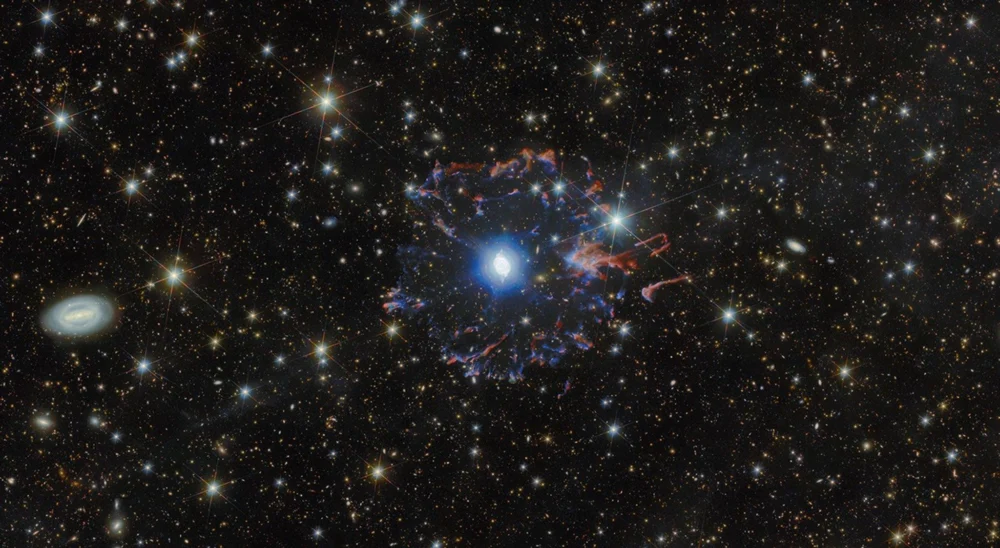
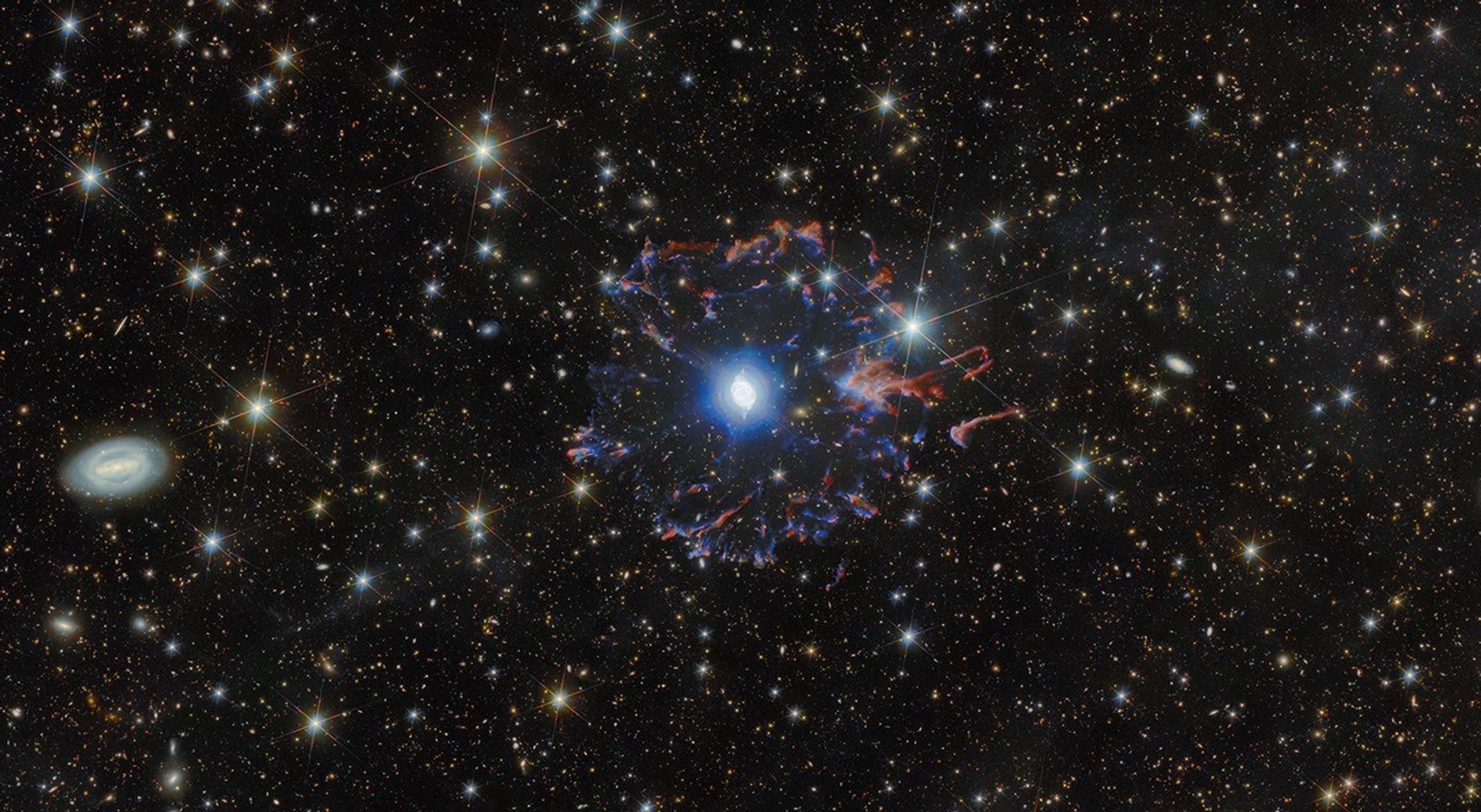
A collaborative imaging effort between the European Space Agency’s (ESA) Euclid mission and NASA’s venerable Hubble Space Telescope has yielded a breathtaking and scientifically significant new perspective on one of the cosmos’s most aesthetically striking and structurally complex celestial objects: the Cat’s Eye Nebula, officially designated NGC 6543. Released on March 3, 2026, this composite image integrates data from both observatories, presenting an intricate tapestry of gas and dust that serves as the visually stunning remnant of a dying star. Positioned approximately 4,400 light-years from Earth within the northern constellation Draco, the Cat’s Eye Nebula has long fascinated astronomers with its elaborate, multi-layered morphology, and this latest observation is poised to offer unprecedented insights into the dynamics of late-stage stellar evolution. The fusion of Hubble’s high-resolution visible and ultraviolet light capabilities with Euclid’s wide-field, near-infrared vision provides a comprehensive view that illuminates both the fine details of the nebula’s inner structures and the broader extent of its cooler, more diffuse outer envelopes, thereby advancing our understanding of these dramatic cosmic phenomena.
The Enigmatic Cat’s Eye Nebula: A Stellar Swan Song
The Cat’s Eye Nebula, NGC 6543, is a prime example of a planetary nebula, a misnomer coined in the 18th century due to their often-round, planet-like appearance through early telescopes. Far from being related to planets, these objects represent the final, spectacular stages in the lives of intermediate-mass stars, similar to our Sun. As a star like the one at the heart of NGC 6543 exhausts the hydrogen fuel in its core, it expands dramatically into a red giant. During this phase, it sheds its outer layers into space, creating an expanding shell of gas and dust. The remaining core of the star collapses into a super-hot, dense white dwarf, which emits intense ultraviolet radiation. This radiation ionizes the surrounding ejected gas, causing it to glow brightly across the electromagnetic spectrum, from visible light to infrared and ultraviolet.
NGC 6543 is particularly renowned for its extraordinary complexity. Unlike many planetary nebulae that exhibit relatively simple spherical or elliptical shapes, the Cat’s Eye displays a bewildering array of concentric shells, jets, knots, and filamentary structures. This intricate architecture suggests a more complicated history than a simple, uniform ejection of gas. Theories propose that the central star may be part of a binary system, where gravitational interactions with a companion star could shape the outflowing material. Alternatively, the star may have undergone multiple, episodic ejections of mass, possibly influenced by magnetic fields or rapid rotation. The nebula’s estimated age is relatively young in cosmic terms, perhaps only a few thousand years, indicating that the processes shaping its current form are still actively unfolding. Its central star, a fiercely hot white dwarf with a surface temperature estimated at around 80,000 Kelvin, is one of the hottest known, providing the energetic photons necessary to illuminate the surrounding gas.
A Legacy of Observation: Hubble’s Unrivaled Eye
NASA’s Hubble Space Telescope, launched in 1990, has revolutionized astrophysics through its unparalleled clarity and sensitivity in the visible, ultraviolet, and near-infrared spectrum. Positioned above Earth’s distorting atmosphere, Hubble has delivered iconic images of distant galaxies, star-forming regions, and perhaps most famously, planetary nebulae. Its high-resolution capabilities have been instrumental in resolving the fine details within objects like the Cat’s Eye Nebula, revealing structures that are utterly invisible from ground-based telescopes. Previous Hubble observations of NGC 6543, dating back to the 1990s and early 2000s, have provided critical insights into its multi-polar outflows and shell structures, contributing significantly to the understanding of how stellar winds and binary interactions can sculpt these cosmic masterpieces. The telescope’s Wide Field Planetary Camera 2 (WFPC2) and later the Advanced Camera for Surveys (ACS) and Wide Field Camera 3 (WFC3) have consistently pushed the boundaries of what astronomers can discern in these gaseous envelopes, mapping out the distribution of different elements through specific emission lines.
Euclid’s Dawn: Mapping the Dark Universe with New Vision
ESA’s Euclid mission, launched in July 2023, represents a new frontier in space astronomy, primarily designed to explore the mysteries of dark energy and dark matter by mapping the large-scale structure of the universe over billions of years. While its core mission focuses on cosmology, Euclid’s wide-field survey capabilities and its two primary instruments – the Visible Imager (VIS) and the Near-Infrared Spectrometer and Photometer (NISP) – make it a powerful tool for observing a diverse range of celestial objects, including those within our own galaxy. VIS captures images in visible light, albeit with a wider field of view than Hubble, while NISP operates in the near-infrared, a spectral range crucial for penetrating dust and observing cooler, fainter gas that might be less visible to Hubble’s optical instruments.
The observation of the Cat’s Eye Nebula by Euclid, therefore, is not a deviation from its primary mission but rather a testament to its versatile scientific potential. By observing NGC 6543 in the near-infrared, Euclid can detect cooler molecular hydrogen and other molecular species that are less excited by the central star’s intense UV radiation but are nevertheless crucial components of the nebula’s outer regions. This capability is particularly important for understanding the full extent of the ejected material and how it interacts with the surrounding interstellar medium.
A Symphony of Data: The Joint Observation and Its Revelations
The decision to combine observations from Hubble and Euclid for the Cat’s Eye Nebula represents a strategic scientific collaboration aimed at leveraging the unique strengths of both observatories. The synergy is profound: Hubble’s exquisite resolution in visible and ultraviolet light excels at dissecting the hot, ionized gas closer to the central star, revealing the intricate filaments, knots, and fast-moving jets that define the nebula’s inner complexity. These features are often critical for tracing the history of mass ejection events and understanding the physical processes at play, such as shock fronts and ionization fronts.
Euclid, conversely, brings its wide-field near-infrared vision, which is less sensitive to the high-energy processes but excels at mapping the cooler, more diffuse gas and dust that often extend far beyond the bright visible core. This cooler material, often composed of neutral or molecular hydrogen, is harder to detect in visible light but holds vital clues about the total mass ejected by the dying star and how it disperses into the interstellar medium. The combined image, therefore, offers a more complete volumetric understanding of the nebula, showing not only the dramatic core but also the often-overlooked, fainter outer halo, which can span much larger angular scales.
Initial analyses of the combined data are expected to shed new light on several key aspects of NGC 6543. For instance, the near-infrared data from Euclid could reveal previously undetected outer shells or a broader, fainter halo of material that provides evidence of earlier, less energetic mass-loss episodes. This could help astronomers reconstruct a more accurate timeline of the star’s death throes. Furthermore, the combined visible and infrared information allows for more precise temperature and density mapping across different regions of the nebula, enhancing models of gas dynamics and chemical enrichment. Scientists anticipate that this multi-wavelength approach will offer stronger constraints on theories regarding the nebula’s formation mechanisms, particularly concerning the role of binary star interactions or stellar magnetic fields in shaping such a complex morphology.
Chronology of a Cosmic Portrait
While the specific observation schedule for this joint image release on March 3, 2026, is part of a complex scientific process, a general chronology can be inferred for such a high-profile collaborative effort:
- Pre-Launch (Euclid) / Ongoing (Hubble): Both missions maintain extensive observation planning teams. The concept for synergistic observations between future missions like Euclid and existing ones like Hubble would likely have been discussed and proposed years in advance, possibly even before Euclid’s launch.
- Euclid’s Commissioning and Early Operations (2023-2024): Following its launch in July 2023, Euclid underwent a rigorous commissioning phase, testing and calibrating its instruments. Early science observations, including potential "demonstration" targets like bright, well-studied nebulae, would have been part of this phase.
- Observation Proposal and Coordination (Late 2024 – Early 2025): Formal proposals for joint observations would have been submitted to the respective telescope time allocation committees of ESA and NASA. Given the scientific value, coordination between the agencies would have been meticulous to ensure optimal scheduling for both Hubble and Euclid to observe the Cat’s Eye Nebula within a suitable timeframe.
- Data Acquisition (Mid-2025): Once approved, the observations would have been executed. Hubble, with its established operational procedures, would acquire its high-resolution visible and UV data. Euclid would concurrently or sequentially capture its wide-field near-infrared data, ensuring sufficient exposure times for both instruments to gather high-quality signals.
- Data Processing and Calibration (Late 2025): Raw data from both observatories would be downlinked to ground stations, then processed, calibrated, and cleaned of instrumental artifacts by dedicated science teams at ESA, NASA, and associated scientific consortia.
- Image Combination and Scientific Analysis (Late 2025 – Early 2026): The calibrated data from Hubble and Euclid would then be meticulously combined. This involves careful alignment, scaling, and color mapping to create a single, coherent composite image. Simultaneously, scientific analysis would commence, extracting quantitative information about the nebula’s physical properties from the combined datasets.
- Peer Review and Publication (Early 2026): Any significant scientific findings derived from this observation would typically undergo peer review and be submitted for publication in scientific journals.
- Public Release (March 3, 2026): Following scientific validation and preparation of outreach materials, the stunning composite image and accompanying scientific highlights were publicly released, showcasing the power of international space collaboration.
Official Responses and Scientific Enthusiasm
The release of the combined image has been met with significant enthusiasm within the astronomical community and among the public. Scientists involved in the project have highlighted the profound implications of multi-wavelength astronomy.
Dr. Elena Petrova, a senior research scientist at the ESA’s Space Science Department, stated, "This collaborative image of the Cat’s Eye Nebula perfectly encapsulates the spirit of international scientific partnership. While Hubble has provided us with unparalleled detail for decades, Euclid’s unique near-infrared perspective offers an entirely new dimension. Together, they paint a far more complete picture of this star’s dramatic final act, allowing us to trace the journey of matter from the stellar core into the vastness of space."
Similarly, Dr. Marcus Thorne, a project scientist for the Hubble Space Telescope at NASA, remarked, "The Cat’s Eye has always been a jewel in Hubble’s crown. To see it now enriched with Euclid’s deep, wide-field infrared data is truly remarkable. It’s a testament to the enduring legacy of Hubble and the exciting future that missions like Euclid promise. These combined observations are not just aesthetically pleasing; they are crucial for refining our models of stellar evolution and the chemical enrichment of galaxies."
Both agencies emphasized the technical challenges overcome in integrating data from two distinct instruments operating in different spectral ranges, underscoring the high level of technical expertise and collaboration required. A spokesperson for the Euclid Consortium noted, "Integrating data from observatories with such different optical designs and scientific goals is a complex endeavor. The successful combination of Hubble and Euclid data for NGC 6543 demonstrates the robust capabilities of our data processing pipelines and the strength of our international scientific teams."
Broader Impact and Future Implications
The joint observation of the Cat’s Eye Nebula carries significant implications across several scientific and technological domains.
Advancing Stellar Evolution Research: The intricate structures within planetary nebulae like NGC 6543 are vital laboratories for understanding the final stages of stellar life. The combined data from Hubble and Euclid will allow astronomers to refine models of mass loss from red giant stars, the mechanisms that create complex shapes (such as binary star interactions, magnetic fields, or rapid rotation), and the processes by which these dying stars enrich the interstellar medium with heavy elements like carbon, oxygen, and nitrogen – elements essential for the formation of new stars, planets, and ultimately, life itself. Understanding these processes is crucial for comprehending galactic chemical evolution.
Showcasing Multi-Messenger Astronomy: This collaboration serves as a powerful illustration of the benefits of multi-wavelength and multi-observatory astronomy. By combining observations across different parts of the electromagnetic spectrum, scientists gain a more holistic understanding of cosmic phenomena that no single telescope or wavelength range could provide alone. This approach is increasingly central to modern astrophysics, as evidenced by efforts to combine data from radio telescopes, X-ray observatories, and gravitational wave detectors.
Public Engagement and Inspiration: Beyond its scientific merit, the stunning visual appeal of the Cat’s Eye Nebula image is a potent tool for public engagement. Such images capture the imagination, fostering a deeper appreciation for the beauty and complexity of the universe, and inspiring future generations of scientists and engineers. The accessibility of such imagery helps bridge the gap between complex scientific research and public understanding.
International Collaboration as a Model: The successful coordination between ESA and NASA on this project underscores the critical importance of international collaboration in large-scale scientific endeavors. With increasingly ambitious and expensive space missions, pooling resources, expertise, and observational capabilities across national boundaries becomes not just beneficial, but often necessary, to push the frontiers of knowledge. This partnership sets a precedent for future collaborative missions and data integration efforts.
Future Research Directions: The insights gained from this observation will undoubtedly inform future research. Astronomers may use these findings to target other complex planetary nebulae with similar multi-wavelength approaches, or to refine theoretical simulations of stellar mass ejection. The data could also help identify specific spectral features in Euclid’s NISP data that correlate with particular physical conditions, enhancing its capability to analyze similar objects encountered during its vast cosmological surveys.
In conclusion, the combined view of the Cat’s Eye Nebula from the Hubble Space Telescope and the Euclid mission is more than just a captivating image; it is a profound scientific statement. It demonstrates the power of combining diverse observational capabilities, highlights the ongoing drama of stellar evolution, and reaffirms the immense value of international collaboration in unraveling the universe’s most intricate mysteries. As both observatories continue their respective missions, the potential for further synergistic discoveries remains vast, promising an even richer understanding of the cosmos we inhabit.