

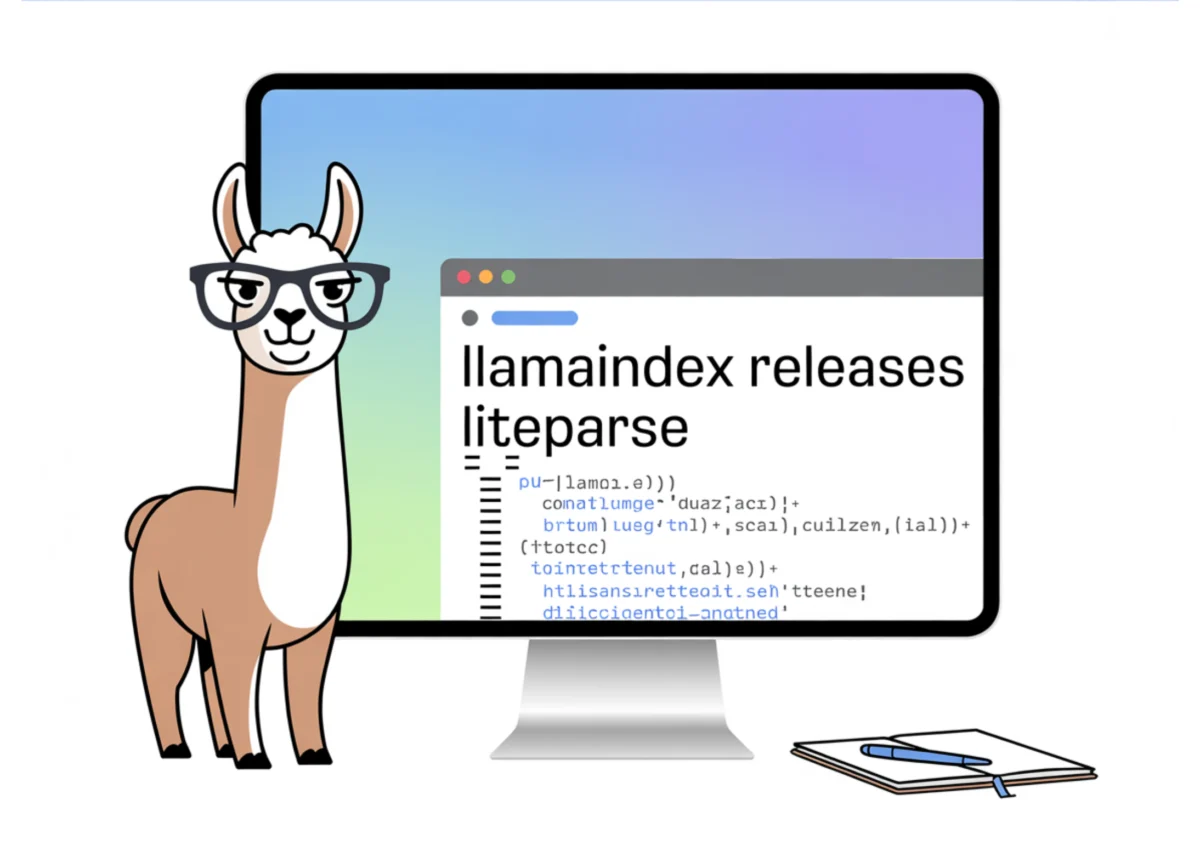
The landscape of artificial intelligence development has shifted significantly over the past eighteen months, moving from a primary focus on large language model (LLM) performance to a concentrated effort on the efficiency of data ingestion pipelines. LlamaIndex, a prominent player in the data framework sector for LLM applications, has addressed a critical industry friction point with the introduction of LiteParse. This new open-source, local-first document parsing library is designed specifically for software developers who face persistent challenges when converting complex, unstructured PDF documents into formats that LLMs can accurately interpret. While cloud-based solutions have dominated the market, LiteParse represents a strategic pivot toward local execution, prioritizing speed, privacy, and spatial accuracy without the overhead of external API dependencies or heavy Python environments.
The release of LiteParse comes at a time when Retrieval-Augmented Generation (RAG) has become the standard architecture for enterprise AI. In a typical RAG workflow, the system retrieves relevant information from a private knowledge base to provide context to an LLM. However, the quality of this retrieval is entirely dependent on the quality of the initial data parsing. Historically, PDFs—the most common format for corporate documentation—have proven to be the "final boss" of data ingestion due to their non-linear structures, multi-column layouts, and embedded tables. LiteParse seeks to solve these issues by offering a "fast-mode" alternative to LlamaIndex’s managed LlamaParse service, allowing developers to process documents entirely on their local machines or at the edge.
The Technical Evolution: A Shift to TypeScript and Node.js
One of the most notable aspects of LiteParse is its architectural departure from the industry-standard Python stack. While Python remains the lingua franca of machine learning research, the deployment of AI applications increasingly occurs within web-based environments and modern software stacks where TypeScript and Node.js are preferred. LiteParse is written natively in TypeScript, ensuring it can run seamlessly in Node.js environments without requiring a Python runtime. This technical choice eliminates the "dependency hell" often associated with complex OCR (Optical Character Recognition) libraries in Python, making LiteParse an attractive option for full-stack developers and DevOps engineers.
To achieve local-first performance, LiteParse integrates two primary engines: PDF.js (specifically the pdf.js-extract variant) for structured text extraction and Tesseract.js for local OCR. By utilizing these tools, LiteParse can handle both "searchable" PDFs, where text data is readily accessible, and "scanned" PDFs, which require visual character recognition. The decision to use Tesseract.js allows for a completely self-contained library that does not require calls to third-party vision APIs, such as those provided by OpenAI or Google Cloud, thereby significantly reducing operational costs and latency.
Spatial Text Parsing: Maintaining Layout Integrity
A recurring failure point in traditional document parsing is the loss of spatial context. Most conventional parsers attempt to convert PDF content into Markdown. While Markdown is readable by LLMs, the conversion process often flattens the document, causing multi-column text to interleave incorrectly or destroying the relational structure of tables. LiteParse introduces a methodology known as Spatial Text Parsing to circumvent these issues.
Instead of forcing a document into a linear Markdown format, LiteParse projects the extracted text onto a spatial grid. It preserves the original layout of the page by utilizing precise indentation and white space. This approach leverages a sophisticated realization in the AI community: modern LLMs, having been trained on massive datasets including source code and ASCII art, possess an inherent capability for spatial reasoning. By presenting the document to the LLM exactly as it appears on the printed page, LiteParse allows the model to "read" the layout naturally. This prevents the loss of context that occurs when a parser misidentifies a page header or fails to recognize the break between two adjacent columns.
Addressing the Table Extraction Dilemma
Table extraction has long been considered one of the most expensive and error-prone tasks in the RAG pipeline. Standard methods usually involve complex heuristics to identify cells, rows, and columns, often resulting in "hallucinated" structures or garbled text when a table lacks clear borders. LiteParse adopts what its developers describe as a "beautifully lazy" approach to this problem.
By maintaining the horizontal and vertical alignment of text through spatial preservation, LiteParse avoids the need to reconstruct a formal table object or a Markdown grid. The relational integrity of the data is maintained through visual alignment. When an LLM processes a spatially accurate block of text, it can identify that a specific figure belongs to a specific row and column based on its position relative to other characters. This method not only reduces the computational power required for parsing but also increases the accuracy of data retrieval for complex financial reports, scientific papers, and legal documents where tabular data is prevalent.
Chronology and Development Context
The development of LiteParse is a direct response to the feedback LlamaIndex received following the launch of LlamaParse, their cloud-based managed service. While LlamaParse was praised for its high accuracy in handling complex layouts via vision-language models, enterprise users expressed a growing need for three specific attributes: lower latency for real-time applications, reduced costs for high-volume processing, and enhanced data privacy for sensitive documents.
In early 2024, the demand for "local-first" AI tools surged as organizations sought to comply with strict data residency regulations such as GDPR in Europe and HIPAA in the United States. The timeline of LiteParse’s development reflects this shift. By moving the parsing logic from the cloud to the user’s local environment, LlamaIndex has enabled developers to process sensitive data without it ever leaving their secure infrastructure. This chronology marks a maturation of the RAG ecosystem, moving from experimental cloud-dependent prototypes to robust, production-ready local tools.
Optimization for Agentic Workflows
LiteParse is not merely a document loader; it is specifically optimized for the burgeoning field of AI agents. Unlike standard RAG systems, which simply retrieve text, AI agents often require multi-modal capabilities to verify information or perform complex reasoning tasks. LiteParse supports these "agentic" workflows by providing multi-modal outputs.
When a document is processed through LiteParse, the library can generate page-level screenshots alongside the extracted spatial text. This allows an engineer to build an agent that can switch between modalities. For instance, if an agent encounters an ambiguous piece of text in a technical manual, it can reference the corresponding screenshot to verify the visual context, such as a diagram or a specific formatting cue. The library also outputs comprehensive JSON metadata, including page numbers and layout coordinates, which agents can use to cite sources or navigate through large document sets with high precision.
Supporting Data and Implementation
Initial benchmarks and developer reports suggest that LiteParse offers a significant reduction in the "time-to-first-token" for RAG applications. By eliminating the round-trip time to a cloud API, document processing that previously took several seconds per page can now be accomplished in a fraction of that time, depending on the local hardware’s performance. Furthermore, because LiteParse is an open-source tool, it removes the per-page pricing model associated with managed services, representing a 100% cost saving on parsing fees for developers who choose to self-host.
The implementation of LiteParse is designed for simplicity. It can be installed via the Node Package Manager (npm) and offers a straightforward command-line interface (CLI) for bulk processing. For example, a developer can process an entire directory of PDFs with a single command: npx @llamaindex/liteparse <path-to-pdf> --outputDir ./output. This command populates the target directory with spatial text files, JSON metadata, and screenshots, providing a ready-to-use dataset for vector indexing.
Broader Impact and Industry Implications
The introduction of LiteParse is likely to have a ripple effect across the AI development community. By providing a high-quality, TypeScript-native, local parsing solution, LlamaIndex is lowering the barrier to entry for building sophisticated RAG applications. This democratization of document processing means that smaller startups and independent developers can now build systems that previously required the budget of a large enterprise.
Furthermore, the emphasis on spatial text parsing challenges the industry’s reliance on Markdown as the universal intermediate format for LLMs. If spatial preservation proves to be more effective for layout-heavy documents, we may see a broader shift in how data is prepared for LLM consumption across the board. The success of LiteParse also signals a growing trend toward "edge AI," where as much of the pipeline as possible is moved closer to the data source to ensure privacy and performance.
In conclusion, LiteParse represents a strategic advancement in the LlamaIndex ecosystem. By solving the "table problem" through layout preservation and providing a TypeScript-native tool for local execution, LlamaIndex has provided developers with a powerful new asset for building the next generation of AI agents. As the industry continues to move toward more complex, agentic workflows, the ability to parse documents with spatial accuracy, speed, and privacy will remain a cornerstone of successful AI implementation. The library is currently available on GitHub, where the open-source community is expected to contribute to its ongoing refinement and expansion.