

The debut of "Detective Hole" on Netflix, a nine-episode adaptation of Jo Nesbø’s acclaimed novel The Devil’s Star, plunges audiences into the grim and atmospheric world of Oslo’s most notorious detective. While the series offers a compelling, albeit convoluted, exploration of its titular character, its strengths lie in strong performances and evocative visuals, even as its narrative complexities occasionally overshadow its narrative thrust. This adaptation, based on Nesbø’s fifth Harry Hole mystery, arrives as a significant entry in the burgeoning genre of high-quality Scandinavian crime dramas, a space increasingly populated by meticulously crafted, character-driven thrillers.
The Enduring Appeal of Harry Hole
The character of Harry Hole, created by Jo Nesbø, has become a touchstone in contemporary crime fiction. Known for his maverick approach, personal demons, and a knack for attracting trouble, Hole has captivated millions of readers worldwide since his first appearance in The Bat (1997). The phonetic pronunciation of his name, "HAR-ee Hoo-leh," has become a point of affectionate amusement for fans, a testament to the character’s global reach and cultural impact. The Harry Hole series has sold over 45 million copies globally, translated into 50 languages, cementing its status as a literary phenomenon. This new adaptation, Detective Hole, aims to translate the intense psychological landscape and intricate plotting of Nesbø’s novels to the visual medium, a challenge previously met with varying degrees of success by earlier adaptations, most notably the 2017 film The Snowman, starring Michael Fassbender.
A Netflix Production with Amazonian Roots?
The placement of Detective Hole on Netflix has sparked some discussion within the industry. While officially a Netflix original, its production style and thematic preoccupations bear a striking resemblance to the output of Amazon Prime Video, which has carved out a significant niche in adapting grimdark procedural novels. Series like Bosch, The Lincoln Lawyer, and Jack Reacher share a similar DNA with Detective Hole: driven by flawed, often morally ambiguous protagonists, steeped in dark urban environments, and characterized by a meticulous focus on investigative detail. The inclusion of a "This season on Detective Hole…" teaser montage at the conclusion of the pilot episode is a hallmark of Amazon’s programming strategy, further fueling this comparison. However, the logistical realities of avoiding confusion with other similarly titled shows, such as Amazon’s Outer Range, likely played a role in Netflix securing the streaming rights.
Plotting the Descent: The Devil’s Star Unveiled
Detective Hole adapts Nesbø’s The Devil’s Star, a novel that saw Harry Hole grappling with a complex case involving stolen weapons, a brewing gang war in Oslo, and a series of brutal murders. The narrative unfolds over nine episodes, providing ample room for the intricate plotting and character development that are hallmarks of Nesbø’s writing.
Chronology of the Case:
The series opens with a violent bank robbery that escalates into a homicide, setting in motion a chain of events that will deeply impact Detective Hole. The immediate aftermath of this crime leads to a tragic car chase and the death of Harry’s partner, an event that casts a long shadow over his subsequent investigations.
Five years later, Harry remains haunted by the unsolved murder from the bank robbery. Despite his personal struggles and a well-documented tendency to bend, if not break, the rules, he has achieved a commendable clearance rate. His personal life shows glimmers of stability, with a supportive girlfriend, Rakel, and a tentative bond forming with her son, Oleg. However, this fragile equilibrium is soon threatened by a confluence of escalating criminal activity in Oslo.
The city finds itself on the precipice of a full-blown gang war as rival factions are seemingly being armed, a situation the under-equipped police force is ill-prepared to handle. Simultaneously, a series of gruesome murders and disappearances points to the emergence of a calculating serial killer. The perpetrator’s methods—removing digits and leaving cryptic clues—suggest a chillingly methodical approach, drawing parallels to biblical prophecies, specifically the Book of Revelation.
The investigation inevitably leads to the doorstep of Tom Waaler, Harry’s colleague. Played by Joel Kinnaman, Waaler is portrayed as a deeply compromised figure, whose Swedish origins and ambiguous loyalties raise immediate suspicions. The series confirms early on that Waaler is not merely corrupt but potentially sociopathic, serving as a primary antagonist whose machinations are intertwined with the unfolding crimes.
Production and Artistic Vision
The creative team behind Detective Hole has strived to capture the dark, brooding atmosphere that defines Nesbø’s literary world. Jo Nesbø himself is credited as a creator, working alongside directors Øystein Karlsen and Anna Zackrisson. This collaborative effort has resulted in a visually arresting series that emphasizes the grim realities of urban crime.
Cinematography and Score:
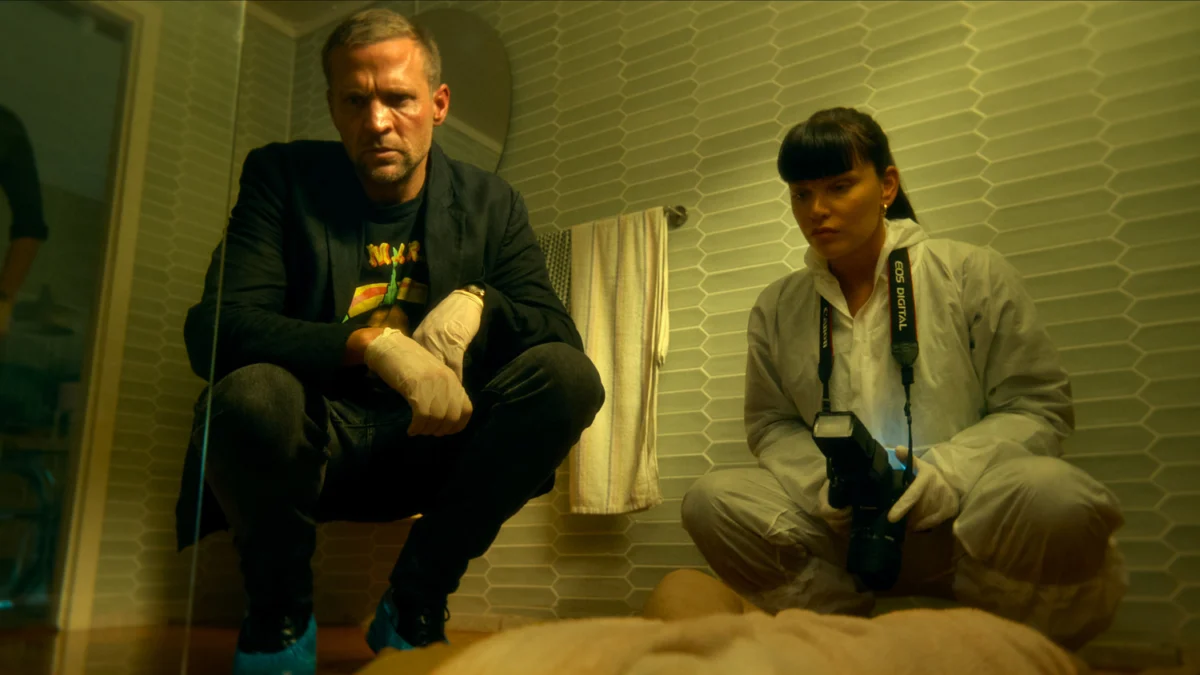
Ronald Plante’s cinematography is a significant contributor to the show’s oppressive mood. The visual palette leans heavily on the darker corners of Oslo, portraying a city populated by individuals on the fringes of society—addicts, sex workers, and the homeless. Yet, the series also juxtaposes these gritty scenes with breathtaking vistas and nocturnal cityscapes, where filtered lights cast an eerie yellow or green aura. While undeniably shadowy, the darkness is rendered with a visual intelligibility that distinguishes it from more opaque productions.
The musical score, a collaboration between Nick Cave and Warren Ellis, provides a melancholic counterpoint to the on-screen tension. Their signature atmospheric dirges underscore the somber tone, a deliberate contrast to the soundtrack’s reliance on punk music, reflecting Harry Hole’s personal tastes.
Performances: Anchoring the Darkness
The success of any character-driven crime drama hinges on the strength of its central performances, and Detective Hole is no exception.
Tobias Santelmann as Harry Hole: Santelmann delivers a brooding and nuanced portrayal of the tormented detective. His Harry is a man perpetually teetering on the edge, grappling with addiction, loss, and the moral compromises inherent in his profession. Santelmann’s performance masterfully conveys Harry’s descent into bleakness, making his internal struggles palpable. While the character’s gruff demeanor and relentless pursuit of justice can be exhausting for viewers at times, his moments of connection with Rakel (Pia Tjelta) and Oleg (Maxime Baune Bochud) offer glimpses of humanity, making him a compelling, albeit challenging, protagonist.
Joel Kinnaman as Tom Waaler: Kinnaman excels as the menacing antagonist, Tom Waaler. He embodies a smirking demon, a character whose wickedness is established from the outset. Kinnaman’s performance channels a charismatic yet chilling energy, drawing parallels to his earlier role as Detective Stephen Holder in AMC’s The Killing. Waaler is a complex character, a mosaic of traumas and pathologies designed to amplify his menace, though the series sometimes struggles to imbue him with greater depth beyond his villainous archetypes.
Supporting Cast: The ensemble cast provides robust support. Ellen Helinder shines as Beate, a versatile procedural character who serves as a vital asset to the investigative team, capable of providing technical expertise and crucial insights. The series also features notable cameos, including Peter Stormare as the gruff gang leader Odin and Anders Danielsen Lie as a morally ambiguous academic whose recommendation of Heidegger signals immediate suspicion. Pia Tjelta as Rakel and Maxime Baune Bochud as Oleg provide crucial emotional anchors, grounding Harry’s character arc.
Narrative Strengths and Weaknesses
Detective Hole benefits from Nesbø’s established talent for intricate plotting and atmospheric storytelling. The series successfully establishes a palpable sense of dread and nihilistic doom from its early episodes, effectively propelling Harry into his characteristic spiral of drinking and rule-breaking. The initial setup is strong, hinting at a complex web of conspiracies and personal vendettas.
However, the series is not without its narrative challenges. The pacing, particularly in the middle episodes, can feel drawn out, with some critics suggesting that the narrative is unnecessarily padded. The finale, in particular, has been described as reaching a conclusion that borders on the illogical and the implausible. The abundance of red herrings, the explicit focus on violence and fatal wounds, and the frequent invocation of biblical prophecy, while characteristic of the source material, occasionally lead to a sense of déjà vu for viewers familiar with the genre. The narrative often grapples with the weight of its own complexity, leading to moments where the overarching plot becomes obscured by intricate subplots.
Broader Implications and Genre Context
The success of "Detective Hole" further solidifies the global appetite for Scandinavian crime dramas. The genre, which gained significant traction with shows like The Bridge and The Killing, continues to evolve, offering a distinct brand of atmospheric suspense and complex character studies. Detective Hole fits squarely within this tradition, providing a dark and psychologically intense viewing experience.
The series’ exploration of themes such as systemic corruption, the cyclical nature of violence, and the personal cost of justice resonates deeply in contemporary society. The portrayal of Oslo as a city grappling with internal conflict and external threats offers a critical lens on urban life and the challenges faced by law enforcement in increasingly complex environments. The series’ fixation on the darker aspects of human nature and societal decay, while potentially off-putting to some, is integral to its artistic vision and its faithful adaptation of Nesbø’s gritty narratives.
Ultimately, Detective Hole is a testament to the enduring power of Jo Nesbø’s creation. While its narrative convolutions and relentless darkness may not appeal to all viewers, its strong performances, atmospheric direction, and faithful adaptation of beloved source material make it a noteworthy addition to the streaming landscape. It offers a deep dive into the murky recesses of the human psyche and the grim realities of crime, proving that even in its most convoluted moments, the world of Harry Hole remains a compelling and captivating place to explore. The question posed by the protagonist himself—"Why did it have to be so complicated?"—echoes the viewing experience, a journey through a meticulously crafted, albeit intensely somber, narrative labyrinth.