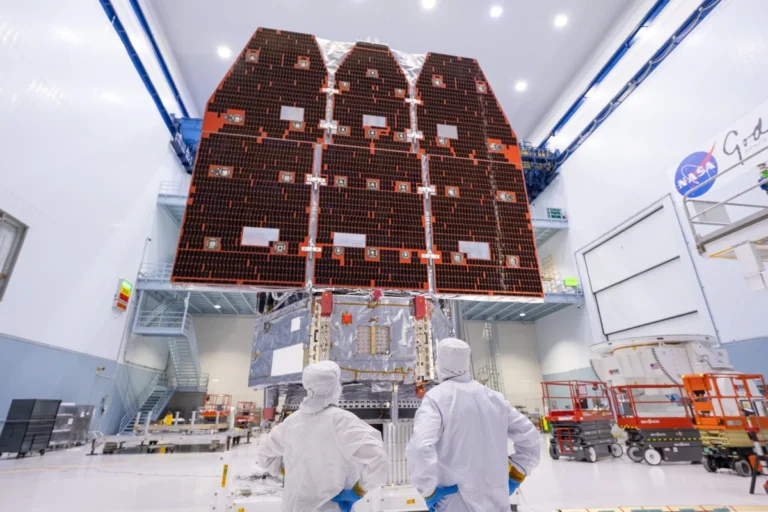

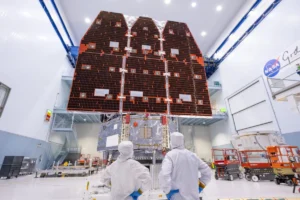


In a pivotal moment for humanity’s ambitious return to the Moon, NASA is poised to roll out the largest section of its Space Launch System (SLS) rocket – the foundational element for the upcoming Artemis III mission – from the agency’s Michoud Assembly Facility in New Orleans. The highly anticipated event, scheduled for Monday, April 20, marks a significant step in assembling the powerful rocket destined to launch the second crewed Artemis mission. This crucial component, comprising the top four-fifths of the SLS core stage, includes the intricate liquid hydrogen tank, liquid oxygen tank, intertank, and forward skirt. Once moved from the assembly facility, it will be meticulously loaded onto NASA’s specialized Pegasus barge for its journey across the Gulf of Mexico to the Kennedy Space Center (KSC) in Florida, where final integration and launch preparations will commence.
A Critical Milestone for Artemis III
The rollout of this massive core stage section is more than just a logistical exercise; it represents years of intricate design, manufacturing, and testing culminating in tangible hardware. The SLS core stage is often referred to as the backbone of the entire rocket, standing taller than a 20-story building and serving as the primary propulsion element during liftoff. For Artemis III, this particular section is critical as it houses the cryogenic propellant tanks that will feed the four powerful RS-25 engines, generating over 2 million pounds of thrust to propel the Orion spacecraft and its astronaut crew towards lunar orbit.
The journey of this core stage from its birthplace in New Orleans to the iconic Vehicle Assembly Building (VAB) at KSC is a testament to NASA’s complex logistical capabilities and the extensive collaboration with industry partners. The Michoud Assembly Facility, a sprawling 832-acre site with a rich history of producing components for Saturn V rockets and the Space Shuttle, stands as a cornerstone of America’s space industrial base. Here, advanced manufacturing techniques, including friction stir welding, are employed to create the robust yet lightweight aluminum structures that can withstand the immense stresses of launch.
Upon its arrival at Kennedy Space Center, the core stage will undergo a series of crucial outfitting and vertical integration procedures. This phase involves installing hundreds of sensors, avionics, and thermal protection systems, transforming the structural components into a fully functional flight article. Following these intricate steps, the hardware will be handed over to NASA’s Exploration Ground Systems Program, which is responsible for the final stacking operations within the VAB and all subsequent launch preparations at Launch Complex 39B.
The Engineering Marvel: SLS Core Stage
The Space Launch System is NASA’s super heavy-lift expendable launch vehicle, designed to provide an entirely new capability for human deep-space exploration. Its core stage, an engineering marvel, is the largest rocket stage ever built by NASA. Standing at 212 feet (64.6 meters) tall and 27.6 feet (8.4 meters) in diameter, it is equipped with two colossal tanks: the liquid hydrogen tank and the liquid oxygen tank. These tanks are responsible for holding 730,000 gallons (approximately 2.76 million liters) of super-cooled propellant – liquid hydrogen at -423 degrees Fahrenheit (-253 degrees Celsius) and liquid oxygen at -297 degrees Fahrenheit (-183 degrees Celsius) – which will be consumed by the four RS-25 engines during the ascent phase of the mission.
The intertank, situated between the liquid oxygen and liquid hydrogen tanks, houses critical avionics, flight computers, and electrical systems that control the rocket’s operations during launch. Below the liquid hydrogen tank is the engine section, which will eventually integrate the four RS-25 engines. The forward skirt, the uppermost section of the core stage, connects to the Interim Cryogenic Propulsion Stage (ICPS) or, for future missions, the more powerful Exploration Upper Stage (EUS), which provides the final push to send the Orion spacecraft towards its lunar trajectory.
The fabrication process at Michoud is a highly specialized endeavor. The facility utilizes a 170-foot-tall vertical assembly center, one of the largest welding tools in the world, to precisely join the barrel and dome sections of the massive propellant tanks. This vertical integration method ensures structural integrity and alignment, crucial for a vehicle that must withstand extreme forces. The fact that all five major structures for the SLS core stage – the forward skirt, liquid oxygen tank, intertank, liquid hydrogen tank, and engine section – are manufactured at Michoud underscores the facility’s unparalleled capabilities and central role in the Artemis program.
A Legacy of Power: The RS-25 Engines
Powering the SLS core stage are four Aerojet Rocketdyne RS-25 engines, a direct evolution of the Space Shuttle Main Engines (SSMEs) that flew 135 missions with exceptional reliability. These engines are among the most powerful and efficient liquid-fueled rocket engines ever built. While the SSMEs were designed for reusability, the RS-25s for SLS are expendable, operating at a higher thrust level – 109% of their original rated power – to meet the demands of the heavy-lift mission profile. Each engine delivers 512,000 pounds of thrust at sea level, combining for a staggering total of over 2 million pounds of thrust from the core stage alone. When combined with the two solid rocket boosters, the SLS will produce a total of 8.8 million pounds of thrust at liftoff, making it the most powerful rocket in the world.
The RS-25 engines for Artemis III are scheduled to ship from NASA’s Stennis Space Center in Bay St. Louis, Mississippi, no later than July 2026 for integration into the engine section. Stennis has been instrumental in the RS-25 program, conducting extensive hot-fire testing, including the "Green Run" test series for the Artemis I core stage, which validated the integrated performance of the engines and core stage avionics. This rigorous testing ensures the engines are flight-ready and capable of performing flawlessly under the extreme conditions of launch.
From Factory to Launchpad: The Journey to Kennedy
The transportation of such a colossal component requires specialized infrastructure. NASA’s Pegasus barge, a 310-foot-long vessel, is custom-designed to carry the SLS core stage through inland waterways and across open seas. The barge has a storied history, previously transporting the Space Shuttle external tanks from Michoud to KSC. Its role for SLS continues this legacy, underscoring the vital link between manufacturing facilities and the launch complex. The journey from New Orleans to Florida is a carefully choreographed operation, navigating various bodies of water, including the Gulf of Mexico, to ensure the safe and timely delivery of the invaluable hardware.
Once the core stage arrives at Kennedy Space Center, it will be moved to the iconic Vehicle Assembly Building (VAB). The VAB, one of the largest buildings in the world by volume, is where the various components of the SLS rocket are stacked vertically. This includes the core stage, the two solid rocket boosters (SRBs) that flank it, the Interim Cryogenic Propulsion Stage (ICPS), and finally, the Orion spacecraft with its Launch Abort System. The Artemis III SLS engine section and boat-tail, which protects the engines during launch, have already been moved from the Space Systems Processing Facility at NASA Kennedy to the Vehicle Assembly Building in July 2025, awaiting the arrival of the core stage and the RS-25 engines. This sequential assembly process highlights the meticulous planning and coordination required for deep-space missions.
Artemis Program: Charting Humanity’s Return to the Moon
The Artemis program represents NASA’s bold initiative to return humans to the Moon for the first time since 1972, with the ultimate goal of establishing a sustained human presence and using the Moon as a proving ground for future missions to Mars. This program is designed to be progressive, with increasingly complex missions building upon one another:
- Artemis I: An uncrewed test flight of the SLS rocket and Orion spacecraft around the Moon. This mission, successfully launched in November 2022, validated the rocket’s performance and the spacecraft’s systems in a deep-space environment, concluding with Orion’s safe splashdown.
- Artemis II: The first crewed test flight of Orion and SLS, which will send astronauts on a lunar flyby mission. According to the current timeline for this phase, this mission successfully concluded on April 10, demonstrating critical life support systems and operational procedures with humans aboard.
- Artemis III: The mission for which this core stage section is being prepared, targeting a lunar landing. This mission aims to land the first woman and the first person of color on the lunar surface.
The Artemis program is not merely about planting flags; it’s about scientific discovery, economic development, and international collaboration. The establishment of an enduring human presence on the lunar surface, potentially including a lunar base and Gateway orbital outpost, will facilitate long-duration scientific research, resource utilization, and the development of technologies crucial for eventual human missions to Mars.
The Artemis III Mission: Objectives and Milestones
Artemis III, currently scheduled for launch in 2027, will be a landmark mission. It will launch American astronauts aboard the Orion spacecraft on top of the SLS rocket into Earth’s orbit. A primary objective of this mission, as outlined for its operational capabilities, is to test rendezvous and docking capabilities between Orion and a commercial Human Landing System (HLS) spacecraft. This crucial in-orbit maneuver is needed to transfer astronauts to the HLS, which will then transport them to the lunar surface. The successful demonstration of this capability in 2028 is paramount for future lunar landings and the establishment of a sustainable lunar infrastructure.
The SLS rocket is unique in its capability to send Orion, its crew, and substantial supplies to the Moon in a single launch. This "direct to lunar orbit" capability eliminates the need for multiple launches and in-orbit assembly of mission components, streamlining operations and reducing mission complexity. The Orion spacecraft, designed for deep-space travel, will provide a safe and habitable environment for the astronauts during their journey to and from the Moon.
Once on the lunar surface, the Artemis III astronauts are expected to conduct extensive scientific research, collect samples, and test new technologies. The landing sites for Artemis missions are targeted for the Moon’s south pole, an area believed to harbor significant water ice resources in permanently shadowed craters. Access to water ice is critical for future sustained human presence, as it can be converted into breathable air, drinking water, and rocket propellant.
A Collaborative Endeavor: Industry and Innovation
The success of the Artemis program, and specifically the development and launch of the SLS rocket, is a testament to the power of collaboration between NASA and its industry partners. Boeing serves as the lead contractor for the SLS core stage, overseeing its design, development, and manufacturing at Michoud. Their expertise in large-scale aerospace production is fundamental to the project. L3Harris Technologies is the lead contractor for the RS-25 engines, responsible for their integration and performance, building upon decades of experience with these high-performance powerplants.
This partnership extends beyond these prime contractors, encompassing a vast network of suppliers and subcontractors across all 50 U.S. states. This distributed industrial base supports tens of thousands of jobs, fostering innovation and economic growth throughout the nation. The optimization of space at NASA Kennedy and NASA Michoud for production, integration, and outfitting is a strategic approach designed to streamline production for a standardized SLS configuration, ensuring efficiency and consistency across future Artemis missions.
Statements from agency and industry leadership consistently highlight the immense pride and dedication invested in the Artemis program. "This rollout represents a monumental step forward in our journey back to the Moon and beyond," a NASA official might express, emphasizing the collective effort. "The dedication of our teams and partners is bringing us closer to establishing a sustained human presence on the lunar surface, paving the way for Mars." Industry partners like Boeing would likely echo this sentiment: "We are incredibly proud of the work being done at Michoud and across our facilities. The SLS core stage is a testament to American ingenuity, and we are committed to delivering the hardware that will launch the next generation of explorers." The Exploration Ground Systems team at KSC would emphasize their readiness: "Our teams at Kennedy are poised to receive this critical hardware. The meticulous process of integration and launch preparation is paramount to mission success, and we are ready for the next phase of bringing Artemis III to the launchpad."
Looking Ahead: Sustained Lunar Presence and Mars Exploration
Artemis III is the second crewed mission under the agency’s Artemis program, where NASA is sending astronauts on increasingly difficult missions to explore more of the Moon. The ultimate vision extends beyond the Moon, with the lunar missions serving as a crucial stepping stone for the first crewed missions to Mars. The technologies developed, the operational experience gained, and the scientific knowledge acquired during Artemis will be directly applicable to the challenges of interplanetary travel.
Establishing an enduring human presence on the lunar surface will not only advance scientific discovery but also create economic benefits through commercial partnerships and the development of a lunar economy. This includes potentially mining lunar resources, developing new energy sources, and creating infrastructure that supports both human and robotic exploration. The Artemis program also fosters international collaboration, with partners like the European Space Agency (ESA), the Canadian Space Agency (CSA), and the Japan Aerospace Exploration Agency (JAXA) contributing key elements and expertise, forging a global effort in space exploration.
Media Access and Public Engagement
Recognizing the public interest and historical significance of this event, NASA has extended an opportunity for U.S. media to capture images and video of the core stage rollout. Media representatives will also have the chance to hear remarks from agency and industry leadership and speak with NASA subject matter experts and Artemis industry partners. This commitment to transparency and public engagement is a hallmark of NASA’s operations, allowing the world to follow along as humanity reaches for the stars. Interested media were required to apply by Wednesday, April 15, contacting Jonathan Deal and Craig Betbeze for accreditation and further information.
As the Space Launch System core stage embarks on its journey from New Orleans to Florida, it carries with it not just tons of hardware, but the hopes and dreams of a nation and the world. This milestone for Artemis III underscores the relentless pursuit of knowledge and the enduring human spirit of exploration, pushing the boundaries of what is possible in space.
Learn more about NASA’s Artemis program: https://www.nasa.gov/artemis