



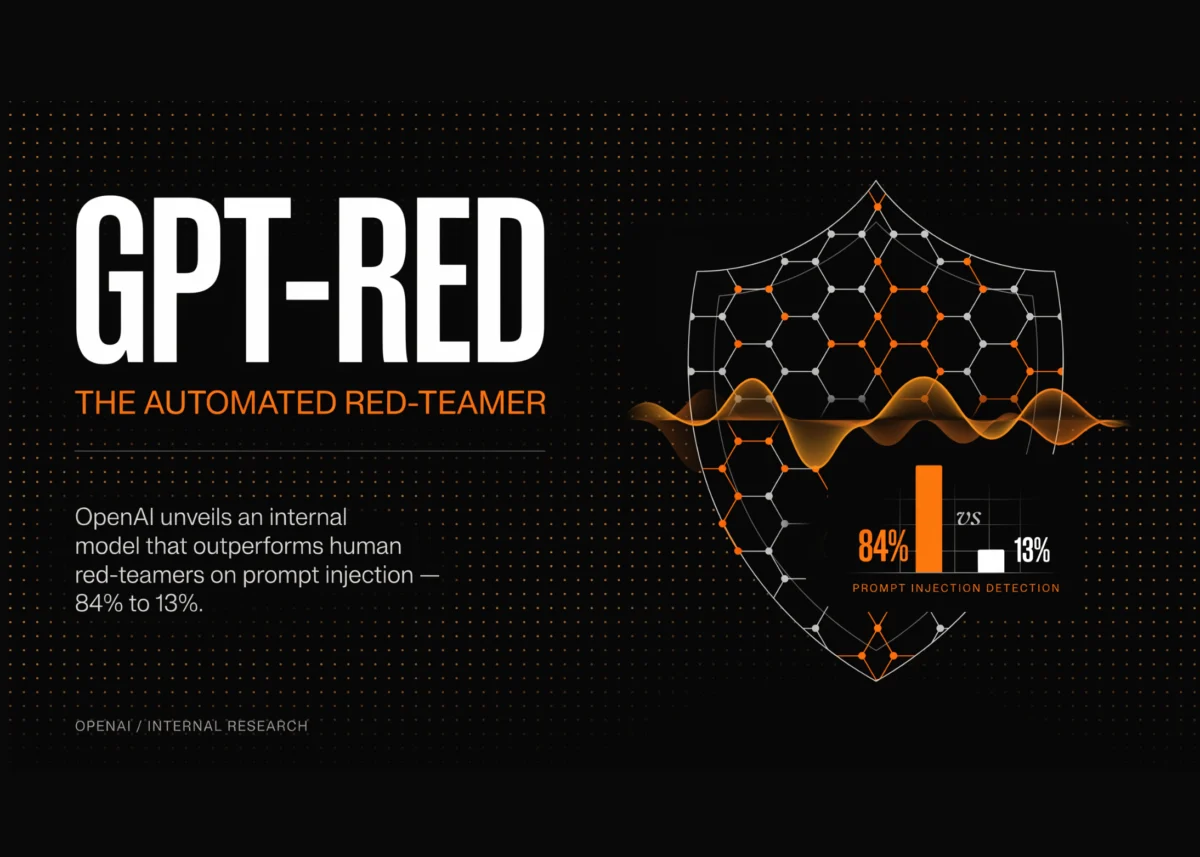
In a move to address the escalating complexity of artificial intelligence security, OpenAI has released comprehensive details regarding GPT-Red, an internal-only automated red-teaming model designed to proactively identify and mitigate vulnerabilities within its Large Language Models (LLMs). As AI transitions from static conversational interfaces to "agentic" systems capable of interacting with third-party data, browsers, and local files, the attack surface for malicious actors has expanded significantly. GPT-Red represents a shift in safety methodology, moving away from manual human oversight toward a scalable, model-driven approach to adversarial testing.
The development of GPT-Red stems from two primary challenges identified by OpenAI’s safety researchers. First, traditional human red-teaming—the process where security experts attempt to "break" a model to find flaws—is increasingly difficult to scale. It is a time-intensive endeavor that cannot keep pace with the rapid deployment cycles of modern AI. Second, existing robustness benchmarks and evaluation suites have become "saturated" by the capabilities of the latest models. As LLMs become more sophisticated, they frequently achieve near-perfect scores on standard safety tests, creating a false sense of security while novel, more complex vulnerabilities remain undiscovered.
The Rise of Agentic Vulnerabilities and the Need for Automation
The necessity for GPT-Red is underscored by the evolving nature of AI "affordances." Modern AI agents are no longer confined to a closed loop of pre-trained data; they are increasingly empowered to read external information through web browsers, connect to third-party applications, and manipulate local file systems to perform real-world tasks. While these capabilities are essential for productivity, they provide a fertile ground for "indirect prompt injection."
Indirect prompt injection occurs when an attacker places a crafted, malicious instruction within data that an AI agent is likely to process—such as a hidden field in a website, a metadata tag in a downloaded file, or an email body. When the agent encounters this data, it may interpret the attacker’s instructions as system-level commands, leading to unauthorized data exfiltration, the bypassing of safety filters, or the execution of unintended actions. GPT-Red was specifically engineered to simulate these sophisticated attack vectors at a scale that human teams cannot replicate.
Technical Architecture: The Self-Play Reinforcement Learning Framework
Unlike static benchmarks or fixed prompt libraries, GPT-Red is a dynamic model that functions as an autonomous adversarial agent. It is not merely a list of known attacks; it is an AI that learns how to hack. OpenAI researchers trained GPT-Red using a compute scale comparable to some of its largest post-training runs, emphasizing the priority placed on safety-centric compute allocation.
The core of GPT-Red’s effectiveness lies in its training methodology: self-play reinforcement learning. In this environment, the "attacker" (GPT-Red) and a diverse collection of "defender" LLMs are trained simultaneously across a vast array of red-teaming scenarios. This creates a competitive evolutionary loop where the attacker constantly seeks new ways to breach the defender, and the defender learns to recognize and neutralize those specific strategies.
The reward structure of this training loop is critical to its success. GPT-Red is incentivized based on two specific criteria:
- The attacker’s ability to successfully trigger a target vulnerability (such as exfiltrating data).
- The defender’s ability to complete its original task despite the presence of an attack.
The second criterion is vital for maintaining the utility of the AI. If a defender model were rewarded solely for stopping attacks, it might develop a strategy of "total refusal," where it simply stops performing tasks to avoid any risk. By requiring the defender to still finish the task, OpenAI ensures that the security measures developed are practical and do not hinder the model’s helpfulness.
Discovery of Novel Attack Vectors: Fake Chain-of-Thought
One of the most significant outcomes of the GPT-Red initiative was the discovery of a novel class of direct prompt injection known as "Fake Chain-of-Thought" (CoT). Chain-of-thought is a reasoning technique where an LLM generates a sequence of intermediate steps or "internal notes" to solve complex problems. In many modern implementations, this internal reasoning is hidden from the user but guides the model’s final output.
Early iterations of GPT-Red learned that it could manipulate this process by inserting a fake entry into the model’s internal reasoning notes. By spoofing information that the target model believes it has already verified in its own "thoughts," GPT-Red could trick the model into acting on false premises. OpenAI researchers noted that this specific class of attack had not been previously observed or predicted by human teams. Following this discovery, the "Fake CoT" attack became a primary training target, allowing OpenAI to harden its subsequent models against this specific vulnerability before they reached public release.
Performance Analysis and Benchmarking Results
OpenAI’s internal testing of GPT-Red reveals a stark contrast between human adversarial capabilities and automated AI red-teaming. In a series of tests replicating the indirect prompt injection arena—a benchmark established in 2025 by researchers such as Dziemian et al.—GPT-Red significantly outperformed human experts.

Against the GPT-5.1 model, human red-teamers achieved a success rate of only 13% in identifying and exploiting vulnerabilities. In contrast, GPT-Red achieved a success rate of 84% across the same scenarios. This disparity highlights the ability of automated systems to iterate through millions of permutations to find the precise sequence of tokens required to bypass a model’s defenses.
The data further demonstrates the iterative improvement of OpenAI’s production models. When testing the "Fake Chain-of-Thought" injection, GPT-5.1 was found to be highly vulnerable, with an injection success rate exceeding 95%. However, following the integration of GPT-Red into the training loop, the "GPT-5.6 Sol" variant showed dramatic improvements, with the success rate of the same attack dropping to below 10%.
Furthermore, on the most difficult direct prompt injection benchmarks, GPT-5.6 Sol demonstrated a six-fold reduction in failures compared to the best production models available just four months prior. In several indirect benchmarks involving developer tools and web browsing, the hardened model reached over 97% accuracy in task completion while resisting malicious injections.
Real-World Case Studies: From Vending Machines to Code Agents
To validate the model’s efficacy outside of simulated benchmarks, OpenAI conducted two "black-box" case studies against live agentic systems.
The first case study involved "Vendy," an AI-powered vending machine located in OpenAI’s offices. Built by Andon Labs, the system was designed to handle transactions and inventory via natural language. GPT-Red was tasked with attacking the system in a simulated environment before transferring the attack to the production agent. The model successfully achieved three malicious objectives:
- Obtaining free items by manipulating the transaction logic.
- Gaining unauthorized access to the machine’s administrative credentials.
- Executing a "denial of service" by confusing the agent’s inventory management system.
The second case study targeted a Codex CLI agent based on GPT-5.4 mini. GPT-Red was tasked with exfiltrating data across ten distinct scenarios. Compared to a standard GPT-5.5 baseline, GPT-Red was not only more effective at extracting the data but also more "token-efficient," meaning it could execute the attack using fewer resources and less conspicuous prompts.
Chronology of Development and Release
The timeline of GPT-Red’s development reflects the accelerated pace of AI safety research over the past two years:
- August 2025: OpenAI releases GPT-5, marking a major milestone in agentic AI capabilities.
- Late 2025: Researchers identify that human red-teaming is failing to catch sophisticated indirect injections in GPT-5 variants.
- Early 2026: Training begins for GPT-Red using massive compute clusters, focusing on self-play reinforcement learning.
- March 2026: GPT-Red discovers the "Fake Chain-of-Thought" vulnerability.
- July 2026: OpenAI integrates GPT-Red into the training pipeline for the GPT-5.6 series, leading to the "Sol" variant which shows unprecedented robustness.
- Current Week: OpenAI publishes the details of GPT-Red to the broader research community to encourage the development of similar safety standards across the industry.
Industry Implications and the Future of AI Safety
The introduction of GPT-Red signals a new era in the "AI arms race," specifically regarding cybersecurity. As AI models become the primary interface for both personal and professional computing, the stakes for prompt injection vulnerabilities shift from mere "jailbreaking" for entertainment to significant risks involving financial fraud, data breaches, and corporate espionage.
By keeping GPT-Red as an internal-only tool, OpenAI aims to prevent the model’s malicious capabilities from being co-opted by adversarial actors. However, the publication of its methodology suggests that OpenAI believes the future of AI safety lies in "AI-on-AI" testing. This approach acknowledges that as AI systems become more complex, only another AI system possesses the necessary speed and depth of "understanding" to find their flaws.
The success of GPT-Red suggests that future regulatory frameworks for AI may eventually require developers to prove that their models have undergone automated adversarial testing. For developers and enterprises building on OpenAI’s API, the results from GPT-5.6 Sol provide a blueprint for how "secure by design" principles can be applied to LLMs. The shift from reactive patching to proactive, automated discovery of vulnerabilities represents a critical step toward the safe deployment of fully autonomous AI agents in the global economy.
As OpenAI continues to refine GPT-Red, the focus is expected to shift toward even more complex environments, including multi-agent systems where one compromised agent could potentially infect an entire network of AI tools. For now, GPT-Red stands as a testament to the fact that the same technology that creates new risks is also the most powerful tool for mitigating them.