

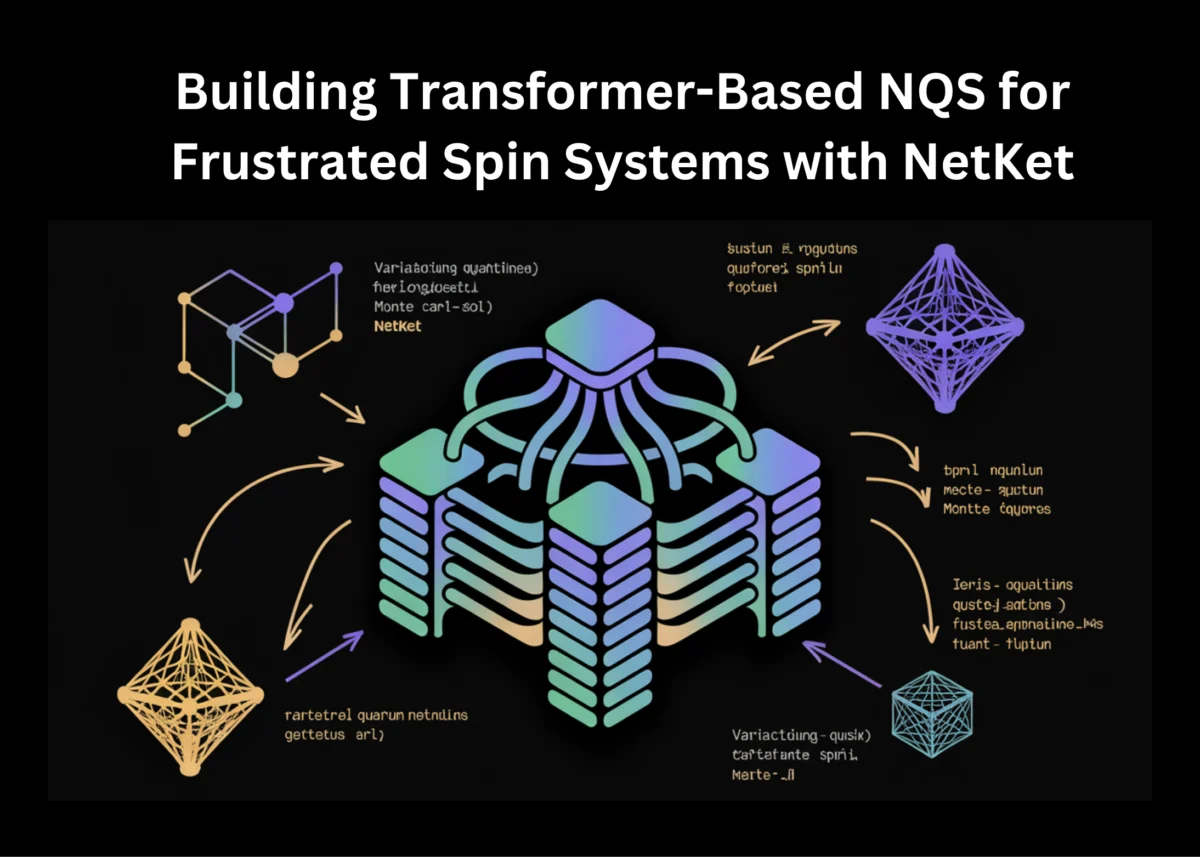
The field of many-body quantum physics is currently undergoing a paradigm shift as researchers increasingly leverage the representational power of deep learning to solve problems that have long been considered computationally intractable. At the center of this transformation is the development of Neural Quantum States (NQS), a framework where artificial neural networks are used to represent the wavefunctions of complex quantum systems. While traditional numerical methods such as Density Matrix Renormalization Group (DMRG) and standard Quantum Monte Carlo (QMC) have seen immense success, they often encounter significant barriers when applied to high-dimensional systems or those exhibiting "frustration"—a condition where competing interactions prevent the system from reaching a simple, ordered ground state. To address these challenges, a new generation of researchers is turning to the Transformer architecture, the same technology underlying modern large language models, to capture the intricate global correlations inherent in quantum magnetism.
The Challenge of Frustrated Quantum Systems
The study of quantum many-body systems is fundamentally a struggle against the "curse of dimensionality." For a system of $N$ spins, the size of the Hilbert space grows exponentially as $2^N$. For a modest system of 50 spins, the number of possible configurations exceeds one quadrillion, making exact diagonalization—the process of finding the lowest energy state by solving the Schrödinger equation directly—impossible for all but the smallest systems.
Among the most challenging models in this domain is the $J_1-J_2$ Heisenberg spin chain. This model describes a series of quantum spins where each spin interacts with its nearest neighbor (the $J_1$ coupling) and its next-nearest neighbor (the $J_2$ coupling). When both interactions are antiferromagnetic (tending to align spins in opposite directions), they compete with one another. This competition, known as frustration, leads to a complex phase diagram including Luttinger liquid phases and dimerized phases. Traditional Monte Carlo methods often suffer from the "sign problem" in these frustrated regimes, where the weights in the statistical sampling become negative or complex, leading to a total breakdown of the simulation.
The Role of Transformers in Quantum Wavefunction Representation
The emergence of Transformers as a tool for physics stems from their unique ability to handle long-range dependencies through the self-attention mechanism. In a quantum system, particles are not isolated; they are entangled, meaning the state of one particle is intrinsically linked to the state of others, regardless of the physical distance between them.
By treating a configuration of spins as a sequence—much like words in a sentence—a Transformer can learn the probability amplitude of that configuration. In the NQS framework, the neural network acts as an ansatz, a sophisticated "guess" for the ground-state wavefunction $psi(s)$. The network is trained to minimize the expectation value of the energy using the Variational Monte Carlo (VMC) method. This process involves sampling spin configurations, calculating their local energies, and updating the network parameters to lower the overall energy of the system.
Chronology of Neural Quantum States Development
The integration of neural networks into quantum physics is a relatively recent but rapidly accelerating development.
- 2017: The Foundation: Giuseppe Carleo and Matthias Troyer published their seminal paper in Science, introducing the concept of using Restricted Boltzmann Machines (RBMs) as Neural Quantum States. This proved that simple neural networks could represent ground states and time evolution of many-body systems.
- 2018-2019: Expansion to CNNs and RNNs: Researchers began exploring Convolutional Neural Networks (CNNs) for two-dimensional systems and Recurrent Neural Networks (RNNs) for sequential data, expanding the types of physical systems that could be modeled.
- 2020-2021: The Transformer Revolution: Following the success of the "Attention is All You Need" paper in AI, physicists began applying self-attention mechanisms to NQS. This allowed for better capturing of the volume-law entanglement found in many complex quantum phases.
- 2022-Present: High-Performance Frameworks: The development of specialized libraries like NetKet, built on top of Google’s JAX and Flax, has democratized access to these methods. These tools allow researchers to utilize hardware acceleration (GPUs and TPUs) and automatic differentiation to solve larger and more complex models than ever before.
Technical Implementation: The NetKet and JAX Pipeline
The current state-of-the-art approach involves a multi-stage pipeline designed for stability and high-precision computation. Utilizing JAX allows for the compilation of Python code into optimized machine code via XLA (Accelerated Linear Algebra), which is essential for the iterative nature of VMC.
Hamiltonian Construction and Hilbert Space
The simulation begins with the definition of the $J_1-J_2$ Hamiltonian. Using NetKet’s graph-based operators, a chain of $L$ sites is constructed. The Hilbert space is constrained to a total $S_z = 0$ sector, reflecting the physical reality of many antiferromagnetic ground states where the total magnetization is zero. This constraint significantly reduces the search space, though it remains exponentially large.
Transformer Architecture (Log-Psi)
The neural architecture, often termed "TransformerLogPsi," is designed to output a complex-valued log-amplitude. This is a critical distinction from standard AI models: quantum wavefunctions are complex-valued. The architecture typically involves:
- Embedding Layers: Converting discrete spin values (up/down) into continuous vectors.
- Positional Encodings: Providing the model with information about the relative locations of spins in the chain.
- Multi-Head Attention Blocks: Allowing the model to focus on multiple different types of correlations simultaneously.
- Global Pooling: Aggregating the information from all sites to produce a single scalar value representing the log-amplitude of the configuration.
Optimization via Stochastic Reconfiguration
To train these models effectively, researchers employ Stochastic Reconfiguration (SR). SR is a second-order optimization technique that is closely related to the Natural Gradient Descent used in machine learning. It accounts for the geometry of the Hilbert space, ensuring that updates to the neural network parameters lead to meaningful changes in the physical wavefunction. When paired with the Adam optimizer, SR allows the model to converge to the ground state energy with high accuracy, even in the presence of frustration.
Supporting Data and Benchmarking Analysis
A crucial component of any NQS study is validation against Exact Diagonalization (ED) or the Lanczos algorithm. In typical benchmarks, such as those performed on a 14-site lattice, the NQS approach can achieve an energy accuracy (the "absolute gap") that is within $10^-4$ or better of the exact theoretical value.
Once validated on small systems, the Transformer NQS can be scaled to larger lattices, such as $L=24, 48,$ or even $100$ sites, where ED is no longer possible. Data extracted from these larger simulations includes:
- Energy vs. $J_2$: By sweeping the next-nearest neighbor coupling from $0.0$ to $1.0$, researchers can map out the energy landscape and identify where the system undergoes phase transitions.
- Structure Factor Peaks: The static structure factor $S(q)$ is calculated via a Fourier transform of the spin-spin correlation functions. A peak at $q=pi$ indicates Néel (antiferromagnetic) ordering, while shifts in the peak position can signal the transition to a "spiral" phase or a "valence bond solid."
Official Responses and Academic Perspectives
The scientific community has responded to the rise of Transformer-based NQS with a mixture of excitement and rigorous scrutiny. Leading researchers in computational physics have noted that while NQS methods are powerful, they are not yet a "black box" solution. The choice of architecture, the quality of the sampling, and the stability of the SR preconditioner are all factors that require deep domain expertise.
"The ability of Transformers to represent complex entanglement patterns is a significant step forward," says one senior researcher in the field of condensed matter physics. "However, the challenge remains in ensuring that these models obey the fundamental symmetries of physics, such as SU(2) spin symmetry or lattice translation symmetry. Integrating these symmetries directly into the neural architecture is the next great frontier."
Broader Impact and Future Implications
The implications of this research extend far beyond the theoretical study of spin chains. The ability to accurately model frustrated quantum systems is a prerequisite for several technological breakthroughs:
- Material Science: Understanding frustrated magnetism is key to discovering new states of matter, such as Quantum Spin Liquids (QSLs), which could be used to create robust qubits for topological quantum computing.
- High-Temperature Superconductivity: Many theories suggest that the mechanism behind high-$T_c$ superconductivity is linked to the behavior of doped Mott insulators, which are essentially frustrated many-body systems.
- Quantum Computing Validation: As quantum processors become larger, we need classical methods to verify their results. Transformer-based NQS provides a high-fidelity classical benchmark for quantum hardware.
Furthermore, the methodologies developed for NQS are being adapted for time-dependent quantum simulations. This allows scientists to study "quantum quenched" systems—where a system is suddenly pushed out of equilibrium—providing insights into the thermalization of quantum matter and the dynamics of information propagation in quantum networks.
Conclusion
The integration of Transformers, JAX, and NetKet into the physicist’s toolkit represents a milestone in the evolution of computational science. By treating the Schrödinger equation as an optimization problem solvable through deep learning, researchers are bypassing classical limitations and gaining a clearer view of the quantum world. As these neural architectures become more sophisticated and hardware continues to improve, the boundary between what is "solvable" and what is "impossible" will continue to shift, promising a new era of discovery in quantum materials and information science.