

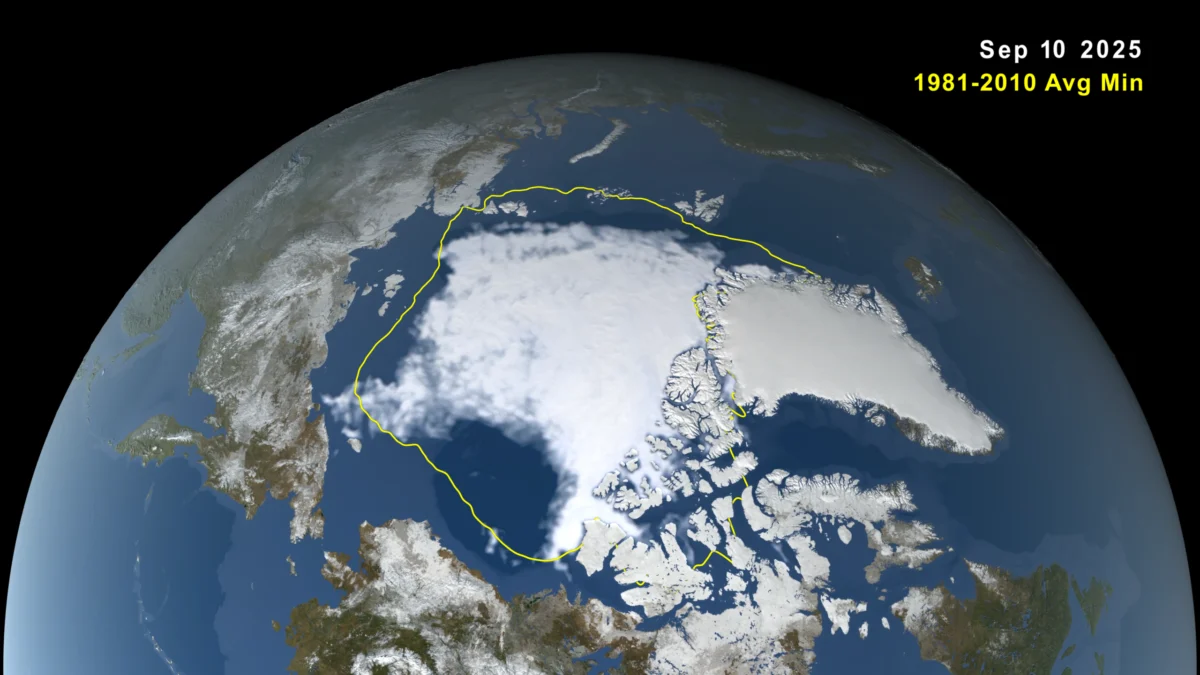
For the second consecutive year, the maximum extent of winter sea ice in the Arctic has reached a level statistically tied with the lowest peaks observed since comprehensive satellite monitoring commenced in 1979, signaling a persistent and alarming trend in global climate change. On March 15, the Arctic sea ice extent was recorded at 5.52 million square miles (14.29 million square kilometers), a figure remarkably close to a previous record low of 5.53 million square miles (14.31 million square kilometers) observed in recent history. Scientists from NASA and the National Snow and Ice Data Center (NSIDC) at the University of Colorado, Boulder, have confirmed that these two years are statistically indistinguishable, highlighting the critical nature of these repeated low maximums. This consistent pattern of diminished winter ice cover is not merely an isolated event but rather a stark indicator of the profound and accelerating transformations occurring within the Arctic region, with far-reaching implications for global climate systems, ecosystems, and human societies.
The Shrinking Arctic: A Long-Term Trend of Decline
The current observations are not anomalies but rather fit within a decades-long trajectory of decline that has seen the Arctic’s vital ice cover diminish significantly. Since 1979, when continuous satellite observations began providing a reliable baseline, the Arctic has experienced a consistent reduction in both the maximum winter extent and the minimum summer extent of its sea ice. The 1981-2010 period serves as a crucial benchmark for scientists, representing a relatively stable period against which current measurements are compared. This year’s peak ice cover fell below this average by approximately half a million square miles (about 1.3 million square kilometers), illustrating the substantial deviation from historical norms.
The annual cycle of Arctic sea ice is characterized by its expansion throughout the cold, dark winter months, reaching its maximum extent typically in March, followed by a period of melt through spring and summer, culminating in its minimum extent, usually in September. While some ice naturally melts and reforms each year, the overall trend points to a systemic weakening of this natural cycle. The rate of decline for Arctic sea ice extent has been approximately 12.6% per decade relative to the 1981-2010 average for the September minimum, and about 2.8% per decade for the March maximum. The fact that the Arctic is now experiencing consecutive years at or near record lows for its winter maximum is particularly concerning, as it indicates less resilience and a reduced capacity for ice recovery even during the coldest period. This continuous downward spiral is a clear manifestation of Arctic amplification, where the polar regions are warming at a rate two to three times faster than the global average, creating a feedback loop that further exacerbates ice loss.
Beyond Extent: The Critical Factor of Ice Thickness
While the total area covered by sea ice, known as its extent, provides a crucial metric, researchers are also keenly observing changes in ice thickness, which offers additional insights into the health and resilience of the Arctic ice pack. Nathan Kurtz, chief of the Cryospheric Sciences Laboratory at NASA’s Goddard Space Flight Center in Greenbelt, Maryland, emphasized this point: “Based on what we’re seeing with NASA’s ICESat-2 satellite, much of the ice in the Arctic is thinner this year, especially in the Barents Sea northeast of Greenland.” Thinner ice is inherently more vulnerable to melt, making the entire ice pack less stable and more susceptible to disappearing completely during the summer months.
The Arctic ice pack is composed of both first-year ice, which forms over a single winter, and multi-year ice, which survives at least one summer melt season. Multi-year ice is typically thicker, stronger, and more resistant to warming temperatures. Its decline is particularly alarming, as it represents the core, resilient component of the Arctic ice cover. The observed reduction in new ice formation and the subsequent accumulation of multi-year ice means the Arctic is increasingly dominated by thinner, younger ice. This shift makes the ice pack less durable and more prone to rapid retreat, creating a positive feedback loop: less multi-year ice means more heat absorption, leading to even less multi-year ice in subsequent years.
Regionally, the Barents Sea, located northeast of Greenland and bordering the European Arctic, is an area of particular concern. Its thinning ice has implications for regional ocean circulation and weather patterns. Kurtz also noted that “The Sea of Okhotsk that borders northern Japan and Russia also had relatively low ice this year – a region that naturally experiences significant year-to-year variability.” While the Sea of Okhotsk often exhibits greater natural fluctuations, its inclusion in the broader pattern of reduced ice cover across various Arctic regions adds to the overall picture of systemic change. These regional observations, when viewed collectively, underscore the widespread nature of ice loss across the Arctic Ocean.
Understanding the Arctic’s Role in Global Climate
The Arctic’s sea ice is not merely a frozen expanse; it is a fundamental component of Earth’s climate system, playing a critical role in regulating global temperatures. Its decline triggers a cascade of effects that extend far beyond the polar regions.
-
Albedo Effect: Sea ice is highly reflective, bouncing up to 80% of incoming solar radiation back into space. This phenomenon is known as the albedo effect. As ice melts, it exposes the darker ocean surface beneath, which absorbs up to 90% of solar radiation. This absorbed heat further warms the ocean, leading to more ice melt, in a potent positive feedback loop known as the ice-albedo feedback. This mechanism is a primary driver of Arctic amplification, contributing significantly to the region’s accelerated warming.
-
Arctic Amplification: The Arctic is warming at a rate two to four times faster than the global average. This disproportionate warming is largely driven by the albedo effect and changes in atmospheric and oceanic circulation. The amplified warming in the Arctic has profound implications for global climate patterns, as the polar regions act as Earth’s "refrigerator."
-
Impact on Atmospheric Circulation: The diminishing temperature difference between the Arctic and mid-latitudes can influence the jet stream, a fast-flowing current of air high in the atmosphere that dictates weather patterns. Some research suggests that a weaker, wavier jet stream can lead to more extreme and persistent weather events in the Northern Hemisphere, including prolonged heatwaves, cold snaps, and droughts in regions far removed from the Arctic.
-
Permafrost Thaw and Methane Release: While distinct from sea ice, the warming Arctic also leads to the thawing of permafrost – permanently frozen ground that underlies vast areas of the Arctic landmass. Permafrost contains immense stores of organic carbon. As it thaws, this carbon decomposes, releasing potent greenhouse gases like carbon dioxide and methane into the atmosphere, creating another powerful positive feedback loop that further accelerates global warming.
Ecological and Societal Ramifications
The rapid transformation of the Arctic environment due to sea ice loss has dire consequences for its unique ecosystems and the indigenous communities that depend on them.
-
Impact on Arctic Wildlife: Polar bears, iconic symbols of the Arctic, rely on sea ice as a platform for hunting seals, their primary food source, for mating, and for migrating. Reduced ice extent and thickness force them to travel longer distances, leading to increased energy expenditure and reduced hunting success, ultimately impacting their survival and reproductive rates. Seals, walruses, and various marine bird species also depend on sea ice for breeding, resting, and foraging. The entire food web, from phytoplankton blooming under the ice to apex predators, is intricately linked to the presence and health of the sea ice.
-
Threats to Indigenous Communities: For millennia, indigenous peoples of the Arctic, such as the Inuit, Yup’ik, Sámi, and others, have adapted their cultures and livelihoods to the rhythms of the sea ice. It is essential for traditional hunting, fishing, and travel. Diminishing and less predictable ice conditions make traditional activities perilous or impossible, threatening food security, cultural practices, and ancient ways of life. Coastal erosion, exacerbated by less protective sea ice, also poses a direct threat to homes and infrastructure in many Arctic villages.
-
Changes in Ocean Currents and Marine Ecosystems: The influx of fresh water from melting ice can alter ocean salinity and stratification, potentially impacting major ocean currents that distribute heat and nutrients globally. Changes in ice cover also affect light penetration, primary productivity, and the distribution of marine species, with ripple effects throughout global fisheries.
Geopolitical and Economic Implications
The retreating Arctic sea ice is not only an environmental concern but also a catalyst for significant geopolitical and economic shifts, opening up new frontiers for commerce and resource extraction.
-
Opening of New Shipping Lanes: The reduction in ice cover is making previously inaccessible maritime routes, such as the Northern Sea Route along Russia’s Arctic coast and the Northwest Passage through the Canadian Arctic Archipelago, increasingly viable for commercial shipping during summer months. These routes offer significantly shorter transit times between Asia and Europe compared to traditional routes through the Suez or Panama Canals, potentially reshaping global trade patterns.
-
Increased Accessibility for Resource Extraction: The melting ice also makes the vast, previously unexploited natural resources of the Arctic – including oil, natural gas, and minerals – more accessible for exploration and extraction. This potential for resource exploitation raises environmental concerns, as drilling and mining operations in a fragile Arctic environment carry significant risks of pollution and ecological damage.
-
Strategic Shifts in the Arctic: The increased accessibility and resource potential have heightened geopolitical interest and competition among Arctic nations (Canada, Denmark/Greenland, Finland, Iceland, Norway, Russia, Sweden, and the United States) and non-Arctic states seeking influence in the region. This has led to increased military presence, territorial claims, and international cooperation and contention over governance and resource management.
The Antarctic Anomaly: A Different Story of Variability
While the Arctic continues its dramatic decline, the Antarctic presents a more complex and historically variable picture regarding its sea ice dynamics. On February 26, Antarctic summer sea ice reached an annual low of 996,000 square miles (2.58 million square kilometers). This year’s coverage represents an increase compared to the unusually low levels observed in the past four years. Although still 100,000 square miles (260,000 square kilometers) lower than the 1981-2010 average, the Antarctic sea ice minimum was notably well above the record low set on February 21, 2023, which measured a stark 691,000 square miles (1.79 million square kilometers).
The difference in trends between the two poles is largely attributed to their distinct geographies and atmospheric dynamics. The Arctic is an ocean surrounded by continents, while Antarctica is a continent surrounded by an ocean. This fundamental difference means Antarctic sea ice is more influenced by complex atmospheric and oceanic circulation patterns, such as the Southern Annular Mode (SAM) and the effects of the ozone hole over the continent. For many years, while the Arctic was losing ice, Antarctic sea ice extent was actually stable or even slightly increasing, confounding some predictions. However, recent years have seen periods of exceptionally low Antarctic sea ice, particularly in 2017, 2022, and 2023, raising concerns that the continent might also be entering a phase of sustained decline. The recent "increase" should therefore be viewed cautiously within this context of high inter-annual variability and against the backdrop of several recent record lows, rather than as a definitive reversal of a potential downward trend. Scientists continue to monitor Antarctic sea ice closely to discern whether these extreme lows represent short-term fluctuations or the onset of a new, long-term pattern of decline driven by global warming.
The Science of Observation: How We Monitor the Ice
Accurate and continuous monitoring of sea ice is paramount for understanding these complex environmental changes. Scientists rely on a sophisticated suite of satellite technologies and historical data to track sea ice extent and thickness.
Historically, the NSIDC tracked sea ice extent primarily using satellites within the Defense Meteorological Satellite Program (DMSP). These satellites, equipped with microwave radiometers, could penetrate cloud cover and darkness, providing continuous data regardless of weather or time of day.
In recent years, the NSIDC has increasingly relied on the Advanced Microwave Scanning Radiometer 2 (AMSR2) aboard JAXA’s (Japan Aerospace Exploration Agency) Global Change Observation Mission 1st-Water (GCOM-W1) satellite for real-time sea ice data. AMSR2 offers high-resolution, multi-frequency microwave measurements that allow for precise mapping of sea ice concentration and extent.
For measuring ice thickness, NASA’s ICESat-2 (Ice, Cloud, and land Elevation Satellite-2) is a game-changer. Launched in 2018, ICESat-2 uses a laser altimeter to measure the precise elevation of ice surfaces. By comparing the elevation of sea ice floes to the surrounding open water, scientists can calculate the ice’s freeboard (the part above water) and, using knowledge of ice density, determine its thickness. This capability provides invaluable data on the volume of Arctic sea ice, which is arguably an even more critical indicator of its health than mere extent.
Researchers also compare current ice coverage to historical sources, such as the data collected between 1978 and 1985 with the Nimbus-7 satellite, jointly operated by NASA and the National Oceanic and Atmospheric Administration (NOAA). This multi-source approach, combining contemporary high-resolution data with historical baselines, allows scientists to construct a comprehensive, long-term record of sea ice changes, crucial for discerning trends from natural variability.
Expert Outlook and Future Projections
Walt Meier, an ice scientist with NSIDC, aptly summarized the scientific perspective: “A low year or two don’t necessarily mean much by themselves.” He continued, "But viewed within the long-term downward trend since 1979, they add to the overall picture of change in Arctic sea ice throughout the seasons.” This statement underscores the importance of context. While individual year-to-year fluctuations can occur due to regional weather patterns, the consistent pattern of reaching or nearing record lows, especially for consecutive years, provides compelling evidence of a systemic, climate-driven transformation.
Climate models project a continued decline in Arctic sea ice, with scenarios predicting an "ice-free" Arctic Ocean in summer within decades, possibly as early as 2030 or 2040, under high greenhouse gas emission pathways. An "ice-free" Arctic is typically defined as having less than 1 million square kilometers of sea ice. The implications of such a scenario are profound, fundamentally altering the Arctic environment and further accelerating global warming through the enhanced albedo effect.
The observations from NASA and NSIDC serve as a critical alarm, reinforcing the urgency of addressing global climate change. The consistent retreat and thinning of Arctic sea ice are not just distant environmental issues; they represent fundamental shifts in Earth’s operating system with tangible consequences for weather patterns, ecosystems, economies, and human societies worldwide. The scientific community’s continued vigilance and the data they provide are indispensable for informing policy decisions aimed at mitigating climate change and adapting to its inevitable impacts.
By James Riordon, NASA’s Goddard Space Flight Center, Greenbelt, Md.
Media contact: Elizabeth Vlock, NASA Headquarters, Washington