

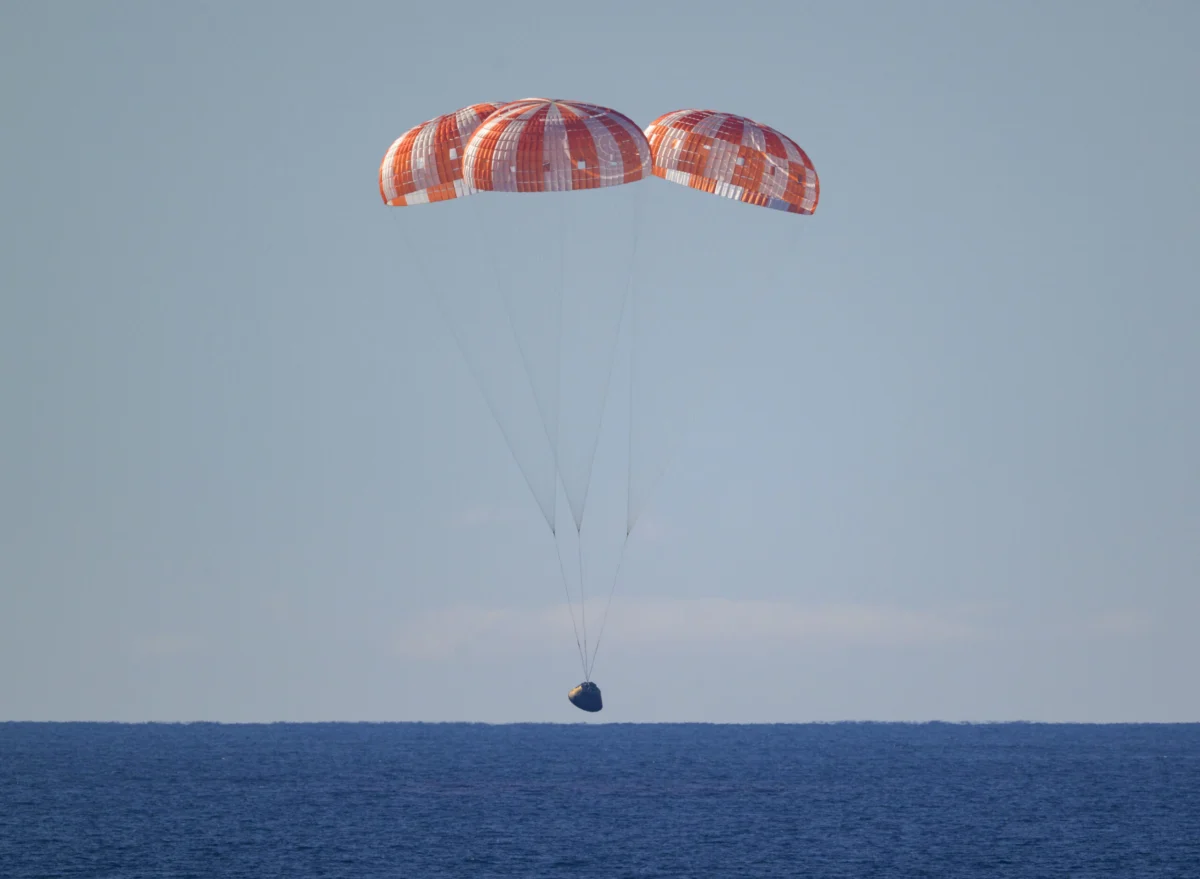
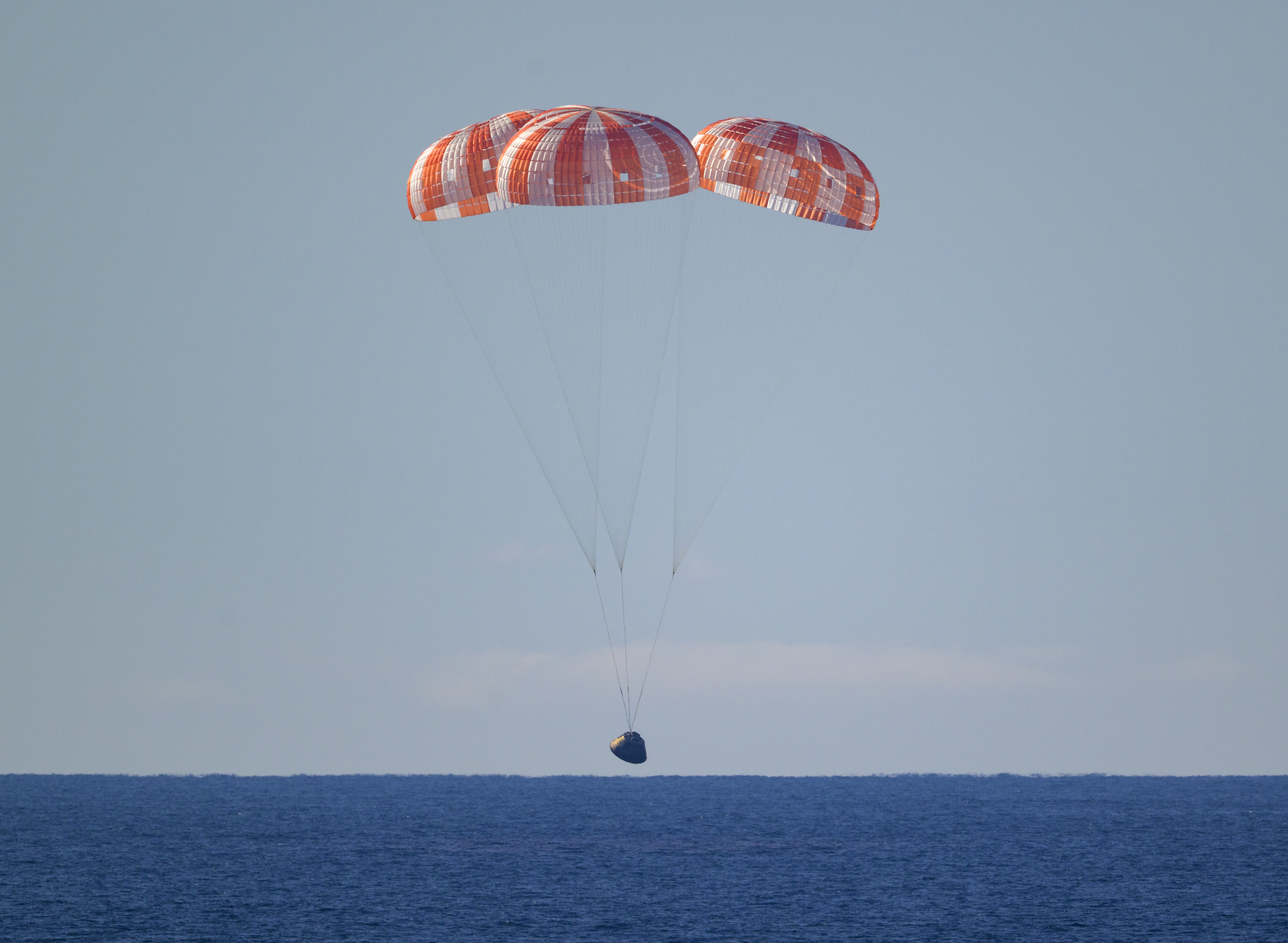
The NASA Orion spacecraft, carrying the Artemis II crew, successfully concluded its nearly 10-day mission with a precision splashdown in the Pacific Ocean on April 10, 2026. This monumental achievement marks a critical milestone in humanity’s return to deep space, propelling the Artemis program forward in its ambitious quest to establish a sustainable human presence on the Moon and pave the way for future crewed missions to Mars. Captured moments before its oceanic return, the Orion capsule was seen descending gracefully under a trio of vibrant parachutes, signaling the triumphant completion of a journey that pushed the boundaries of human spaceflight. The four-person crew aboard Orion not only accomplished a comprehensive set of test objectives but also surpassed the enduring record set by Apollo 13 for the farthest human spaceflight from Earth, offering unprecedented views of the lunar far side during their orbital pass.
A New Chapter in Lunar Exploration: The Artemis Program Context
The successful completion of the Artemis II mission is a testament to years of meticulous planning, advanced engineering, and unwavering dedication from NASA and its international and commercial partners. Artemis, meaning "twin sister of Apollo," is NASA’s flagship program designed to return humans to the Moon, building on the legacy of the Apollo era while employing significantly more advanced technology and aiming for long-term sustainability. Unlike the Apollo missions, which were primarily focused on short-duration lunar landings, Artemis seeks to establish a permanent presence, fostering scientific discovery, economic development, and serving as a crucial proving ground for the ultimate goal: sending astronauts to Mars.
Artemis II stands as the first crewed mission of this ambitious program, following the highly successful uncrewed Artemis I mission in late 2022. Artemis I, which launched an uncrewed Orion spacecraft atop the Space Launch System (SLS) rocket, validated the spacecraft’s performance, heat shield, and parachute systems during a 25-day journey around the Moon and back. This critical precursor mission provided invaluable data and confidence, setting the stage for human spaceflight. Artemis II was specifically designed to test Orion’s life support systems, navigation capabilities, and re-entry procedures with astronauts on board, demonstrating the spacecraft’s readiness for future lunar landings.
Mission Objectives and Key Milestones Achieved
The Artemis II mission was laden with critical objectives, all of which were successfully met or exceeded during the nearly 10-day duration. The primary goals included:
- Human-rated spacecraft validation: Thoroughly testing Orion’s systems with a crew aboard, including environmental control and life support systems, power distribution, communications, and thermal control.
- Lunar flyby trajectory verification: Proving the navigation and propulsion systems required for a precise trajectory around the Moon and back.
- Deep space operational experience: Providing the crew with hands-on experience operating Orion in the deep space environment, beyond the protective magnetosphere of Earth.
- Re-entry and splashdown demonstration: Confirming the spacecraft’s ability to safely re-enter Earth’s atmosphere at lunar return velocities and execute a controlled splashdown.
Among the most celebrated achievements was the crew’s journey to a record-setting distance of approximately 410,000 kilometers (250,000 miles) from Earth, surpassing the 1970 Apollo 13 mission’s record of 400,171 kilometers (248,655 miles). This milestone underscored the extended reach and capabilities of the Orion spacecraft. Furthermore, the crew captured stunning, never-before-seen high-definition views of the far side of the Moon, a region not directly visible from Earth and one of immense scientific interest due to its distinct geological features and potential resources. These visual records, along with telemetry data, will be critical for planning future lunar surface missions.
A Chronology of the Historic Journey
The journey of Artemis II began long before its launch, with the selection of its diverse four-person crew in 2023. Comprising experienced NASA astronauts, including individuals poised to become the first woman and first person of color to orbit the Moon, the crew underwent intensive training for years, familiarizing themselves with Orion’s complex systems, emergency procedures, and the rigors of deep space travel.
- Launch Day (Early April 2026): The mission officially commenced with a powerful launch from NASA’s Kennedy Space Center in Florida, utilizing the Space Launch System (SLS) rocket. The launch was a spectacle of engineering prowess, as the world’s most powerful rocket ascended, carrying the Orion spacecraft and its precious cargo of human explorers into orbit.
- Earth Orbit and Trans-Lunar Injection (TLI): After achieving initial Earth orbit, the SLS rocket’s upper stage performed the crucial Trans-Lunar Injection burn, propelling Orion out of Earth’s gravitational sphere of influence and onto a trajectory towards the Moon. This maneuver was precisely executed, setting the stage for the lunar flyby.
- Outbound Journey and Systems Checks: Over the course of several days, as Orion traversed the vast distance to the Moon, the crew meticulously performed a series of in-space tests. They evaluated the spacecraft’s propulsion systems, adjusted its trajectory with precision burns, and conducted comprehensive checks of the environmental control systems, ensuring the capsule could sustain human life far from Earth. Communication systems were rigorously tested, maintaining clear links with Mission Control in Houston.
- Lunar Flyby and Far Side Observations: The mission reached its apogee when Orion rounded the far side of the Moon. During this critical phase, the spacecraft dipped within approximately 100 kilometers (62 miles) of the lunar surface. For a period, the crew was out of direct communication with Earth, relying on their training and the spacecraft’s autonomous systems. It was during this segment that they captured the unparalleled imagery of the Moon’s rugged, crater-strewn far side, a region of enduring mystery and scientific fascination. The crew also surpassed the Apollo 13 distance record, a symbolic and tangible demonstration of Artemis’s expanded capabilities.
- Return Trajectory and Earth Re-entry: Following the lunar flyby, Orion used the Moon’s gravity for a slingshot maneuver, accelerating back towards Earth. The return journey involved precise trajectory corrections and preparations for the demanding re-entry phase. On April 10, 2026, the spacecraft, protected by its advanced heat shield, plunged into Earth’s atmosphere at velocities exceeding 38,000 kilometers per hour (24,000 miles per hour).
- Splashdown and Recovery: The final phase saw the deployment of Orion’s parachute system, which progressively slowed the capsule from supersonic speeds to a gentle splashdown in the Pacific Ocean. Naval recovery teams were swiftly on site to retrieve the spacecraft and ensure the safe egress of the crew, bringing to a close a nearly 10-day odyssey.
The Orion Spacecraft and Space Launch System: Engineering Marvels
The success of Artemis II hinges on the performance of its cutting-edge hardware. The Orion Multi-Purpose Crew Vehicle (MPCV) is a state-of-the-art spacecraft designed for deep space exploration. It consists of a crew module, a service module (provided by the European Space Agency, ESA), and a launch abort system. The crew module, capable of housing four astronauts, is equipped with advanced life support, navigation, and communication systems, making it suitable for missions lasting several weeks. Its robust heat shield, made of Avcoat material, is designed to withstand the extreme temperatures generated during high-speed atmospheric re-entry from lunar trajectories.
Powering Orion into space is the Space Launch System (SLS), NASA’s super heavy-lift rocket. Standing taller than the Statue of Liberty, the SLS Block 1 configuration used for Artemis II generates an astounding 8.8 million pounds of thrust at launch, making it the most powerful rocket ever built. It comprises a core stage powered by four RS-25 engines (derived from the Space Shuttle Main Engines) and two solid rocket boosters, providing the initial immense thrust. An upper stage, the Interim Cryogenic Propulsion Stage (ICPS), provides the necessary push to send Orion on its trans-lunar injection trajectory. Together, Orion and SLS represent a formidable capability for extending human exploration far beyond low-Earth orbit.
Scientific Objectives and Data Collection
Beyond the engineering validation, Artemis II also carried significant scientific objectives. The crew actively participated in experiments designed to study human performance and physiology in the deep space environment. This included monitoring radiation exposure levels, assessing the impact of microgravity on the human body over an extended period, and testing new technologies for in-space communication and navigation. The far side lunar imagery and data collected during the flyby will contribute to geological mapping and understanding the Moon’s formation and evolution. The mission also provided an opportunity to test new procedures for medical emergencies and psychological well-being in isolated, confined environments, invaluable lessons for future long-duration missions to Mars. The collected data is expected to significantly enhance our understanding of the challenges and opportunities for human exploration beyond Earth.
Official Reactions and Future Prospects
The successful return of Artemis II was met with widespread jubilation and official commendations. NASA Administrator Bill Nelson lauded the crew and the entire Artemis team, stating, "This mission represents a monumental leap for humanity and a critical step in our journey to Mars. The Artemis II crew performed flawlessly, demonstrating the capabilities of Orion and the SLS, and proving that we are ready to take on the next challenge: returning astronauts to the lunar surface." Mission Control teams, who meticulously monitored every aspect of the flight, expressed immense pride in the mission’s execution. Flight Director Emily Chang commented, "The precision of the launch, the flawless execution of the lunar flyby, and the textbook splashdown are a testament to years of dedication and rigorous training. We have gathered invaluable data that will inform every future deep space mission."
The success of Artemis II directly paves the way for Artemis III, the mission slated to return humans to the lunar surface for the first time since Apollo 17 in 1972. Artemis III will feature a crewed landing near the Moon’s South Pole, a region believed to harbor significant reserves of water ice in permanently shadowed craters, a crucial resource for future lunar habitats and for producing rocket fuel. Subsequent Artemis missions (Artemis IV and beyond) will focus on establishing the Gateway lunar orbiting outpost and building a sustained human presence on the Moon, utilizing international partnerships and commercial ventures.
The Broader Vision: Moon to Mars
The Artemis program is not merely about returning to the Moon; it is fundamentally about preparing for Mars. The Moon serves as a strategic proving ground where NASA and its partners can develop and test technologies, refine operational procedures, and gain invaluable experience in a deep space environment, albeit one much closer than Mars. Lessons learned from Artemis II, particularly concerning human health in deep space, radiation mitigation, and long-duration life support systems, are directly applicable to future Mars missions. The establishment of a lunar base will also allow for the testing of in-situ resource utilization (ISRU) technologies, which are vital for living off the land on Mars, reducing the amount of material that needs to be launched from Earth.
This ambitious vision also emphasizes international collaboration. Partners such as the European Space Agency (ESA), the Canadian Space Agency (CSA), and the Japan Aerospace Exploration Agency (JAXA) are contributing critical components and expertise to the Artemis program, fostering a global effort in space exploration. Commercial partners are also playing an increasingly vital role, developing lunar landers, habitats, and providing logistics services, fostering a new space economy that will accelerate human expansion into the solar system.
Legacy and Inspiration
The safe return of the Artemis II crew on April 10, 2026, marks a pivotal moment in the history of space exploration. It reaffirms humanity’s capacity for ingenuity, perseverance, and exploration. The mission not only validated critical technologies and procedures but also rekindled the spirit of discovery that captivated the world during the Apollo era. For a new generation, the images of Orion sailing past the far side of the Moon and the successful splashdown serve as a powerful inspiration, demonstrating that the future of space exploration is vibrant and within reach. As humanity looks towards a sustained presence on the Moon and the eventual journey to Mars, Artemis II stands as a testament to what can be achieved when nations and individuals unite in pursuit of the extraordinary. More photos and multimedia from this historic mission are available on NASA’s official website, documenting every step of this groundbreaking journey.