



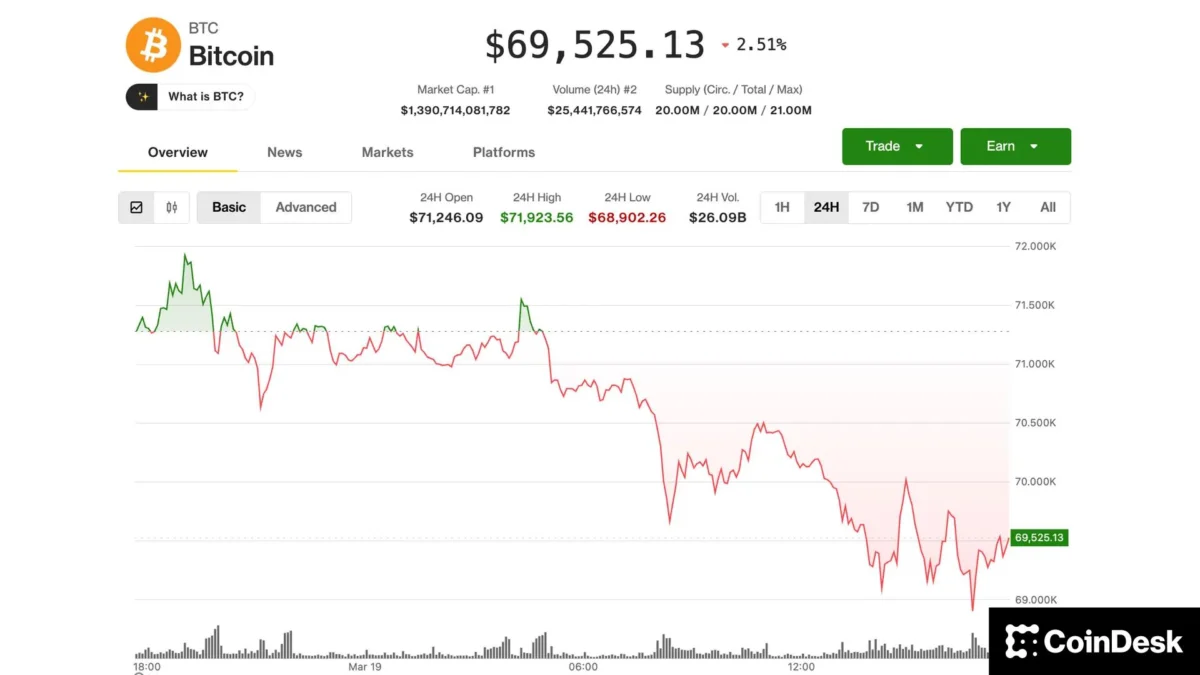
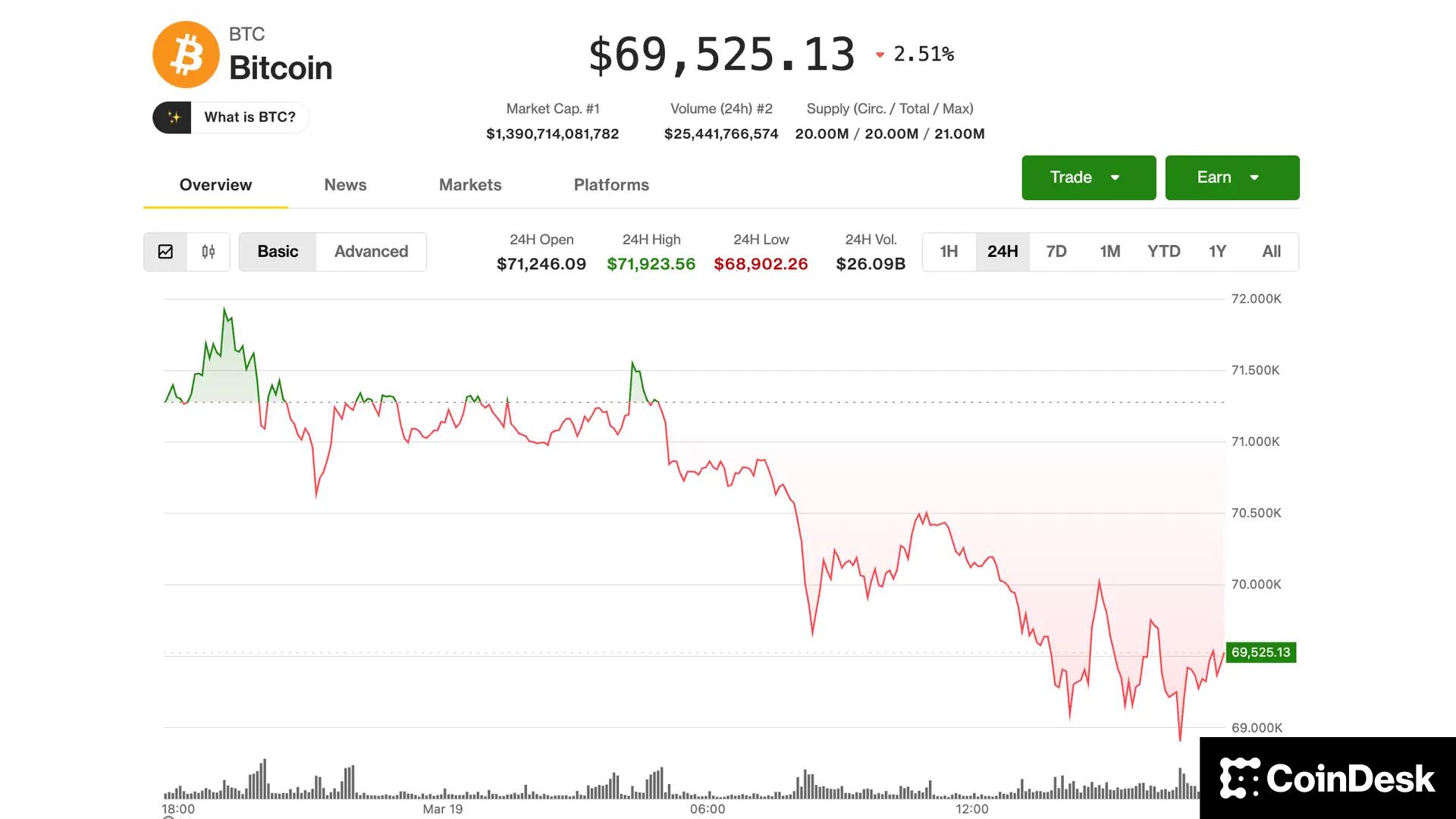
The global financial landscape faced a period of intense volatility on Thursday as geopolitical tensions in the Middle East reached a critical juncture, triggering a massive realignment of asset classes. Bitcoin, the world’s largest cryptocurrency by market capitalization, demonstrated unexpected resilience, maintaining a position above the $69,000 threshold despite a broader retreat from risk-on assets. This stability stood in stark contrast to the precious metals market, where gold suffered a significant sell-off, and the energy sector, where crude oil prices surged toward the $100-per-barrel mark.
The catalyst for this market turbulence is the deepening conflict involving Iran, which has escalated to include targeted strikes on critical energy infrastructure. As news of the strikes disseminated through global trading floors, the initial reaction was a flight to liquidity, characterized by a sharp decline in traditional safe-haven assets and a concurrent spike in energy costs. While Bitcoin has historically been categorized as a high-risk, high-reward asset, its recent decoupling from the downward trajectory of gold has sparked renewed debate among institutional investors regarding its role in a modern diversified portfolio.
Geopolitical Escalation and the Energy Shock
The current market environment is heavily influenced by the deteriorating security situation in the Middle East. Reports emerging on Thursday indicated that the conflict in Iran has begun to spill over into broader regional instability, with specific threats directed at energy production facilities and maritime transit routes. For global markets, the primary concern remains the potential for a sustained disruption in the supply of crude oil, which would exert upward pressure on already sensitive inflation metrics.
Crude oil prices remained the focal point of Thursday’s trading session. After an initial dip, prices reversed course following a report from Politico stating that the United States government is not currently considering a ban on crude oil exports. This clarification eased some fears regarding domestic supply gluts but reinforced the reality of high global prices. With oil swinging back toward $100 a barrel, the "inflationary ghost" has returned to haunt central banks, many of which were previously expected to begin a cycle of interest rate cuts in the second half of 2026.
The prospect of sustained high energy costs has forced a reassessment of macroeconomic projections. Investors are now weighing the possibility that central banks, led by the U.S. Federal Reserve, may be forced to maintain higher interest rates for a longer duration—or even consider further hikes—to combat the secondary inflationary effects of an energy shock. This sentiment weighed heavily on the S&P 500 and the Nasdaq, both of which slid nearly 1% during morning trading, reaching new lows for the 2026 calendar year.
The Surprising Divergence: Bitcoin vs. Gold
Perhaps the most significant development in Thursday’s market action was the divergence between Bitcoin and gold. Gold, traditionally the primary beneficiary of geopolitical unrest, experienced a precipitous decline, dropping 5% to approximately $4,500 per ounce. This represented the metal’s lowest valuation since early February. Silver followed suit, falling 6.6% as a multi-week rally came to an abrupt end.
The liquidation in metals suggests that the current market move is not a standard rotation into safe havens, but rather a broader "dash for cash" or a de-risking event where investors sell profitable positions to cover losses elsewhere or to build liquidity. In this environment, Bitcoin’s performance was notably steady. At the time of reporting, Bitcoin was trading near $69,400, representing a modest 2.6% decline on the day.
This relative strength has not gone unnoticed by market participants. Bryan Tan, a trader at the liquidity provider Wintermute, noted that Bitcoin has outperformed gold by roughly 20% since the initial outbreak of the Iran conflict. This dynamic is unusual for an asset that has historically traded in high correlation with technology stocks and other risk-sensitive instruments. However, Tan cautioned against over-optimism, pointing out that Bitcoin’s inability to break and hold above the $75,000 resistance level indicates a market that remains cautious and rangebound.
Performance Across the Crypto Ecosystem
The broader digital asset market mirrored Bitcoin’s cautious stance. The CoinDesk 20 Index, a benchmark for the most liquid cryptocurrencies, fell by approximately 2.1%. Major altcoins, including Ether (ETH), XRP, BNB, and Solana (SOL), all recorded losses, though these were generally contained within the 3% range.
In the equity markets, companies with direct exposure to the crypto industry also faced selling pressure, though the intensity varied:
- Coinbase (COIN): The leading U.S. exchange saw its shares slip by 1.7%.
- MicroStrategy (MSTR): The Bitcoin treasury firm, known for its aggressive accumulation of the asset, fell by 2.6%.
- Circle (CRCL): The issuer of the USDC stablecoin experienced a more pronounced pullback of 6%. This decline follows a period of exceptional growth in which the stock more than doubled over the preceding three weeks, suggesting a natural correction and profit-taking by investors.
Alvin Kan, Chief Operating Officer at Bitget Wallet, observed that the simultaneous drop in gold and Bitcoin (albeit to different degrees) points to a macro-driven de-risking phase. According to Kan, rising energy prices are feeding directly into inflation expectations, which in turn tightens global liquidity. For risk assets, this combination of high inflation and tightening liquidity creates a challenging environment for sustained upward momentum.
Chronology of Market Events: March 2026
To understand the current market volatility, it is essential to look at the timeline of events leading up to the March 19 trading session:
- Early March 2026: Diplomatic efforts to resolve tensions in the Middle East stall, leading to increased military posturing. Gold begins a rally as investors seek protection against potential conflict.
- March 12-15, 2026: Initial reports of localized skirmishes emerge. Oil prices begin to climb from $85 to $92.
- March 17, 2026: Attacks on energy infrastructure in Iran are confirmed. Global markets react with a sharp sell-off in equities. Bitcoin briefly touches $73,000 before retreating.
- March 18, 2026: Gold hits a peak near $4,800 before profit-taking begins. Rumors of a U.S. oil export ban circulate, causing oil prices to fluctuate wildly.
- March 19, 2026 (Today): The Politico report clarifies the U.S. stance on oil exports. Gold collapses 5% as liquidity is pulled from the market. Bitcoin holds the $69,000 support level, outperforming traditional hedges on a relative basis.
Analyst Recommendations: The Case for "Dry Powder"
Despite Bitcoin’s relative strength, professional traders are advising a high degree of caution. The primary concern is that the current price action is being driven almost exclusively by headlines rather than underlying fundamental shifts or organic demand. In such a "headline-driven" market, volatility can swing in either direction with little warning.
Bryan Tan of Wintermute emphasized the importance of patience in the current climate. "When sentiment swings on each headline about the conflict, and correlation to oil prices are so elevated, being flat is a strong position," Tan stated. He advised investors to reserve "dry powder"—a financial term for unallocated cash reserves—until the market provides a meaningful confirmation of its next direction. This could come in the form of a definitive break above $75,000 or a material change in the geopolitical landscape that reduces the risk of further energy shocks.
The cautious outlook is further complicated by the arrival of "quadruple witching" on Friday, March 20. This quarterly event involves the simultaneous expiration of market index futures, market index options, stock options, and stock futures. Historically, quadruple witching days are associated with increased trading volume and heightened volatility. Data from 2025 suggests that Bitcoin often experiences muted performance on these days, followed by a period of weakness in the subsequent weeks.
Broader Implications and Future Outlook
The resilience of Bitcoin at $69,000 during a period of intense geopolitical and macroeconomic stress provides further evidence of the asset’s evolving maturity. However, the broader implications of the Iran conflict and the energy spike cannot be ignored. If oil remains near or above $100 per barrel, the resulting inflationary pressure could derail the "soft landing" scenario that many economists had predicted for 2026.
For the cryptocurrency market, the immediate future depends on two factors: the stability of the $69,000 support level and the ability of the market to absorb the volatility associated with the upcoming options expirations. If Bitcoin can maintain its current range despite the "higher-for-longer" interest rate narrative, it may solidify its reputation as a viable alternative to traditional safe havens like gold.
Conversely, if the conflict escalates further or if central banks signal a return to aggressive rate hikes, the liquidity crunch could eventually overwhelm Bitcoin’s current buyers. For now, the consensus among analysts is one of watchful waiting. As the global market navigates a complex web of energy risks, inflationary fears, and geopolitical strife, the strategy of maintaining liquidity and staying on the sidelines appears to be the preferred path for institutional participants.