

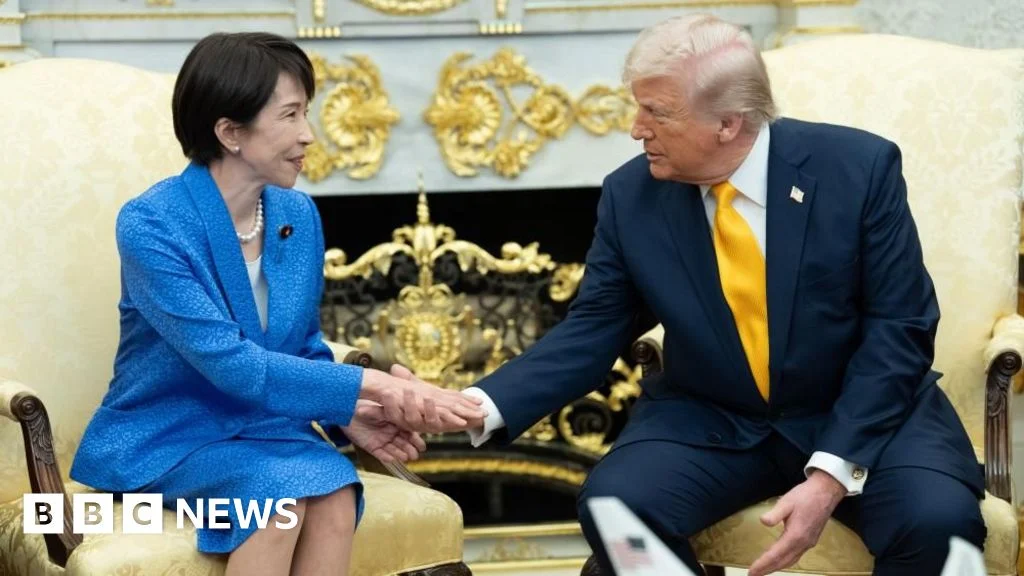
In a highly anticipated and ultimately "very difficult" encounter, Japanese Prime Minister Sanae Takaichi convened with former U.S. President Donald Trump in the Oval Office, grappling with intense pressure from the American leader to bolster security efforts in the war-stricken Strait of Hormuz. The meeting, initially envisioned as a celebration of a "golden age" in bilateral ties, quickly transformed into a complex negotiation shadowed by geopolitical uncertainties, a contentious historical remark, and the delicate balance of Japan’s pacifist constitution.
Prime Minister Takaichi, arriving in Washington just days after Trump’s public appeals for allied assistance in the vital shipping lane went largely unanswered, had publicly acknowledged the challenging nature of her mission. Hours before her departure, she addressed the Japanese parliament, stating her unwavering commitment to "do everything to maximise [Japan’s] national interest." This assertion underscored the immense domestic and international pressures on her administration to navigate a path that satisfied American demands without compromising Japan’s deeply ingrained post-war principles or exacerbating regional tensions.
The Shifting Sands of the Strait of Hormuz
The primary point of contention revolved around the Strait of Hormuz, a critical maritime chokepoint through which approximately one-fifth of the world’s total oil supply and a significant portion of liquefied natural gas (LNG) passes daily. Its strategic importance for global energy markets, particularly for energy-hungry Asian economies like Japan, is undeniable. Any disruption in this narrow passage, located between Oman and Iran, sends immediate ripples through the global economy, impacting oil prices and supply chains.
Trump’s engagement on the issue had been characteristically unpredictable. Earlier in the week, he took to his Truth Social platform, directly appealing to nations heavily reliant on Middle Eastern energy. He specifically pointed to Japan and other Asian economies, arguing that their dependence on fuel from the region—compared to the less than 1% of U.S. oil derived from the Strait—necessitated their active involvement in securing it. "We want them to come and help us," he wrote, framing the issue as one of equitable burden-sharing. However, following a lukewarm international response, Trump abruptly reversed course in a subsequent post, declaring that the United States did "NOT NEED THE HELP OF ANYONE!". This swift retraction and the preceding public demand created an atmosphere of uncertainty and frustration among allies, questioning the coherence and consistency of U.S. foreign policy.
Despite Trump’s fluctuating rhetoric, the underlying expectation for Japan to "step up" remained a central theme during the Oval Office meeting. While Trump did not explicitly detail what form this assistance should take, he had previously urged U.S. allies to deploy naval forces to the Persian Gulf and the Strait of Hormuz. For Japan, a direct military deployment presents a formidable challenge. Its post-World War Two pacifist constitution, specifically Article 9, famously renounces war as a sovereign right and prohibits the country from maintaining land, sea, and air forces with war potential. This constitutional constraint allows for military action only in cases of self-defense, a provision that has been reinterpreted over decades but still severely limits offensive capabilities or participation in international military interventions far from its shores.
Adding to Takaichi’s predicament, public sentiment in Japan remains overwhelmingly against foreign military entanglement. A recent poll by The Asahi Shimbun newspaper revealed a striking 82% disapproval rate for the war, highlighting the profound domestic resistance to any move that could be perceived as a departure from the nation’s pacifist principles. Analysts had warned prior to the meeting that a flat refusal from Takaichi would be diplomatically perilous, given Japan’s almost total reliance on Strait of Hormuz oil, yet outright military compliance would be politically suicidal.
In a diplomatic maneuver reflecting this delicate balance, Japan, alongside the UK, France, Germany, Italy, and the Netherlands, had issued a joint statement earlier on Thursday. The statement expressed a shared "readiness to contribute appropriate efforts to ensure safe passage" through the strait. This carefully worded commitment, while avoiding specifics on military deployment, signaled a willingness to engage through non-kinetic means such as intelligence sharing, logistical support, or enhanced surveillance, allowing Japan to acknowledge the gravity of the situation without violating its constitutional tenets. Seated with Takaichi, Trump later expressed his belief that Japan "is stepping up to the plate," though he, too, refrained from offering specifics on the nature of this commitment. Takaichi, for her part, acknowledged a "very severe security environment" and a "huge hit" to the global economy, expressing her faith in Trump’s ability to resolve global conflicts: "I firmly believe that it is only you, Donald, who can achieve peace across the world," she stated through an interpreter, adding, "I am ready to reach out to many of the partners in the international community to achieve our objective together." This blend of deference and a commitment to multilateral engagement highlighted Japan’s complex diplomatic strategy.
The Echoes of Pearl Harbor: A Diplomatic Faux Pas
The meeting took an unexpected and highly controversial turn when, in response to a question about why U.S. allies were not informed about a particular operation ahead of time, Trump invoked Japan’s 1941 attack on the United States. "We didn’t tell anybody about it because we wanted surprise. Who knows better about surprise than Japan? Why didn’t you tell me about Pearl Harbor, OK?" Trump stated, referring to Japan’s devastating surprise attack on U.S. naval facilities in Hawaii.
This remark, widely seen as historically insensitive and deeply undiplomatic, immediately sent shockwaves through political and media circles. For a nation that has spent decades rebuilding its international image as a peaceful and democratic ally, and one that hosts significant U.S. military bases as a cornerstone of regional security, such a comment from a former U.S. president was a stark reminder of the unique challenges in managing the alliance under Trump’s unconventional leadership. The comment risked undermining the goodwill and strategic trust painstakingly built over the past 70 years, particularly as Japan grapples with increasingly assertive regional powers.
From "Golden Age" to Geopolitical Crossroads: The Evolving US-Japan Alliance
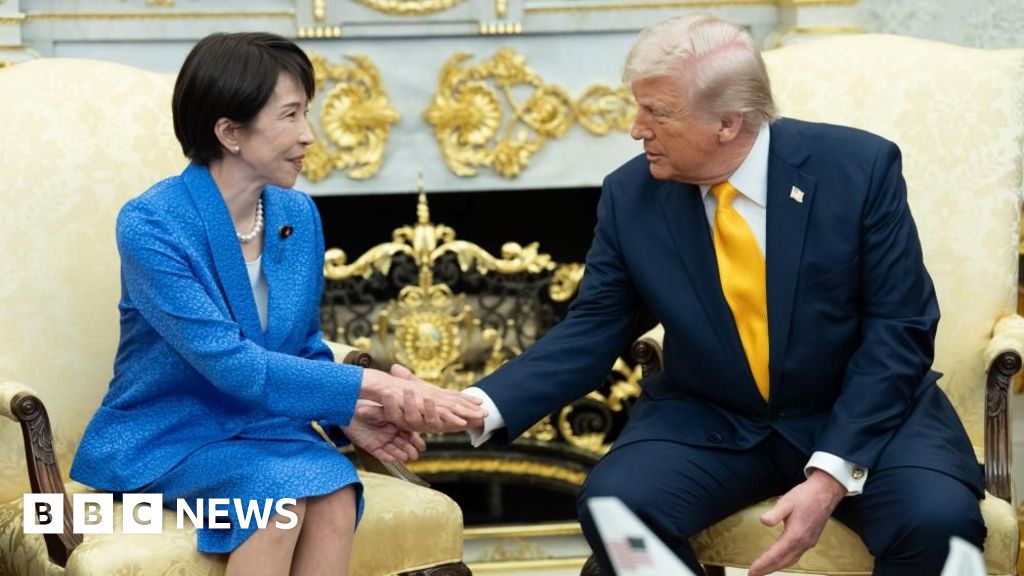
The current tensions stood in stark contrast to the initial optimism that surrounded Takaichi’s rise to power and her first interactions with Trump. Her visit was originally scheduled back in October, just a week after she took office, a period when Tokyo had "rolled out the red carpet" for Trump. The two leaders had then exchanged compliments, heralding what many hoped would be a "golden age" in bilateral ties. Emma Chanlett-Avery, director for political and security affairs at the Asia Society Policy Institute, noted that just weeks prior, the meeting appeared destined for success, with Takaichi "fresh off a dominant election victory and with a new round of investment projects in the US." This initial warmth and shared enthusiasm for strengthening the alliance were meant to lay the groundwork for addressing common challenges, particularly Japan’s concerns about Chinese aggression. However, as Chanlett-Avery observed, recent events, specifically the escalating tensions in the Strait of Hormuz and Trump’s shifting demands, had "complicated things."
Beyond the immediate crisis in the Strait, the leaders were also expected to delve into broader strategic and economic issues vital to the alliance’s long-term health. Security cooperation remains a cornerstone of the relationship, particularly in the face of North Korea’s continued missile development and China’s growing military might. Japanese media reports ahead of the meeting indicated discussions about Japan’s potential participation in the U.S.’s "Golden Dome" missile defense system. This ambitious project, earmarked with an initial sum of $25 billion (£18.7 billion), draws inspiration from Israel’s highly effective Iron Dome system, designed to intercept incoming rockets and missiles. Such a system would significantly enhance Japan’s defensive capabilities, aligning with its self-defense posture while integrating further into U.S.-led regional security architecture.
Navigating the Dragon: Japan’s China Strategy
Another critical agenda item was China, which Sheila Smith of the U.S.-based Council on Foreign Relations aptly described as Japan’s "biggest strategic challenge." Relations between Beijing and Tokyo have seen a significant downturn since November, following Takaichi’s controversial remarks suggesting Japan would activate its self-defense force in the event of an attack on Taiwan. China views self-governed Taiwan as an inseparable part of its territory, reserving the right to "reunify" it by force if necessary. Takaichi’s statement, made without subsequent apology or retraction, signaled a more assertive stance from Tokyo on regional security, directly challenging Beijing’s red lines.
During her meeting with Trump, however, Takaichi adopted a more conciliatory tone regarding China. She reiterated that "Japan has been consistently open to dialogue with China" and expressed hope that the US-China relationship would be "conducive for regional security and also ensuring a global supply chain for the world." This nuanced position reflects Japan’s complex relationship with its giant neighbor: while recognizing China as a primary security concern, Tokyo also acknowledges Beijing’s indispensable role in regional trade and economic stability. Maintaining open lines of communication and encouraging a stable U.S.-China relationship is crucial for Japan’s own economic prosperity and regional peace.
Economic Imperatives: Trade and Domestic Challenges
Trade, a perennial topic in U.S.-Japan relations, was also high on the agenda. Takaichi expressed her desire to discuss critical sectors such as energy and rare earth minerals. For Japan, securing a stable economic partnership with the U.S. is paramount, especially given its current domestic economic struggles. The nation is grappling with rising inflation, a weakened yen against major currencies, and sluggish consumer spending, all of which threaten its economic stability. A robust and predictable trade relationship with the world’s largest economy offers a crucial buffer against these internal and external economic headwinds.
Broader Implications and the Path Forward
The meeting between Prime Minister Takaichi and Donald Trump underscored the multifaceted challenges confronting the U.S.-Japan alliance in a volatile geopolitical landscape. Trump’s "America First" approach, coupled with his unpredictable communication style and willingness to challenge diplomatic norms, creates an environment of constant adjustment for traditional allies. For Japan, the imperative to balance its economic dependence on global trade routes, its constitutional constraints on military action, and its strategic alliance with the U.S. against rising regional threats is a delicate act.
The Strait of Hormuz crisis highlights the vulnerability of global energy supplies and the complex interplay between economic interests and security commitments. Japan’s "appropriate efforts" to ensure safe passage will likely focus on non-military contributions, reflecting its commitment to international security while adhering to its constitutional principles. The controversial Pearl Harbor remark, while a diplomatic misstep, also serves as a stark reminder of the historical foundations and ongoing complexities of the alliance, which must constantly adapt to new realities without forgetting its past.
As both leaders navigate their respective domestic political landscapes and an increasingly multipolar world, the future of the U.S.-Japan alliance will hinge on their ability to find common ground, manage expectations, and maintain a shared strategic vision despite differences in approach and rhetoric. The "very difficult" conversation between Takaichi and Trump may not have resolved all outstanding issues, but it certainly set the stage for continued, complex diplomatic engagement in an era defined by geopolitical fluidity and economic uncertainty.