

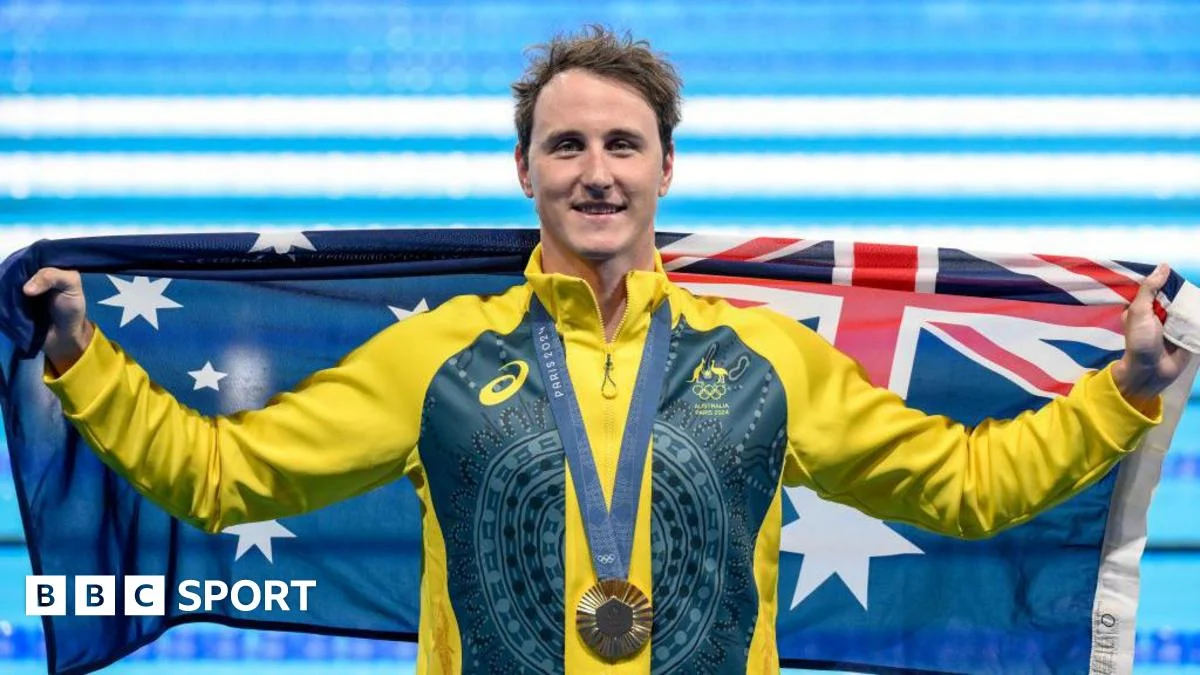
Australian swimmer Cameron McEvoy has expressed disbelief and declared it "crazy" that he has not received any financial reward for shattering the men’s 50-meter freestyle world record at the recent China Open. The 31-year-old’s historic achievement in Shenzhen saw him eclipse the 20.91-second mark set by Brazilian Cesar Cielo 17 years ago, a feat accomplished during swimming’s controversial "supersuit" era. McEvoy’s performance, achieved through a "harder pathway" without the aid of advanced technology or performance-enhancing substances, stands in stark contrast to the $1 million (approximately £745,000) bonus promised to swimmers who break the 50m freestyle world record at the upcoming Enhanced Games.
The Unprecedented Leap and the Zero-Dollar Reward
McEvoy’s blistering time of 20.91 seconds at the China Open, held last week in Shenzhen, has rewritten the record books. This remarkable swim not only dethroned a long-standing mark but also cemented McEvoy’s place in swimming history. However, the elation of this monumental achievement has been tempered by the absence of any financial recognition from the event’s organizers.
"It’s crazy to think that to get a world record without a suit and without any performance-enhancing drugs, as a clean athlete, the bonus is zero dollars," McEvoy stated, highlighting the perceived disparity in the sporting landscape. His sentiments underscore a broader debate about athlete compensation and the value placed on pure athletic achievement versus technologically enhanced or controversially facilitated performances.
A Tale of Two Games: Enhanced Games vs. Traditional Aquatics
The juxtaposition of McEvoy’s achievement with the incentives offered by the Enhanced Games is particularly striking. The inaugural Enhanced Games, scheduled for May in Las Vegas, have generated significant controversy by permitting athletes to use banned performance-enhancing drugs under strict medical supervision. This radical approach aims to push human athletic capabilities to unprecedented levels, offering substantial financial rewards for such breakthroughs.
The $1 million bonus for a 50m freestyle world record at the Enhanced Games is not the sole incentive. Athletes also stand to gain a $250,000 prize for winning the event, effectively creating a lucrative package for record-breaking performances. McEvoy’s reflection on this stark contrast is poignant: "You get not only a $1 million bonus [at the Enhanced Games], but there’s also a $250,000 prize money for first place, which you’d get on top of the world record. And the zero-dollar pathway is the much harder pathway to do something like this." He further articulated his bewilderment, stating, "So it’s pretty ludicrous… I’m dumbfounded in terms of the stark contrast that exists currently in the landscape of sport and swimming."
World Aquatics’ Reward Structure: A Different Paradigm
World Aquatics, the international governing body for swimming, does have a system for rewarding athletes who set world records. However, these rewards are contingent on the events being sanctioned by the organization. The China Open, not being an event organized by World Aquatics, therefore did not qualify for the official bonus payouts.
Under World Aquatics’ current structure, athletes receive:
- $30,000 (approximately £22,200) for world records set at World Aquatics Championships.
- $25,000 (approximately £18,600) for world records set at Swimming World Championships.
- $10,000 (approximately £7,500) for world records achieved at World Cup meets.
These figures, while significant, are dwarfed by the Enhanced Games’ prize money and highlight the different priorities and funding models at play within the world of elite swimming. McEvoy’s achievement, while celebrated by many within the traditional sporting community, falls outside the direct financial incentive framework of the sport’s governing body.
Historical Context: The Shadow of the Supersuit Era
Cesar Cielo’s previous world record of 20.91 seconds, set in 2009, was a product of a period often referred to as the "supersuit era." During this time, swimmers wore highly advanced, full-body polyurethane suits designed to reduce drag and enhance buoyancy, leading to a cascade of world records across various disciplines. These suits were later banned by FINA (now World Aquatics) in 2010, leading to a reset of many records and a return to more traditional swimwear.
McEvoy’s swim represents a triumph over the limitations of current technology and a testament to pure athletic prowess. He achieved his record without the technological advantages that characterized Cielo’s era. This distinction is crucial in understanding McEvoy’s perspective on the "harder pathway" he navigated.
The Unofficial Record and the $1 Million Claim
Adding another layer to the narrative is the claim made by Enhanced Games swimmer Kristian Gkolomeev. Last year, Gkolomeev reportedly swam a 50m freestyle time of 20.89 seconds at a trial in the United States. While this time was faster than McEvoy’s official world record, it was considered unofficial by traditional swimming federations. Crucially, Gkolomeev was reportedly awarded $1 million for this performance, further amplifying the financial disparities and the controversial nature of the Enhanced Games. McEvoy’s direct comparison highlights the perceived injustice: "McEvoy’s time was faster than the unofficial 20.89 that Enhanced Games swimmer Kristian Gkolomeev claimed last year at a trial in the United States – for which he received $1m."
Beyond the Pool: Age, Sponsorship, and Future Prospects
McEvoy’s reflections extend beyond the immediate financial implications of his world record. He revealed that he had been denied commercial sponsorship opportunities, partly due to his age. At 31, he is considered by some in the sponsorship landscape as being past his prime for sprinting disciplines. His record-breaking performance serves as a powerful rebuttal to this notion, demonstrating that sprinters in their 30s can still achieve peak performance.
"McEvoy added that he had been denied a commercial sponsorship because of his age and said his time proved swimmers in their 30s could sprint," the original report noted. This aspect of his journey adds a layer of resilience and determination, as he battled not only the clock but also perceptions within the sports marketing industry.
A Legacy in Shenzhen: The Starting Block’s Future
While financial rewards may be absent, McEvoy’s historic swim will not be forgotten. His starting block from the China Open race is slated to be preserved in a sports museum in Shenzhen, serving as a tangible reminder of his remarkable achievement. This honors his accomplishment in a different, perhaps more enduring, way.
Broader Implications for the Sport of Swimming
Cameron McEvoy’s situation brings to the forefront critical questions about the future of elite swimming and the evolving definition of athletic excellence. The existence of organizations like the Enhanced Games, with their radically different approach to performance enhancement and reward, presents a significant challenge to the established order of sports governance.
Analysis of Implications:
- Athlete Compensation Models: The stark contrast in financial rewards raises questions about how elite athletes should be compensated for breaking world records. Should rewards be solely tied to traditional, drug-free performances, or should they acknowledge achievements facilitated by scientific advancements, even if controversial?
- The Integrity of Sport: The Enhanced Games directly challenge the long-held principles of fair play and the prohibition of performance-enhancing drugs. This raises concerns about the long-term integrity and public perception of traditional sports.
- Athlete Choice and Autonomy: For athletes like McEvoy, the situation presents a dilemma. They can pursue the "harder pathway" of clean sport, which may offer less financial reward but aligns with their ethical principles, or they could potentially engage with systems that offer greater financial incentives but compromise those principles.
- Technological Advancements: The historical context of the supersuit era and the current debates around technological aids in sports continue to shape the landscape. McEvoy’s record, achieved in standard swimwear, emphasizes the importance of human physiology and training.
- Media and Public Perception: The narrative surrounding McEvoy’s record highlights how the media and public react to different types of athletic achievements. The controversy surrounding the Enhanced Games, coupled with McEvoy’s clean record, is likely to fuel ongoing discussions.
The debate ignited by Cameron McEvoy’s record-breaking swim is far from over. It serves as a potent reminder that the pursuit of athletic excellence exists within a complex and rapidly changing ecosystem, where financial incentives, ethical considerations, and the very definition of human performance are constantly being re-evaluated. His "crazy" observation is a sentiment likely shared by many clean athletes striving for greatness in a world where the lines between natural ability and augmented performance are becoming increasingly blurred.