


A volatile wave of extremist Jewish settler attacks has swept across Palestinian villages in the occupied West Bank, leaving a trail of destruction including burnt homes, vehicles, and vital agricultural fields. The coordinated assaults, which began late Saturday, March 22, 2026, were reportedly a direct response to the death of an 18-year-old settler, Yehuda Sherman, earlier that day. This latest surge in violence exacerbates an already fraught humanitarian and security situation in the territory, drawing sharp condemnations from Palestinian authorities and reigniting calls for international intervention to protect civilian populations and uphold international law.
Unfolding Chaos: A Night of Arson and Retribution
The immediate catalyst for the widespread unrest was the death of Yehuda Sherman, a young Israeli settler, on Saturday. Initial reports indicate Sherman was fatally struck by a vehicle driven by a Palestinian while riding his quad bike. Israeli police have initiated an investigation to determine whether the incident was deliberate or accidental, a crucial distinction that nonetheless failed to quell the burgeoning anger within settler communities. Almost immediately following the news of Sherman’s death, calls for a "revenge campaign" began circulating rapidly through WhatsApp groups widely used by settlers, as reported by Haaretz newspaper. These digital directives quickly translated into tangible, destructive actions on the ground.
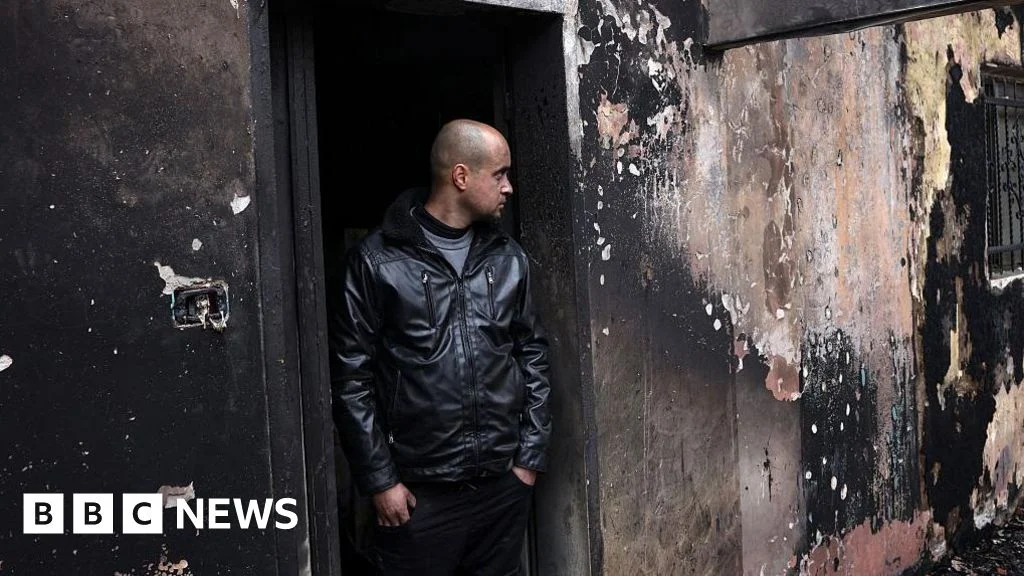
By Saturday night, the West Bank plunged into a state of heightened tension and fear. Israeli media, citing a defense official, reported more than 20 separate settler attacks overnight, targeting numerous Palestinian communities. Among the villages hardest hit were Jalud, Qaryut, al-Funduqmiya, and Silat al-Dhah. Eyewitness accounts and unverified footage shared online depicted scenes of utter chaos. In Jalud, specifically, images appeared to show upwards of 90 individuals, many clad in black and masked, storming the village. The ensuing rampage resulted in multiple vehicles being torched, buildings sustaining smashed windows, and the chilling sound of sirens piercing the night as emergency services struggled to reach the affected areas. A stark visual testament to the motive behind the attacks was captured in a photograph showing the words "Avenge Yehuda" spray-painted onto a damaged building, leaving no ambiguity about the settlers’ intent.
The Palestinian Red Crescent Society reported that at least three Palestinians sustained head wounds and required hospitalization after attempting to confront the attackers, highlighting the inherent danger faced by residents defending their homes and property. While the focus remained on the Palestinian victims, Israeli media also noted unconfirmed reports of some settlers sustaining injuries during the confrontations. Messages from settler WhatsApp groups, intercepted and reported, further underscored the vengeful sentiment, with one reading, "Jews won’t remain silent over spilled Jewish blood," and another demanding, "We demand vengeance and expulsion of the enemy."
Official Reactions and the Funeral of Yehuda Sherman
The Palestinian Ministry of Foreign Affairs swiftly condemned the assaults, issuing a statement decrying the "burning of homes and property, terrorising and killing of civilians, and the targeting of vital roads, junctions, and main streets during Eid al-Fitr." The timing of the attacks, coinciding with the significant Muslim holiday of Eid al-Fitr, added another layer of grievance, amplifying the sense of disrespect and aggression directed towards Palestinian communities during a period traditionally marked by peace and celebration.
In response to the escalating violence, the Israel Defense Forces (IDF) issued a statement confirming the deployment of its troops and border police units to several Palestinian villages on Saturday night. The IDF acknowledged receiving "reports of Israeli civilians committing acts of arson against structures and property, as well as engaging in disturbances in the area." However, the effectiveness of these deployments in preventing or containing the widespread attacks remains a point of contention, with critics arguing that Israeli security forces often fail to adequately protect Palestinians from settler aggression.
On Sunday afternoon, the somber atmosphere shifted to the funeral of Yehuda Sherman. Israeli media reported a significant turnout, with over 500 individuals attending to pay their respects. Notably, among the mourners was Israel’s far-right Finance Minister, Bezalel Smotrich, whose presence underscored the political sensitivity and high-level attention given to the incident. Smotrich, a prominent figure known for his strong support of the settlement movement and controversial statements regarding Palestinian rights, often draws criticism from the international community for his perceived inflammatory rhetoric. His attendance at the funeral, in the context of the ongoing revenge attacks, was interpreted by many as a tacit endorsement or at least a lack of strong condemnation for the retaliatory actions.
As Sunday evening progressed, tensions remained dangerously high. Jewish settlers continued to block roads in protest across the occupied West Bank, further disrupting Palestinian life and movement. Unconfirmed reports emerged from the local news agency WAFA, suggesting that settler groups had once again begun to gather outside some Palestinian villages, with one report detailing the burning of a car wash north-west of Nablus, indicating a sustained and potentially expanding campaign of aggression.
A Broader Context of Escalation: The Shadow of Regional Tensions
This recent wave of settler violence is not an isolated incident but rather part of a disturbing and accelerating trend observed over recent months and years. The United Nations (UN) has consistently documented a significant surge in settler violence, particularly since what the original report refers to as the "US and Israel attacked Iran" on February 28, a period which seems to denote a general uptick in regional tensions and localized conflict. This broader context is crucial for understanding the current events. Since March 1 alone, six Palestinians have been killed by settlers, according to UN figures. Looking at the wider picture for the current year, seven Palestinians have been killed by Israeli settlers and 18 by Israeli forces, with 15 of these fatalities occurring since the onset of the "Iran war" context. These statistics paint a grim picture of escalating lethality for Palestinians in the West Bank.
The historical backdrop of the Israeli-Palestinian conflict in the West Bank is inextricably linked to the issue of Israeli settlements. Israel occupied the West Bank and East Jerusalem during the 1967 Middle East war. Since then, it has systematically built approximately 160 settlements, housing an estimated 700,000 Jewish settlers. These settlements are considered illegal under international law, a position upheld by the vast majority of the international community. Article 49 of the Fourth Geneva Convention explicitly prohibits an occupying power from transferring parts of its own civilian population into the territory it occupies. Despite this, the settlements have expanded dramatically, creating a complex and often violent reality where an estimated 3.3 million Palestinians live alongside these growing settler communities.
The presence and expansion of settlements are a constant source of friction, land confiscation, and human rights abuses, as reported by numerous human rights organizations. Settler violence often includes harassment, destruction of property, intimidation, and physical assaults, frequently occurring with impunity or insufficient intervention from Israeli authorities. The Israeli human rights group B’Tselem, for instance, has documented countless incidents where Israeli soldiers either stood by idly or actively supported settlers during attacks on Palestinians. This perceived lack of accountability further emboldens extremist elements within the settler movement.
International Condemnation and Legal Imperatives
The international community has repeatedly expressed alarm over the escalating violence. Earlier this month, both the European Union (EU) and the United Kingdom (UK) issued strong demands for Israel to halt the surge in settler violence against Palestinians. These statements reflect a growing frustration among global powers with Israel’s perceived failure to curb settler aggression and enforce law and order within the occupied territories. Such diplomatic pressure underscores the international consensus that the settlements are illegal and that their associated violence undermines the prospects for a two-state solution.
Under international humanitarian law, as the occupying power, Israel has a responsibility to protect the Palestinian civilian population in the West Bank. This includes preventing attacks by its own citizens, investigating such attacks thoroughly, and prosecuting those responsible. Critics argue that Israel has largely failed in this duty, leading to a climate of lawlessness and fear for Palestinians. The consistent condemnations from international bodies and individual states serve as a reminder of these legal obligations and the broader implications for regional stability and human rights.
Humanitarian Toll and Future Implications
The human cost of this escalating violence is profound. For Palestinian communities, these attacks mean the destruction of homes, livelihoods, and a pervasive sense of insecurity. Agricultural fields, often the sole source of income for many families, being set ablaze can have devastating long-term economic consequences. The trauma inflicted by masked individuals storming villages, burning property, and assaulting residents leaves deep psychological scars, particularly on children. The disruption of daily life, compounded by movement restrictions and the constant threat of violence, severely impacts access to education, healthcare, and essential services. The coincidence with Eid al-Fitr further amplified the pain, transforming a period of celebration into one of mourning and fear.
Politically, the unchecked settler violence further erodes any remaining trust between Israelis and Palestinians and complicates efforts towards a peaceful resolution. The presence of high-ranking Israeli officials at the funeral of Yehuda Sherman, coupled with the perceived inaction or insufficient response from security forces during the revenge attacks, sends a clear message of tacit approval or at least a lack of serious commitment to reining in extremist settlers. This stance alienates international allies and fuels accusations of double standards in the application of justice.
The trajectory of events suggests a dangerous cycle of violence and retribution that threatens to further destabilize an already volatile region. Without firm action from Israeli authorities to dismantle extremist settler groups, enforce accountability, and protect Palestinian civilians, the cycle is likely to intensify. The international community’s repeated calls for restraint and adherence to international law highlight the urgent need for a shift in policy and practice to prevent a full-scale humanitarian and security crisis in the occupied West Bank. The events of Saturday, March 22, 2026, stand as a stark reminder of the fragility of peace and the devastating consequences of unchecked extremism.