


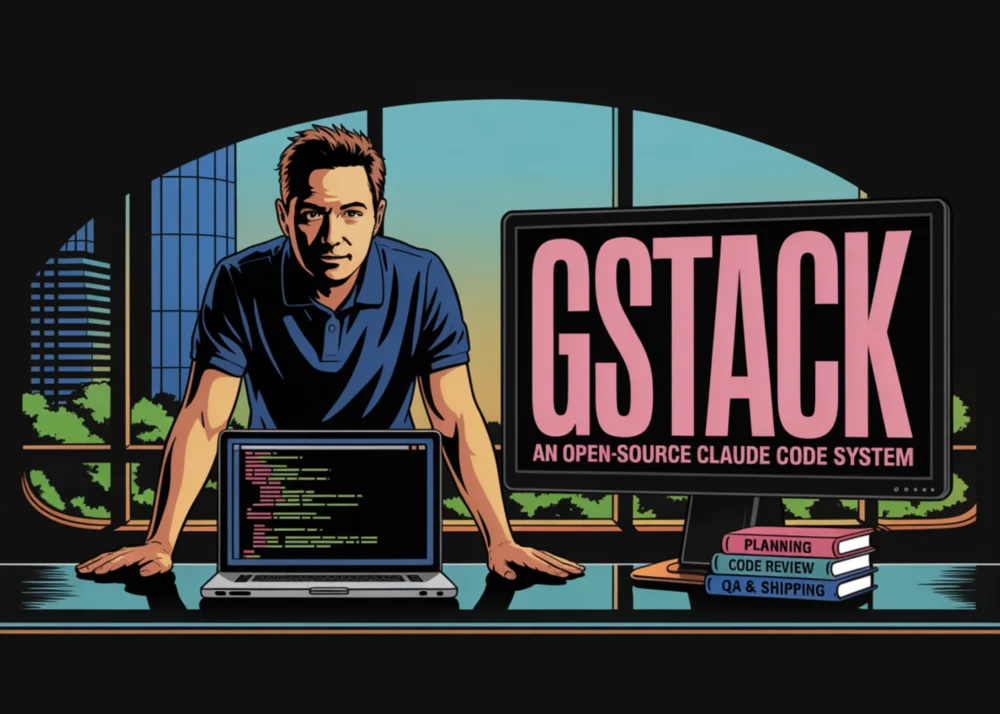
The landscape of artificial intelligence in software development has shifted rapidly from simple code completion to sophisticated agentic workflows capable of managing entire repositories. At the forefront of this evolution is gstack, a new open-source toolkit developed by Garry Tan, President and CEO of Y Combinator. This toolkit is designed to enhance the utility of Claude Code—Anthropic’s command-line interface for its Claude model—by introducing a highly structured, opinionated framework for software delivery. By segregating the development process into eight distinct operating modes, gstack aims to address the common pitfalls of AI-assisted coding, such as lack of context, inconsistent quality assurance, and the "cold start" latency issues associated with browser-based automation.
The core philosophy behind gstack is the imposition of explicit role boundaries. While standard AI coding tools often operate in a generalist capacity, gstack forces the AI to adopt specific personas and technical constraints depending on the task at hand. This methodology mirrors the traditional Software Development Life Cycle (SDLC) used in high-performing engineering teams, where product planning, architectural review, and quality assurance are treated as separate, rigorous disciplines rather than a single continuous stream of code generation.
The Evolution of Agentic Coding Workflows
The release of gstack comes at a pivotal moment in the AI industry. Following the success of GitHub Copilot and the rise of AI-native IDEs like Cursor and Windsurf, the industry has begun to move toward "agentic" systems—AI that does not just suggest code but executes tasks across the terminal, the browser, and the version control system. Anthropic recently entered this space with Claude Code, a tool that allows the model to interact directly with a user’s local environment.
However, as many early adopters discovered, providing an AI with full access to a terminal can lead to unstructured workflows where the agent may attempt to fix bugs without a plan or skip vital testing phases. Garry Tan’s gstack provides the "rails" for this power. By organizing common software delivery tasks into specific "skills," the toolkit ensures that the AI remains focused on the specific requirements of the current phase of development. This structured approach is intended to make AI-assisted coding more reliable, reproducible, and ready for production environments.
Detailed Analysis of the Eight Core Commands
The functionality of gstack is encapsulated in eight primary commands, each designed to trigger a specific set of prompts and technical behaviors within Claude Code. These commands represent a comprehensive end-to-end workflow for modern software engineering.
- /plan-ceo-review: This command initiates a high-level product planning pass. Unlike a standard technical prompt, it instructs the AI to evaluate the proposed changes from a product and business logic perspective, ensuring that the feature aligns with the broader goals of the project before a single line of code is written.
- /plan-eng-review: Following the product pass, this command focuses on the technical architecture. It forces the agent to analyze data flows, potential failure modes, and the necessary test coverage. This stage is critical for preventing technical debt and ensuring that the implementation is robust.
- /review: Positioned as a pre-deployment safeguard, this mode focuses on production risk. The AI acts as a senior reviewer, looking for security vulnerabilities, performance bottlenecks, and adherence to style guides.
- /ship: This command automates the "last mile" of development. It prepares a ready branch, synchronizes it with the main codebase, runs the defined test suites, and opens a Pull Request (PR). This reduces the manual overhead of context switching between the editor and the git CLI.
- /browse: One of the most technically significant features, this command grants the agent access to a persistent browser. This allows the AI to interact with the application’s UI, verify changes visually, and debug front-end issues in real-time.
- /qa: This mode is dedicated to systematic testing. By analyzing the branch diff, the agent identifies exactly which routes and flows have been affected by the code changes and performs targeted testing on those specific areas.
- /setup-browser-cookies: This utility solves a major friction point in AI agents: authentication. It allows the toolkit to import session cookies from a user’s local browser into the headless Chromium instance, enabling the AI to bypass login screens and access authenticated states.
- /retro: Finally, the retrospective command is used to analyze the development process itself, identifying what went well and where the agent or the developer could improve in future sprints.
Technical Architecture: The Persistent Browser Daemon
While the "skills" or prompts provide the logic, the technical backbone of gstack is its persistent browser subsystem. Traditional AI agents often launch a new browser instance for every task, a process known as a "cold start." In a standard environment, this can add three to five seconds of latency per tool call. Over the course of a complex debugging session involving dozens of calls, this latency becomes a significant barrier to productivity.
Gstack solves this by running a long-lived headless Chromium daemon. The agent communicates with this daemon over a localhost HTTP connection. Once the initial startup is complete, subsequent interactions—such as clicking buttons, taking screenshots, or inspecting the DOM—occur in approximately 100 to 200 milliseconds. This near-instantaneous response time allows for a more fluid interaction between the AI and the web application.
Furthermore, the persistence of the browser means that state is retained. If an agent logs into a dashboard during the /browse phase, it remains logged in when the user later triggers a /qa pass. The inclusion of an automatic shutdown feature, which kills the server after 30 minutes of idle time, ensures that system resources are managed efficiently without manual intervention.
Integration with Bun and Modern Runtime Choices
The choice of Bun as the primary runtime for gstack highlights a shift toward high-performance, developer-friendly tooling. The project’s architecture document cites four specific reasons for selecting Bun over the more traditional Node.js environment:
- Native TypeScript Execution: Bun executes TypeScript files directly without a separate compilation step, simplifying the development and contribution process.
- Compiled Binaries: Bun allows gstack to be distributed as a standalone binary, which is essential for a tool intended to live within the
~/.claude/skills/directory where users may not want to manage a complex Node.js toolchain. - Built-in SQLite Support: Gstack needs to read Chromium’s SQLite cookie database to handle session persistence. Bun’s native SQLite drivers eliminate the need for heavy external dependencies that often cause installation issues across different operating systems.
- High-Performance HTTP Server: Using
Bun.serve(), the toolkit can manage the communication between the Claude Code agent and the Chromium daemon with minimal overhead.
These architectural decisions reflect a focus on "developer experience" (DX), ensuring that the tool is not only powerful but also easy to install and maintain across macOS and Linux environments.
Industry Implications and the Future of the SDLC
The introduction of gstack by a figure as influential as Garry Tan suggests a broader trend in the tech industry: the formalization of AI’s role in the workforce. By structuring the AI into roles like "CEO review" and "QA," gstack is effectively creating a digital version of a high-functioning engineering team.
For startups and small teams, this could drastically increase velocity. A single developer using gstack can delegate the tedious aspects of the SDLC—such as writing regression tests, checking for style consistency, and managing PRs—to the AI, while maintaining high-level oversight. This "human-in-the-loop" model is widely considered the most effective way to deploy AI in professional settings, as it leverages the AI’s speed while relying on human judgment for final approval.
Furthermore, the emphasis on QA and browser-driven development addresses one of the biggest criticisms of AI-generated code: that it "looks correct" but fails in execution. By tying source code changes directly to application behavior via the /qa and /browse commands, gstack provides a mechanism for the AI to verify its own work in a real-world environment.
Installation, Requirements, and Community Adoption
As of version 0.3.3, gstack is available as an open-source project on GitHub. It requires Claude Code, Git, and Bun v1.0 or higher. The installation process is streamlined; users clone the repository into their local Claude skills directory, run a setup script, and the commands become immediately available within the Claude Code CLI.
The project also supports repository-local installations. This allows engineering teams to check gstack configurations into their own version control, ensuring that every developer on a project has access to the same "opinionated" workflow. This standardization is crucial for maintaining quality across large, distributed teams.
In conclusion, gstack represents a significant step forward in making AI coding agents practical for professional use. By combining the conversational power of Anthropic’s Claude with a high-performance browser daemon and a structured engineering methodology, Garry Tan has provided a blueprint for how AI will likely be integrated into the software development process in the years to come. As the toolkit continues to evolve, it will likely serve as a benchmark for how other AI agents should handle complex, multi-step engineering tasks.