

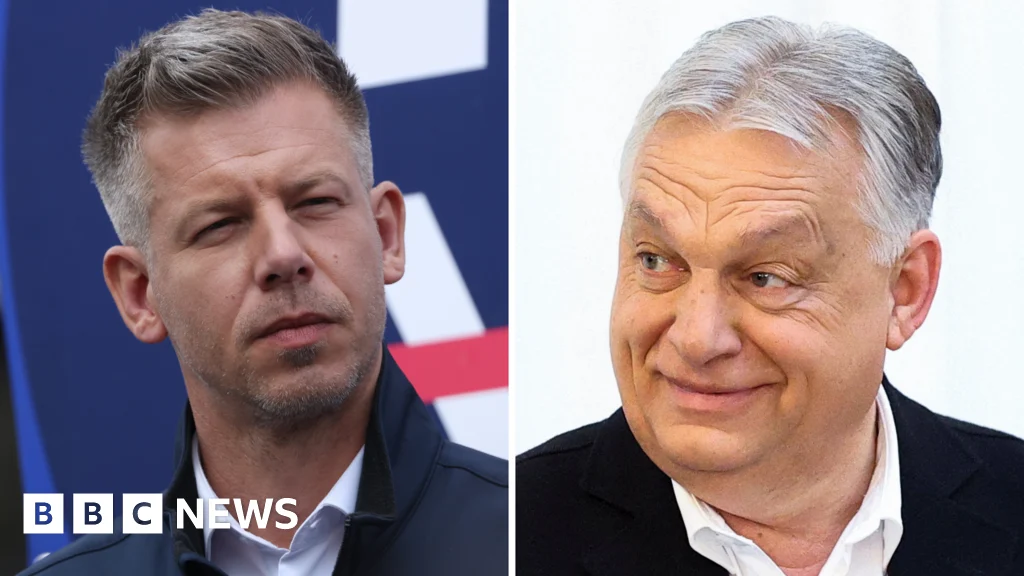
BUDAPEST, Hungary – Hungarians are casting their ballots in unprecedented numbers today, in a general election that could dramatically reshape the nation’s political landscape, potentially unseating Prime Minister Viktor Orbán after 16 years in power. The outcome carries profound implications not only for Hungary’s domestic future but also for its complex relationships within the European Union, NATO, and with global powers like the United States and Russia.
The election sees Orbán, leader of the conservative Fidesz party, challenged by Péter Magyar, a former Fidesz insider who has rapidly risen to prominence with his newly formed grassroots party, Tisza (Respect and Freedom). With polls consistently indicating a tight race, the high voter engagement suggests a highly mobilized electorate eager for change or determined to maintain the status quo.
A Nation at a Crossroads: Orbán’s Legacy and Magyar’s Challenge
Viktor Orbán, 60, has been a dominant figure in Hungarian politics since first becoming Prime Minister in 1998, returning to power for his second stint in 2010. His tenure has been characterized by a self-proclaimed commitment to "illiberal democracy," a strong emphasis on national sovereignty, conservative social policies, and a confrontational stance towards Brussels on issues ranging from migration to rule of law. Under his leadership, Fidesz has systematically reformed the constitution, judiciary, and media landscape, leading the European Parliament to describe Hungary as a "hybrid regime of electoral autocracy."
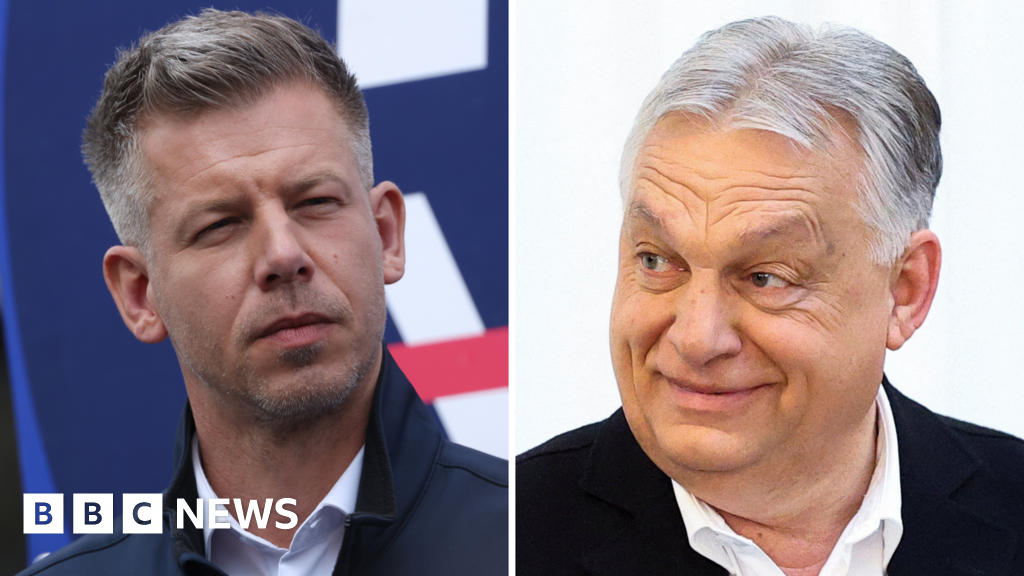
Orbán’s critics, both domestically and internationally, point to concerns over democratic backsliding, state capture, and the erosion of independent institutions. His government has also cultivated close ties with Russia and China, often diverging from the foreign policy consensus of the EU and NATO, notably by delaying crucial aid packages to Ukraine and maintaining diplomatic channels with Moscow despite the ongoing conflict.
Péter Magyar, 43, emerged as an unexpected and formidable challenger following a high-profile scandal involving a presidential pardon earlier this year, which implicated members of the Fidesz establishment. A lawyer and former diplomat, Magyar was previously married to a former Orbán minister and held various state-linked positions. His public break from Fidesz, fueled by accusations of widespread corruption and a call for a more transparent and Western-aligned Hungary, quickly resonated with a significant portion of the disillusioned electorate.
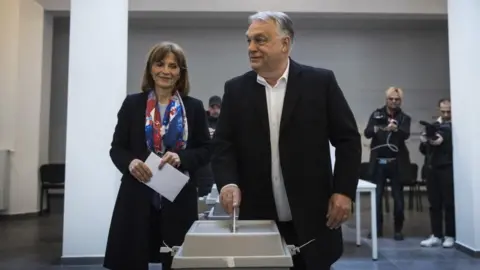
Magyar’s Tisza party, formed just weeks before the election, campaigns on a platform of anti-corruption, strengthening Hungary’s position within the EU and NATO, and restoring genuine public discourse. After casting his vote in Budapest, Magyar reiterated his promise to bolster Hungary’s international standing and vigorously combat corruption.
Election Day Dynamics and Record Turnout
Voting commenced early Sunday morning, with polling stations across the country open until 19:00 local time (17:00 GMT). Early reports indicated an extraordinary level of voter participation. By midday, a remarkable 54.14% of the electorate had already cast their ballots, a dramatic 14-point increase compared to the same period four years ago. This surge in turnout is widely interpreted as a sign of a highly energized and polarized electorate, with both sides mobilizing their bases in what many perceive as the most consequential election in recent memory.
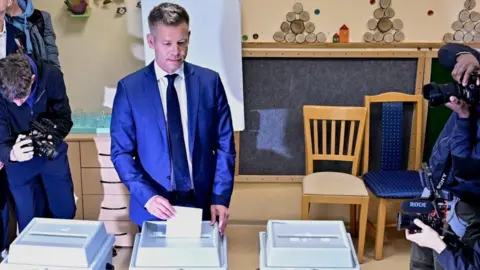
"I am here to win," Prime Minister Orbán declared to reporters after voting, dismissing suggestions that he might have underestimated his rival, stating, "I don’t underestimate anyone." This confident assertion belies the intense pressure Fidesz is facing, particularly given the unprecedented rise of Magyar’s movement.
Conversely, Magyar framed the election as a fundamental choice for Hungary’s future: "East and West, propaganda or honest public discourse, corruption or clean public life." This stark dichotomy encapsulates the perceived ideological battle at the heart of the campaign.
Results are expected to begin trickling in during the evening, though the final outcome in a complex electoral system could take several days to fully materialize.
International Implications: A Geopolitical Chess Match
The Hungarian election is being watched closely far beyond its borders due to the country’s strategic position and Orbán’s often-contrarian foreign policy.
For the European Union: Orbán’s consistent clashes with Brussels over democratic standards and rule of law have led to significant friction, including the withholding of billions in EU cohesion funds. A potential victory for Magyar and Tisza could signal a pivot towards greater cooperation and alignment with core EU values, potentially unblocking funds and improving Hungary’s standing within the bloc. Conversely, an Orbán victory, especially with a strong mandate, might embolden him to continue his confrontational approach, further straining EU unity.
For NATO: Hungary’s role as a NATO member has been complicated by Orbán’s reluctance to fully support Ukraine and his maintained ties with Russia. The admitted regular communication between Hungarian Foreign Minister Péter Szijjártó and his Russian counterpart, even before and after EU summits, has raised eyebrows among allies. Orbán’s veto of €90 billion (£78 billion) in aid to Ukraine has been particularly contentious. A change in leadership could lead to a more unified NATO stance and stronger support for Ukraine, while Orbán’s continued rule would likely perpetuate existing tensions.
For the United States: The relationship between Orbán and elements of the American conservative movement, particularly former President Donald Trump, is notable. Trump has openly endorsed Orbán, calling him a "true friend, fighter, and WINNER," and urged Hungarians to vote for him. This alignment underscores the broader ideological battles playing out globally. The election’s outcome could influence the dynamics of conservative movements worldwide and impact Washington’s diplomatic approach to Central Europe.
For Russia: Moscow has found a pragmatic ally in Orbán, who has consistently advocated for closer ties and often echoes Russian narratives regarding the war in Ukraine. A shift in Hungarian leadership towards a more pro-Western stance would represent a significant blow to Russia’s influence within the EU and NATO, potentially isolating Moscow further.
Polls, Predictions, and Electoral System Complexities
The electoral landscape, according to Hungary’s three most reliable pollsters, suggests a "huge lead" for Péter Magyar’s Tisza party. Róbert László, an election specialist at the Budapest-based think tank Political Capital, noted that contrary to initial expectations, Fidesz has not managed to significantly reduce Tisza’s lead as election day approached.
Hungary’s electoral system is a mixed-member proportional representation system, which has historically benefited larger parties like Fidesz, particularly through its single-member constituencies. Out of 199 seats in parliament, 106 are decided in individual constituencies, and the remaining 93 are allocated through a national party list. This system, which Orbán himself has acknowledged benefits his party, makes it challenging for smaller parties to gain traction.
Magyar has stated that his party needs not just an absolute majority (100 seats) but a two-thirds super-majority to effectively dismantle many of the constitutional changes enacted by Fidesz. These changes, critics argue, have undermined the independence of the judiciary, media freedom, and other democratic safeguards. Hungary consistently ranks at the bottom of Transparency International’s Corruption Perceptions Index within the EU, a point Tisza frequently highlights.
While a two-thirds majority for Tisza is not impossible, most analysts, including László, consider a comfortable absolute majority as the most likely scenario. However, the possibility of a two-thirds mandate, enabling sweeping reforms, cannot be entirely discounted given the current political momentum.
One of the few pollsters predicting a potential Fidesz victory is Nézőpont Institute, which is often seen as close to the ruling party. Its head, Ágoston Mráz, points to 22 "battleground seats" out of the 106 constituencies. If Fidesz can secure these, he believes a victory is still attainable. Mráz also suggests that Fidesz voters, particularly blue-collar conservatives, may be "hidden voters," less inclined to participate in polls or express their support openly compared to the more vocal Tisza supporters. The counting of these critical battleground seats, which might not be immediate, could delay the final results for several days.
Voices from the Ground: Economic Woes and Arrogance of Power
The campaign has been fought fiercely, not in traditional televised debates, but through social media, large rallies, and grassroots organizing. Orbán, addressing supporters on Saturday night, stuck to his core campaign themes, targeting Brussels and Ukraine, declaring, "We don’t give our children, we don’t give our weapons and we don’t give our money." His message resonated with loyalists, who chanted "we won’t let that happen," with one supporter, Johanna, expressing her backing for his family protection policies and stance on the Ukraine war.
However, the Fidesz government has been buffeted by a struggling economy, including periods of high inflation, which has impacted many Hungarian households. While Orbán’s pro-family policies, such as income tax exemptions for mothers with two or more children, have benefited some, not all families have seen relief.
The city of Győr, Hungary’s sixth-largest and located near the Slovak border, has become a significant battleground. Orbán himself notably lost his temper there last month when confronted by booing protesters, accusing them of "pushing Ukrainian interests." Conversely, Magyar hosted a massive rally in Győr, drawing considerable crowds.

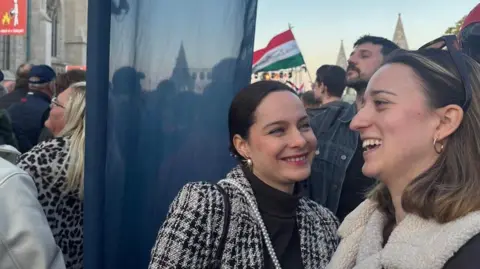
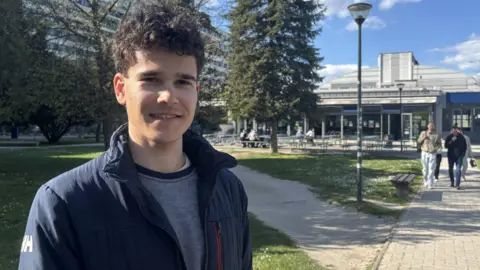
Gergely Németh, a 20-year-old student attending Magyar’s rally with his mother, articulated a common sentiment among younger voters. He spoke of his family’s financial struggles under government policies and emphasized that the desire to defeat Fidesz transcends individual personalities. "I think it’s not the man, Péter Magyar, who’s most important. More important is that someone changes these politicians in the parliament," he told the BBC. This sentiment of wanting systemic change rather than merely a new leader is a powerful undercurrent of the Tisza movement.
Roland Kósa, the independent deputy mayor of Győr, offered insights into the local political dynamics. He described Fidesz’s "arrogance towards power," noting that even with an independent mayor, the ruling party acted as if the city and country remained exclusively theirs. Kósa believes that the success in challenging Fidesz lies in breaking away from traditional party politics, a strategy Magyar has effectively employed by attracting voters from across the political spectrum.
Magyar’s Tisza party, created from the ground up, built "Tisza-islands" – small groups of activists in what were often Fidesz strongholds – echoing a strategy Orbán himself used in his opposition years. These grassroots efforts have formed the backbone of a rapidly growing national movement. Tisza’s candidates are not career politicians but surgical specialists, teachers, and business figures, reflecting a desire for practical solutions to issues in healthcare and education.
The Specter of Post-Election Instability
The highly charged atmosphere has led to concerns about the period following the election results. While Fidesz officials outwardly express confidence, political chief Balázs Orbán (no relation to Viktor Orbán) has suggested the opposition might not accept defeat.
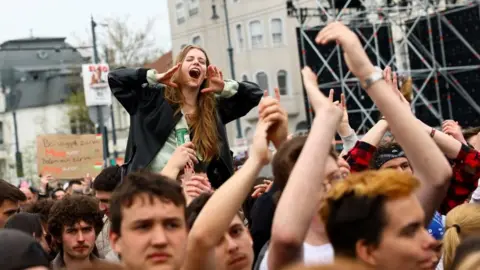
Ágoston Mráz of Nézőpont Institute voiced explicit fears of potential unrest: "I’m really afraid of getting violence on the streets because tension is in the air. I hope very much that every politician will be smart enough to help voters avoid violence on the street." Despite this, a massive anti-Fidesz concert in Heroes’ Square on Friday night, attended by at least 100,000 Hungarians, remained peaceful, with Magyar specifically cautioning supporters "not to fall for any kind of provocation."
As the polls close and the nation awaits the verdict, Hungary stands at a critical juncture. The record turnout signifies a deeply engaged populace, ready to either decisively reaffirm its current leadership or embark on a new, uncertain path. The implications of this choice will resonate for years to come, shaping Hungary’s domestic trajectory and its role on the European and global stages.