


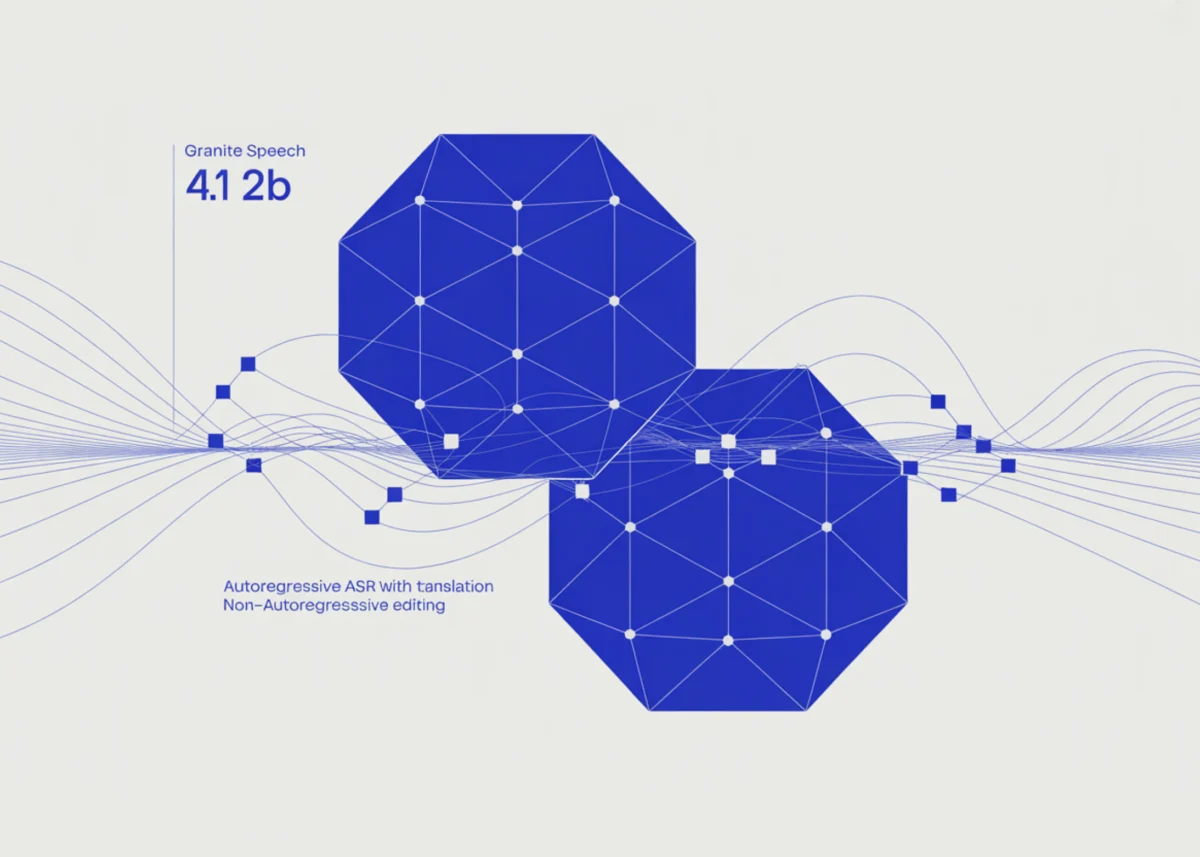
IBM has officially expanded its Granite AI ecosystem with the release of two high-performance open speech recognition models, Granite Speech 4.1 2B and Granite Speech 4.1 2B-NAR, signaling a shift toward more efficient, enterprise-ready audio processing. These models, now available on the Hugging Face platform under the permissive Apache 2.0 license, represent a strategic effort to bridge the gap between high-accuracy transcription and the computational constraints of production environments. By optimizing the architecture within a 2-billion parameter framework, IBM aims to provide developers with a toolset that balances linguistic precision with the low latency required for real-time applications.
The release addresses a persistent challenge in the field of Automatic Speech Recognition (ASR). While massive models have historically dominated accuracy leaderboards, their deployment often requires prohibitive hardware investments. Conversely, smaller models frequently suffer from a "word error rate" (WER) that limits their utility in professional or legal settings. The Granite Speech 4.1 series attempts to resolve this dichotomy by utilizing a modular architecture that separates audio encoding from linguistic decoding, allowing for a more streamlined processing flow without sacrificing the nuances of human speech.
A Triad of Specialized Speech Solutions
While the primary announcement focuses on the 2B and 2B-NAR variants, IBM has introduced a total of three distinct models to cater to varying enterprise needs. The flagship Granite Speech 4.1 2B is an autoregressive model designed for both multilingual ASR and bidirectional Automatic Speech Translation (AST). It supports a robust language suite, including English, French, German, Spanish, Portuguese, and Japanese. This model is intended for use cases where accuracy and translation capability are paramount, such as international conference transcription or content subtitling.
The second variant, Granite Speech 4.1 2B-NAR (Non-Autoregressive), is specifically engineered for latency-sensitive environments. Unlike its autoregressive counterpart, it focuses exclusively on transcription, omitting the translation feature and Japanese language support to maximize speed. This model is optimized for English, French, German, Spanish, and Portuguese, making it a specialized tool for European and North American markets where rapid, real-time feedback is essential.
To round out the suite, IBM also quietly debuted Granite Speech 4.1 2B-Plus. This version targets advanced applications requiring speaker-attributed ASR. It includes word-level timestamps and the ability to distinguish between different speakers in a single audio stream—a feature known as diarization. This makes the "Plus" variant particularly attractive for legal proceedings, medical consultations, and corporate meetings where "who said what" is as critical as the words themselves.
Architectural Innovation: The Three-Component Framework
The technical foundation of the Granite Speech 4.1 series rests on a sophisticated three-part architecture: a speech encoder, a modality adapter, and a language model. This modular approach allows IBM to swap out components or adjust the decoding mechanism depending on whether the model is optimized for accuracy or speed.
The first component, the speech encoder, utilizes 16 Conformer blocks. The Conformer architecture is a hybrid design that integrates convolutional layers, which are adept at capturing local acoustic patterns like phonemes, with attention mechanisms that track long-range dependencies in speech. These blocks are trained using Connectionist Temporal Classification (CTC) with dual classification heads—one for character-level outputs and another for Byte Pair Encoding (BPE) units. This dual-head system, combined with frame importance sampling, ensures the model focuses on the most informative segments of an audio file.
The second component is the modality adapter, which acts as a bridge between the continuous audio signals and the discrete text tokens processed by a language model. IBM employs a 2-layer Window Query Transformer (Q-Former) that operates on acoustic embeddings. By downsampling the audio data by a factor of ten, the Q-Former compresses the representation into a 10Hz embedding rate. This compression is vital for efficiency, as it prevents the language model from being overwhelmed by the high-frequency data inherent in raw audio.
The third and final component is the language model itself. The standard 2B model utilizes an intermediate checkpoint of IBM’s Granite-4.0-1B-Base, featuring a 128k context length. In the NAR variant, this component is transformed into a 1B-parameter bidirectional LLM editor. By removing the causal attention mask, the model can look both "forward" and "backward" across a sentence to refine the initial transcript provided by the CTC encoder.
The Tradeoff: Autoregressive vs. Non-Autoregressive Decoding
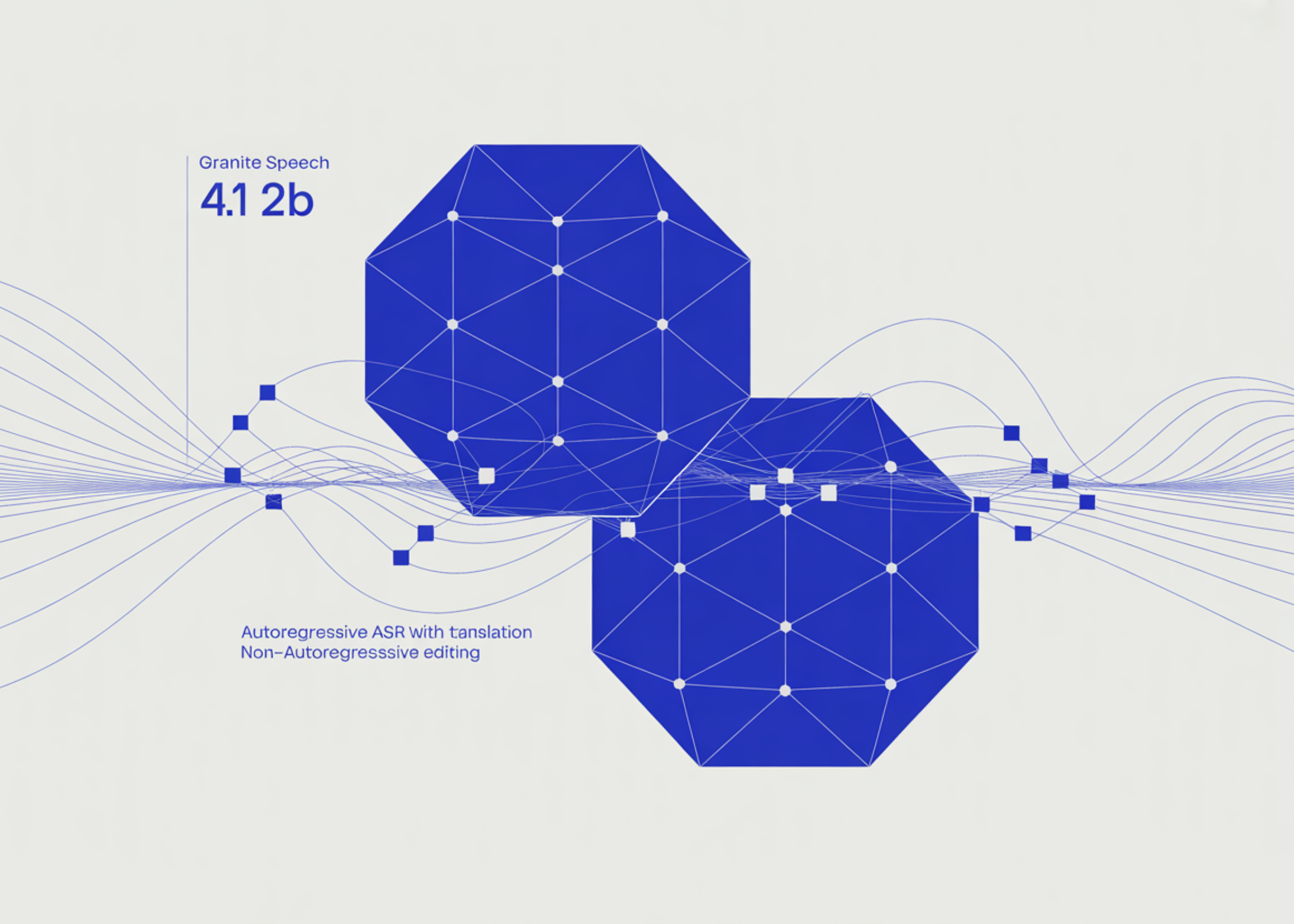
The divergence between the standard and NAR models represents a fundamental choice for AI engineers. In the standard Granite Speech 4.1 2B, text is generated autoregressively—meaning the model predicts one token at a time, with each prediction depending on the previous ones. This method is the industry standard for stability and supports complex tasks like keyword-biased recognition and punctuation insertion. However, it is inherently sequential, which can lead to bottlenecks in high-volume processing.
The 2B-NAR model employs a "Non-autoregressive LLM-based Editing" (NLE) architecture. Instead of building a sentence word-by-word, the CTC encoder generates a rough draft of the transcript. The bidirectional LLM then reviews this draft in a single forward pass, applying edits—copying, inserting, deleting, or replacing words—at all positions simultaneously. This parallel processing capability allows for significantly faster inference speeds without the massive drop in accuracy typically associated with non-autoregressive models.
Performance Benchmarks and Training Efficiency
In terms of raw performance, the Granite Speech 4.1 series has demonstrated competitive results on the Open ASR Leaderboard. As of April 2026, the standard 2B model maintains a mean Word Error Rate (WER) of 5.33%. On the LibriSpeech "clean" benchmark—a standard test for high-quality audio—the model achieved a WER of 1.33, while scoring a 2.5 on the more challenging "other" dataset.
The speed of the NAR model is perhaps its most compelling metric. During testing on a single NVIDIA H100 GPU using batched inference, the model achieved a Real-Time Factor multiplier (RTFx) of approximately 1820. This indicates that the model can process one hour of audio in less than two seconds. For enterprise users managing massive archives of call center data or media broadcasts, this level of throughput represents a significant reduction in operational costs.
The training history of these models also highlights IBM’s focus on resource optimization. The standard model was trained on 174,000 hours of audio over 30 days using eight H100 GPUs. In contrast, the NAR model required only three days of training on 16 H100 GPUs for five epochs. This efficiency suggests that IBM’s architectural decisions allow for rapid iteration and fine-tuning, potentially paving the way for future domain-specific versions of the Granite models.
Industry Context and Broader Implications
The release of the Granite Speech 4.1 series occurs at a pivotal moment in the evolution of AI. While OpenAI’s Whisper has long been the benchmark for open-source speech recognition, its larger versions are computationally heavy. IBM’s entry into the 2B-parameter space challenges the notion that "bigger is always better" for enterprise ASR. By offering a model that fits into the "Small Language Model" (SLM) category, IBM is targeting the growing demand for edge computing and on-premise AI deployments where privacy and hardware limitations are primary concerns.
Industry analysts suggest that the Apache 2.0 licensing is a strategic move to foster a developer ecosystem around the Granite brand. Unlike restrictive licenses that limit commercial use, the open nature of these models encourages third-party integration into everything from customer service bots to automated transcription services for small businesses.
"The move to provide a high-performance, non-autoregressive model is particularly telling," noted one industry consultant. "It shows that IBM is listening to the needs of the telecommunications and live-broadcast sectors, where even a half-second of lag can be the difference between a usable product and a failure."
Chronology of the Granite Evolution
The development of Granite Speech 4.1 is the latest step in a multi-year roadmap for IBM’s AI research division.
- Late 2023: IBM launches the initial Granite LLM series, focusing on code and language tasks.
- Early 2025: The company begins integrating multimodal capabilities, seeking to bridge the gap between text-based AI and audio inputs.
- Late 2025: Training commences for the 4.1 series, utilizing a combination of public datasets such as CommonVoice 15, LibriHeavy, and Earnings-22.
- April 2026: IBM officially releases the 2B, 2B-NAR, and 2B-Plus models to the public via Hugging Face.
By providing these models to the open-source community, IBM is not only contributing to the advancement of speech technology but also positioning itself as a leader in the "efficient AI" movement. As businesses continue to seek ways to implement AI without the astronomical costs of massive cloud-based models, the Granite Speech 4.1 2B series stands as a viable, scalable, and highly accurate alternative for the modern enterprise.