


The monumental Antarctic Iceberg A-23A, after an extraordinary four-decade odyssey, has fragmented in the South Atlantic Ocean, unleashing a torrent of meltwater that has significantly catalyzed an extensive phytoplankton bloom. This natural spectacle, captured by an array of NASA satellites, underscores the profound and often underappreciated role that colossal icebergs play in regulating marine ecosystems and global carbon cycles. As of March 6, 2026, the event stands as a vivid testament to the dynamic interplay between glacial ice and ocean life.
A Megaberg’s Epic Journey: The Saga of A-23A
Iceberg A-23A’s narrative is one of remarkable endurance and dramatic shifts across the Southern Ocean. Its genesis traces back to 1986, when it calved from the Filchner Ice Shelf in Antarctica’s Weddell Sea. Upon its detachment, it became, by area, one of the largest icebergs ever recorded, earning it the designation "megaberg." For nearly four decades, this colossal slab of ice, initially covering an area of approximately 4,000 square kilometers—roughly the size of the Japanese prefecture of Tottori or the U.S. state of Rhode Island—remained largely grounded. It was anchored to the seabed in the treacherous waters of the Weddell Sea, effectively acting as a stationary island for decades, resisting the powerful currents and winds that define the Antarctic Circumpolar Current.
This protracted grounding period, lasting until late 2023, saw A-23A slowly eroding and accumulating sediment, dust, and organic matter on its surface and within its ice structure, a process crucial for its later role as a nutrient dispenser. In late 2023, a significant shift in ocean currents and temperatures, possibly coupled with its natural reduction in mass, finally dislodged the megaberg from its decades-long resting place. It began a deliberate drift northward, propelled by the relentless currents of the Southern Ocean.
Its journey became a subject of intense scientific scrutiny. In early 2024, A-23A entered an oceanic vortex, where it spent several months twirling in a slow, majestic dance, a phenomenon that captivated oceanographers. By late 2024 and early 2025, its trajectory brought it perilously close to South Georgia Island, a critical wildlife haven renowned for its vast populations of penguins and seals. Scientists feared a potential collision could disrupt the island’s delicate ecosystem, possibly scouring the seabed and impacting marine life. Fortunately, the iceberg’s path veered, narrowly avoiding the island.
As A-23A continued its northward migration into warmer waters throughout 2025, the rate of melt accelerated dramatically. By early 2026, the signs of its impending disintegration became increasingly evident. Satellite imagery revealed large pools of meltwater accumulating on its surface, and the shedding of smaller bergs and fragments—known as bergy bits and brash ice—became a continuous process. On January 9, 2026, the initial major fragmentation event occurred, marking the beginning of the end for the intact megaberg. Despite its splintering, as of March 3, 2026, the largest remaining portion of A-23A still exceeded the size threshold required for naming and tracking by the U.S. National Ice Center, a testament to its enduring scale.
The Antarctic’s Fertile Legacy: Unpacking the Science of Iceberg-Fueled Productivity
The disintegration of Iceberg A-23A in early 2026 unleashed a surge of life in the South Atlantic, manifested as an extensive phytoplankton bloom. This event is a powerful demonstration of how large icebergs, far from being inert masses of frozen water, act as dynamic agents of biogeochemical cycling, particularly in nutrient-limited ocean regions.
Phytoplankton, microscopic marine algae, are the cornerstone of the ocean’s food web. They are photosynthetic organisms, meaning they harvest sunlight to convert carbon dioxide and water into organic matter and oxygen. This process is fundamental to life on Earth, as phytoplankton are responsible for producing up to half of the planet’s oxygen supply. Beyond oxygen production, they play a critical role in the "biological carbon pump," a natural mechanism that transfers atmospheric carbon dioxide to the deep ocean, effectively sequestering it from the atmosphere. Without phytoplankton, marine ecosystems would collapse, and global climate regulation would be severely compromised.
In many parts of the Southern Ocean, including the South Atlantic where A-23A disintegrated, phytoplankton growth is often limited by the scarcity of specific micronutrients, most notably iron. These regions are often referred to as High-Nutrient, Low-Chlorophyll (HNLC) zones, characterized by abundant macronutrients (nitrates, phosphates, silicates) but insufficient iron to support large phytoplankton blooms. This is where giant icebergs like A-23A become crucial.
Heidi Dierssen, an oceanographer at the University of Connecticut, explains that melting icebergs contribute to phytoplankton blooms through a dual mechanism. Firstly, the influx of cold, fresh meltwater creates a stable, stratified surface layer in the ocean. This stable layer prevents phytoplankton from being mixed too deeply into the water column by winds and turbulence, ensuring they remain in the sunlit zone where photosynthesis can occur efficiently. Light, even in summer, can be a limiting factor if phytoplankton are constantly dispersed to depths where light penetration is insufficient.
Secondly, and perhaps more critically, icebergs are significant sources of vital nutrients. As icebergs form and move across continental bedrock, they scour and incorporate vast amounts of rock flour, sediment, and dust. Over decades, windblown dust from landmasses also settles on their surfaces, further enriching their composition. This material contains a wealth of micronutrients, including iron, manganese, and macronutrients such as nitrates and phosphates, which are often locked within the ice matrix. When the iceberg melts, these accumulated nutrients are released into the surrounding surface waters. Grant Bigg, an emeritus oceanographer at the University of Sheffield, whose research has focused on iceberg-enhanced phytoplankton activity, emphasizes that the sheer scale of A-23A means its meltwater discharge was a substantial delivery system for these critical elements.
Research published in journals like Nature Geoscience and Deep Sea Research has consistently demonstrated that icebergs can enhance phytoplankton activity, often creating fertile "wakes" hundreds of kilometers long. Studies indicate that surface waters trailing icebergs are about one-third more likely to exhibit increased phytoplankton abundance compared to background levels, highlighting their localized but potent fertilizing effect.
Satellite Eyes: Observing Life from Orbit
The dramatic events unfolding around Iceberg A-23A were meticulously tracked and analyzed by an array of Earth-observing satellites, providing unprecedented insights into the dynamics of iceberg disintegration and ocean fertilization. NASA’s advanced satellite missions played a pivotal role in capturing this phenomenon.
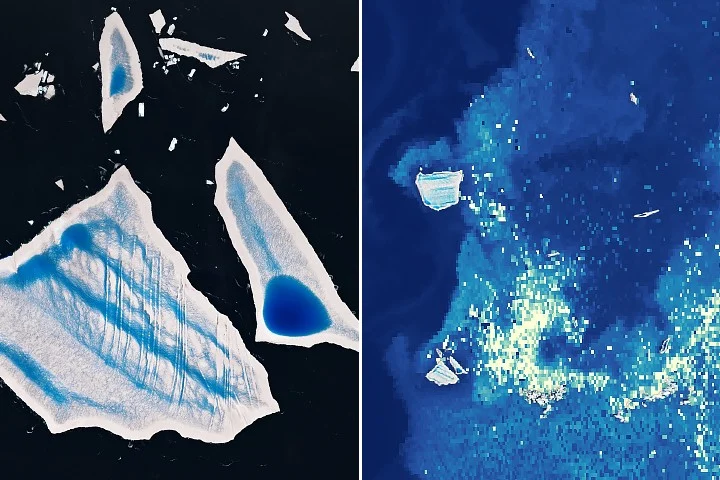
On January 25, 2026, just weeks after A-23A’s initial major fragmentation, the Visible Infrared Imaging Radiometer Suite (VIIRS) aboard the Suomi NPP satellite captured a striking image of the splintering tabular berg. This imagery vividly depicted the largest remaining pieces of the iceberg, now drifting northwestward and then curling northeast, surrounded by a vast debris field comprising brash ice (small fragments) and bergy bits (larger chunks of ice). The visible spectrum data from VIIRS provided crucial information on the physical breakup and drift patterns of the ice.
Concurrently, the Ocean Color Instrument (OCI) on NASA’s Plankton, Aerosol, Cloud, Ocean Ecosystem (PACE) satellite detected distinct plumes of chlorophyll-a drifting around the remaining bergs and the debris field. Chlorophyll-a is the primary photosynthetic pigment in phytoplankton, and its concentration in surface waters serves as a reliable proxy for phytoplankton abundance. The PACE mission, launched with a focus on understanding ocean ecosystems and their role in the global carbon cycle, is uniquely suited for such observations, offering hyperspectral capabilities that provide a more detailed spectral signature of ocean color than previous missions.
Further augmenting these observations, the Operational Land Imager (OLI) on Landsat 8 provided high-resolution imagery on January 25, 2026. This allowed scientists to observe intricate details, such as the distinct blue meltwater pooling on the surfaces of several larger fragments. These blue pools were indicative of the melting process and the release of glacial water. Landsat 8 also revealed linear patterns on the ice surface, likely striations etched hundreds of years ago when the ice was part of a glacier grinding across Antarctic bedrock, offering a geological timestamp. Furthermore, brown staining, possibly soil or sediment, was visible on some bergs, providing visual evidence of the accumulated terrestrial material that would later become ocean nutrients.
The analysis of these satellite data sets required sophisticated tools and expert interpretation. Grant Bigg noted that the phytoplankton signal appeared to be more concentrated near the smaller bergs, a logical observation given that smaller fragments melt faster and thus release their nutrient payload at a higher rate. However, Heidi Dierssen cautioned that algorithms used to process chlorophyll data can sometimes overcorrect for "adjacency effects" near bright surfaces like ice, potentially leading to an underestimation of chlorophyll concentrations immediately adjacent to the largest bergs.
Ivona Cetinić, a researcher on NASA’s PACE science team, leveraged a specialized tool called MOANA (Multiple Ordination ANAlysis) to delve deeper into the composition of the phytoplankton bloom. MOANA taps into the hyperspectral satellite observations from PACE’s OCI to identify different groups of phytoplankton. Her analysis indicated that picoeukaryotic phytoplankton—microscopic eukaryotic organisms known for their rapid response to changes in temperature or nutrient availability—were thriving in these waters. The swirls observed to the west of the main berg fragments were identified as Synechococcus, a genus of cyanobacteria. The PACE team is actively developing additional tools to identify larger types of phytoplankton, which were also likely present, providing a more comprehensive understanding of the bloom’s community structure.
Expert Insights and Ecological Connections
The consensus among oceanographers is that the observed phytoplankton bloom is unequivocally linked to the disintegration of Iceberg A-23A. Grant Bigg’s assertion that the bloom is "too big and too clearly spreading from the icebergs not to be strongly linked to them" encapsulates the scientific confidence in this connection. The persistence of the bloom for weeks, directly traceable to the iceberg’s path, further solidifies this conclusion.
The ecological ramifications of such iceberg-induced blooms extend far beyond the microscopic world of phytoplankton. These localized bursts of productivity form the base of a reinvigorated marine food web. The increased availability of phytoplankton attracts zooplankton, which graze on the microscopic algae. This, in turn, draws in a cascade of higher trophic levels, including fish, seabirds, and marine mammals. Research from institutions like the Monterey Bay Aquarium Research Institute (MBARI) has documented that Antarctic icebergs often act as "hotspots of ocean life," creating fertile oases in otherwise less productive waters. The areas around melting icebergs become temporary feeding grounds, supporting a greater abundance and diversity of marine organisms.
The implications for seabirds, for instance, are significant. Colonies of penguins and other Antarctic birds rely on abundant krill and fish, which themselves depend on phytoplankton. An iceberg-fueled bloom can provide a localized boost to their food supply, potentially impacting breeding success and overall population health. Similarly, baleen whales, which filter-feed on krill, would find richer foraging grounds in the vicinity of these blooms.
Implications for Carbon Cycling and Marine Ecosystems
The phenomenon of iceberg-fueled phytoplankton blooms carries significant implications for global carbon cycling, particularly in the Southern Ocean, which is a crucial sink for atmospheric carbon dioxide. The enhanced primary productivity facilitated by melting icebergs translates directly into increased carbon sequestration.
Some research, including studies cited by Grant Bigg, suggests that large icebergs may contribute substantially to phytoplankton blooms in this region, potentially accounting for up to one-fifth of the Southern Ocean’s total carbon sequestration. This means that a significant portion of the carbon dioxide absorbed by the Southern Ocean and transferred to the deep ocean could be indirectly attributed to the fertilizing effect of melting icebergs. Given the vastness of the Southern Ocean and its critical role in the global carbon budget, this contribution, while localized, is collectively substantial.
The process is straightforward: phytoplankton absorb CO2 from the atmosphere during photosynthesis. When these phytoplankton die, or are consumed by zooplankton which then excrete carbon-rich fecal pellets, the carbon sinks to deeper waters. This process, the "biological carbon pump," effectively removes carbon from the surface ocean and atmosphere, storing it in the deep ocean for hundreds to thousands of years. Therefore, events like the A-23A bloom represent a natural mechanism for mitigating atmospheric CO2 levels, albeit one that is inherently linked to the dynamics of glacial ice.
The overarching question that remains for scientists is how long Iceberg A-23A, or its fragments, will continue to enhance phytoplankton productivity before completely disintegrating. Past research indicates that icebergs can sustain elevated chlorophyll concentrations for more than a month after their passage, leaving behind fertile trails that stretch for hundreds of kilometers. While A-23A continued to shrink and shed mass throughout February 2026, its substantial remaining size as of early March suggested its fertilizing influence would persist for some time.
The broader context of climate change introduces further complexities. As global temperatures rise, the rate of glacial melt and iceberg calving from Antarctic ice shelves may increase. This could potentially lead to a greater frequency or scale of iceberg-fueled blooms, with a corresponding impact on carbon sequestration and marine ecosystems. However, the precise net effect is subject to ongoing research, as other factors like ocean acidification and warming waters also influence phytoplankton dynamics. The journey and disintegration of Iceberg A-23A thus serve not only as a dramatic natural event but also as a critical case study for understanding the intricate and evolving relationship between Earth’s cryosphere, oceans, and atmosphere.