


In a significant breakthrough for the field of artificial intelligence, researchers from Meta’s Fundamental AI Research (FAIR) laboratory, Cornell University, and Carnegie Mellon University have published a study demonstrating that large language models (LLMs) can acquire complex reasoning capabilities using an unprecedentedly small number of trainable parameters. The research introduces a novel parameterization technique called TinyLoRA, which allows for model adaptation that can scale down to as few as one single trainable parameter. This development challenges long-held assumptions regarding the minimum amount of data and computational overhead required to refine the behavior of massive neural networks, potentially opening new avenues for deploying highly efficient, specialized AI on hardware with limited resources.
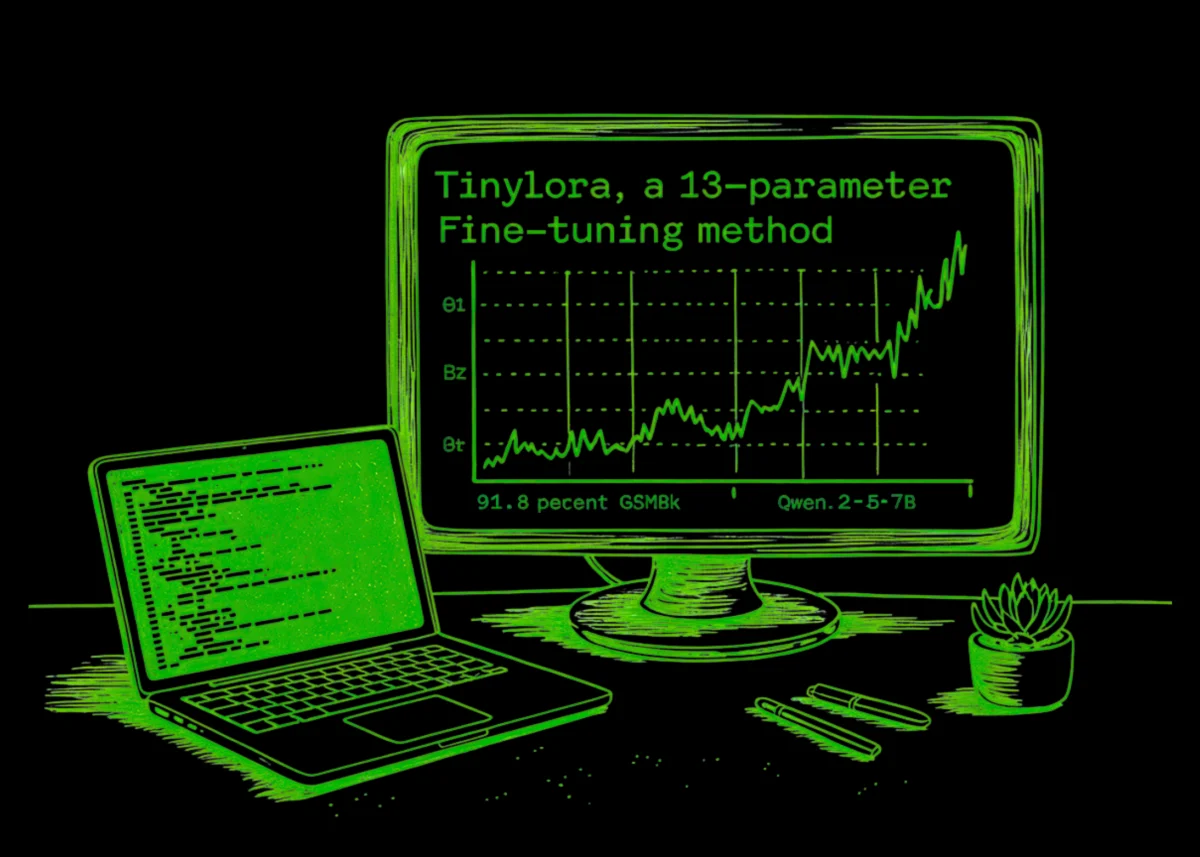
By applying the TinyLoRA method to the Qwen2.5-7B-Instruct model, the collaborative team achieved a 91.8% accuracy rate on the GSM8K benchmark—a standard measure for grade-school math word problems—using only 13 trainable parameters. To put this into perspective, these 13 parameters occupy a mere 26 bytes of memory when stored in the bf16 (brain floating point 16-bit) format. This finding suggests that the latent knowledge required for complex reasoning is already largely present within pre-trained models, and only a microscopic "nudge" is necessary to align that knowledge with specific tasks.
The Evolution of Parameter-Efficient Fine-Tuning
To understand the significance of TinyLoRA, it is necessary to examine the trajectory of Parameter-Efficient Fine-Tuning (PEFT). As LLMs grew from millions to hundreds of billions of parameters, full fine-tuning—where every single weight in a model is updated—became prohibitively expensive for most organizations. This led to the development of Low-Rank Adaptation (LoRA) in 2021, which frozen the original model weights and introduced small, trainable matrices.
Standard LoRA functions by adapting a frozen linear layer using two low-rank matrices. While this significantly reduced the memory footprint compared to full fine-tuning, it still maintained a "lower bound" of parameters. For a model of the scale of Llama 3-8B, even a rank-1 LoRA update requires approximately 3 million parameters. This overhead, while small compared to 8 billion, still presents challenges for hyper-specialized applications or environments where thousands of different task-specific "adapters" must be stored and swapped in real-time.
TinyLoRA addresses this limitation by building upon LoRA-XS, a previous advancement that utilized truncated Singular Value Decomposition (SVD) of the frozen weights. In LoRA-XS, the model still typically required at least one parameter per adapted module. TinyLoRA overcomes this by replacing the trainable matrix with a low-dimensional trainable vector. This vector is then projected through a fixed, random tensor. By implementing a "weight-tying" factor, the research team demonstrated that they could force multiple modules across different layers of the AI to share the same vector, effectively reducing the total trainable parameter count to a single digit without a catastrophic loss in performance.
The Mathematical Framework of TinyLoRA
The technical foundation of TinyLoRA lies in its unique update rule. In standard mathematical terms, the update to a weight matrix is defined by the interaction of SVD components and a projected trainable vector. The team utilized a fixed random tensor to act as a bridge between the low-dimensional trainable vector and the higher-dimensional requirements of the model’s architecture.
The efficiency of this system is governed by a scaling factor known as "n-tie." By adjusting this factor, developers can decide how many modules across the transformer architecture share the same trainable parameters. At the extreme end of this scale, all modules across all layers share a single vector, resulting in a model update that consists of just one parameter. The researchers found that even under these extreme sharing settings, the model retained a surprising amount of its ability to learn and adapt to reasoning tasks.
Reinforcement Learning as a Catalyst for Efficiency
One of the most striking revelations of the study is the role of the training methodology in achieving these ultra-low parameter counts. The research team discovered a profound disparity between Supervised Finetuning (SFT) and Reinforcement Learning (RL) when operating at the "tiny" scale.
According to the report, models trained via SFT required updates that were 100 to 1,000 times larger than those trained with RL to reach comparable performance levels. The researchers attribute this to "information density." SFT typically involves training a model on human demonstrations. These demonstrations are often "noisy," containing stylistic preferences, specific phrasings, and irrelevant structural data that the model tries to mimic. Because SFT treats every token in a sequence as equally important, the model requires a larger parameter space to absorb all these different "bits" of information.
In contrast, Reinforcement Learning—specifically the Group Relative Policy Optimization (GRPO) algorithm—provides a much cleaner signal. In a mathematical reasoning task, the reward is binary: the answer is either correct or incorrect. This "sparse" signal allows the model to focus exclusively on the features that lead to a correct result. Irrelevant variations in style or phrasing cancel out during the resampling process, allowing the model to achieve high performance with a fraction of the parameter updates. This suggests that for reasoning tasks, the "quality" of the training signal is far more important than the "quantity" of parameters being tuned.
Benchmark Performance and Comparative Analysis
The effectiveness of TinyLoRA was tested across several rigorous benchmarks, primarily focusing on mathematics and logic, which are considered the "gold standard" for measuring LLM reasoning. Using the Qwen2.5-7B-Instruct backbone, the team compared various parameter counts against the base model and full fine-tuning.
The baseline Qwen2.5-7B-Instruct model, without any additional training, scored 88.2% on the GSM8K benchmark. With just one trainable parameter, the model maintained an 82.0% accuracy—a slight drop, but a remarkable feat for a single-parameter update. When the parameter count was increased to 13, the accuracy jumped to 91.8%, actually surpassing the performance of a full fine-tuning run (91.7%) on the same hardware.
On more difficult benchmarks, such as MATH500 and AIME24, the results remained consistent. Updates involving only 196 parameters for the Qwen2.5-7B model were able to retain 87% of the absolute performance improvement typically gained from full finetuning across six different math-heavy benchmarks. The researchers also noted that the Qwen-2.5 architecture appeared more "trainable" at these low scales than the LLaMA-3 architecture, often requiring 10 times fewer parameters to reach similar performance thresholds.
Chronology of Development in Model Adaptation
The path to TinyLoRA represents a multi-year effort within the AI research community to optimize how we interact with large models:
- 2020-2021: The rise of massive LLMs like GPT-3 makes full fine-tuning inaccessible to the average developer.
- June 2021: Microsoft researchers introduce LoRA, allowing for the training of less than 1% of a model’s weights while maintaining performance.
- 2023: Introduction of QLoRA, which combined quantization with LoRA to further reduce memory requirements, allowing 30B+ parameter models to be tuned on consumer GPUs.
- Early 2024: LoRA-XS is introduced, using SVD to initialize LoRA weights more effectively, reducing the rank required for high performance.
- Late 2024 – Early 2025: FAIR, Cornell, and Carnegie Mellon researchers develop TinyLoRA, proving that the trend toward smaller updates can be pushed to the theoretical limit of a single parameter.
Industry Implications and Future Outlook
The implications of TinyLoRA are vast, particularly for the burgeoning field of Edge AI and personalized technology. If a model can be fundamentally altered or improved with just 13 parameters, it becomes possible to store thousands of specialized "personalities" or "expert modules" on a standard smartphone. A user could have a specific 26-byte file for medical advice, another for coding assistance, and another for creative writing, all swapping in and out of a single base model instantly.
Furthermore, this research has significant environmental and economic implications. Training 13 parameters requires a fraction of the electricity and compute time needed for traditional methods. This could democratize AI training, allowing researchers with minimal hardware budgets to contribute to the cutting edge of LLM development.
Industry analysts suggest that this research may shift the focus of the "AI arms race" away from simply building larger models and toward finding the most efficient ways to trigger the latent capabilities already residing within existing architectures. The discovery that Reinforcement Learning is the primary driver of this efficiency is likely to lead to a surge in RL-based training frameworks for small-scale developers.
As the AI community continues to digest these findings, the focus will likely turn toward whether TinyLoRA can be applied to non-reasoning tasks, such as creative storytelling or multi-lingual translation. For now, the collaboration between Meta, Cornell, and Carnegie Mellon has proven that in the world of artificial intelligence, sometimes less is truly more. The ability to achieve state-of-the-art reasoning with just a few bytes of data marks a turning point in the quest for efficient, scalable, and accessible AI.