

MiniMax has officially transitioned its most advanced large language model, the M2.7, into the open-source domain by releasing its model weights on Hugging Face. Originally announced to the public on March 18, 2026, the M2.7 represents a milestone in the company’s development trajectory, serving as the most capable open-source offering in the MiniMax portfolio to date. This release is particularly notable not only for its raw performance metrics but for its role in a self-referential development cycle; M2.7 is the first model from the organization to actively participate in its own architectural refinement and optimization, signaling a fundamental shift in the methodology of building and iterating upon large-scale artificial intelligence.
The release of M2.7 arrives at a time when the competitive landscape for large language models (LLMs) is increasingly defined by "agentic" capabilities—the ability for a model to not merely generate text but to operate autonomously across complex software environments. By making the weights publicly available, MiniMax is positioning itself as a primary challenger to proprietary titans such as OpenAI and Anthropic, providing the global research community with a high-performance alternative that rivals the latest iterations of the GPT and Claude series.
A Chronology of Development and Release
The path to the M2.7 release began in late 2025, following the success of the initial M2-series models. Throughout the first quarter of 2026, MiniMax focused on refining the Mixture-of-Experts (MoE) architecture to address the high latency issues often associated with massive parameter counts. On March 18, 2026, the company held a technical briefing announcing that M2.7 had reached parity with several industry-leading closed-source models.
Following a brief period of internal testing and restricted API access for enterprise partners, the decision to open-source the model was finalized in mid-2026. This move aligns with a broader industry trend where developers seek to foster ecosystem growth by allowing third-party integration and fine-tuning. The availability of M2.7 on Hugging Face allows developers to deploy the model on private infrastructure, a critical requirement for industries dealing with sensitive proprietary codebases or financial data.
Technical Architecture: The Mixture-of-Experts Advantage
At the heart of MiniMax M2.7 is a sophisticated Mixture-of-Experts (MoE) design. Unlike traditional dense models where every parameter is utilized for every request, MoE models utilize a gating mechanism that routes specific tasks to specialized "expert" sub-networks. During any single inference pass, only a fraction of the total parameters are activated.
This architectural choice provides two primary advantages: speed and cost-efficiency. By activating only the necessary neurons for a given prompt, M2.7 can deliver high-quality outputs with significantly lower computational overhead than a dense model of equivalent size. This makes it an ideal candidate for real-world production environments where latency is a critical factor. Furthermore, the MoE structure allows the model to maintain a vast "knowledge base" across diverse domains—such as legal reasoning, C++ optimization, and financial forecasting—without the different domains interfering with each other during the training process.
Benchmarking Software Engineering and System Comprehension
The primary value proposition of M2.7 lies in its proficiency in professional software engineering. In the current AI landscape, standard algorithmic coding tests have become less indicative of real-world utility. To address this, MiniMax evaluated M2.7 on SWE-Pro, a benchmark designed to simulate the "messy" reality of production systems, including log analysis, bug troubleshooting, and machine learning workflow debugging.
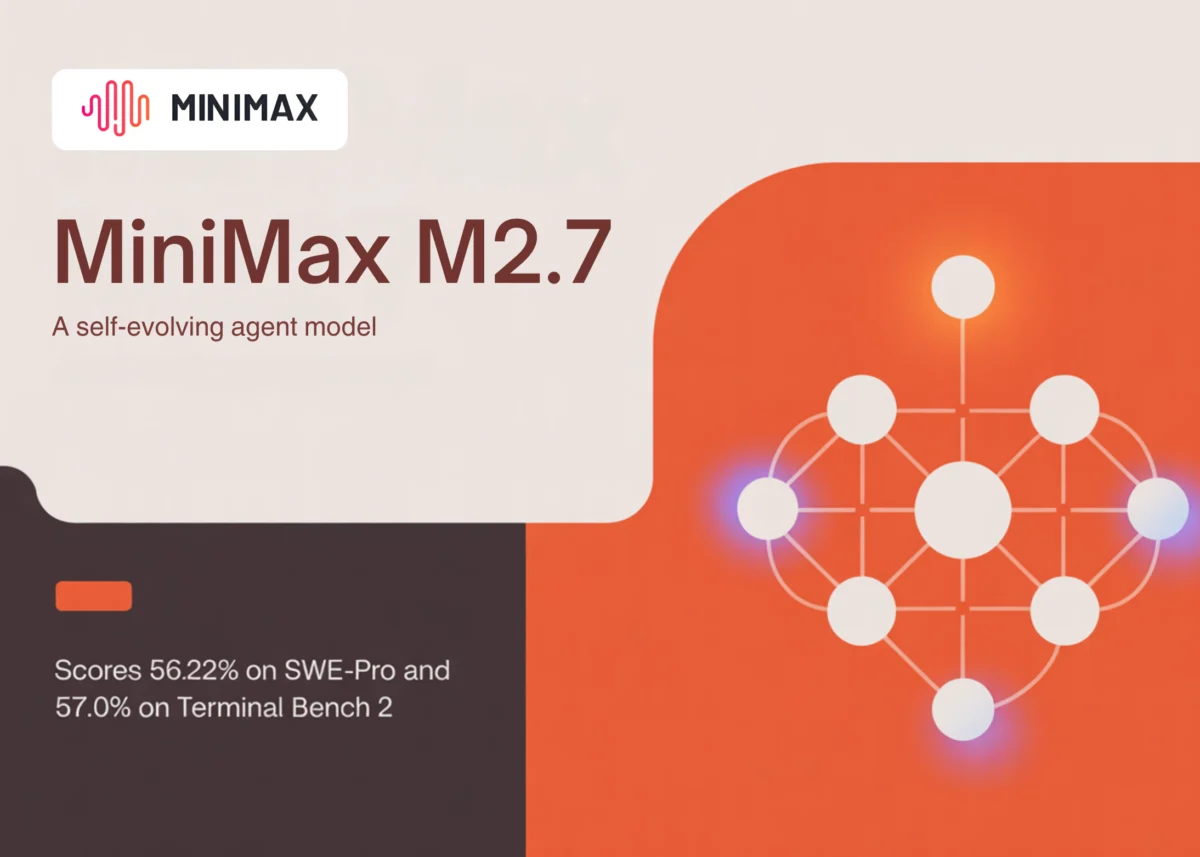
On the SWE-Pro benchmark, which spans multiple programming languages, M2.7 achieved an accuracy rate of 56.22%. This performance matches that of GPT-5.3-Codex, placing the open-source model firmly in the top tier of coding assistants. The model’s ability to navigate large, multi-file repositories is further evidenced by its scores on Terminal Bench 2 (57.0%) and NL2Repo (39.8%). These benchmarks require a high degree of system-level comprehension, testing whether a model can understand how various components of a software ecosystem interact.
In repo-level generation, M2.7 scored 55.6% on VIBE-Pro, nearly matching the performance of Anthropic’s Opus 4.6. This suggests that the model is capable of handling end-to-end development tasks across diverse platforms, including Web, Android, and iOS. For global development teams, the model’s performance on SWE Multilingual (76.5) and Multi SWE Bench (52.7) indicates a robust ability to handle codebase localized in different languages and regional coding standards.
Production Debugging and SRE Capabilities
One of the most significant claims made by the MiniMax team involves the model’s performance in live production environments. In Site Reliability Engineering (SRE), the "Mean Time to Recovery" (MTTR) is a vital metric. MiniMax reports that M2.7 has successfully reduced recovery time for live production incidents to under three minutes in multiple internal scenarios.
When an alert is triggered, M2.7 does not simply suggest code fixes. It performs causal reasoning by correlating monitoring metrics with deployment timelines. It can conduct statistical analysis on trace sampling to form hypotheses about the root cause of a failure. Most impressively, the model can proactively connect to databases to verify these hypotheses—for instance, identifying a missing index migration file—and then use non-blocking index creation to stabilize the system before submitting a formal merge request for a permanent fix. This level of autonomy positions M2.7 as a proactive agent rather than a reactive assistant.
The Self-Evolution Framework
Perhaps the most forward-looking aspect of the M2.7 release is its "Self-Evolution Architecture." MiniMax engineers tasked the model with optimizing its own programming performance using an internal scaffold. Operating entirely autonomously, the model entered an iterative loop consisting of:
- Analyzing failure trajectories from previous attempts.
- Planning structural changes.
- Modifying its own scaffold code.
- Running evaluations to test the changes.
- Comparing results against previous baselines.
- Deciding whether to keep or revert the modifications.
After more than 100 rounds of this autonomous iteration, M2.7 discovered several optimizations that human engineers had not explicitly programmed. This included systematic searches for optimal sampling parameters—such as temperature and frequency penalties—and the implementation of loop detection within its own agentic workflow. These self-discovered improvements resulted in a 30% performance increase on internal evaluation sets. Currently, within MiniMax’s internal reinforcement learning workflows, M2.7 is capable of managing 30% to 50% of the end-to-end tasks, with human researchers stepping in only for high-level strategic decisions.
Autonomous Machine Learning: MLE Bench Lite Results
To further validate its capabilities in technical research, MiniMax tested M2.7 on MLE Bench Lite. This suite, open-sourced by OpenAI, consists of 22 machine learning competitions designed to be runnable on a single A30 GPU. The benchmark covers the entire lifecycle of an ML project, from data cleaning to model training and evaluation.
The MiniMax team utilized a simple three-component harness for this test: short-term memory, self-feedback, and self-optimization. In each trial, the agent was given a 24-hour window to evolve its solution. The results were highly competitive: across three runs, the model achieved an average medal rate of 66.6%. Its best run secured 9 gold, 5 silver, and 1 bronze medal. This performance tied with Google’s Gemini 3.1 and was surpassed only by Opus 4.6 (75.7%) and GPT-5.4 (71.2%). These results demonstrate that M2.7 is not just a coder, but a capable data scientist and researcher.
Professional Office Work and Financial Analysis
Beyond the realm of software engineering, M2.7 is optimized for "Professional Office Work," a category encompassing complex administrative and analytical tasks. In the GDPval-AA evaluation—a benchmark measuring domain expertise across 45 different models—M2.7 achieved an ELO score of 1495. This is currently the highest score for any open-source model, trailing only the most advanced proprietary models from Anthropic and OpenAI.
In the Toolathon benchmark, which measures a model’s ability to use external tools and APIs, M2.7 reached an accuracy of 46.3%. In the MM Claw test—based on real-world usage patterns from the OpenClaw personal agent platform—the model maintained a 97% skill compliance rate across 40 complex skills.
The model’s application in the financial sector is particularly noteworthy. M2.7 can autonomously process a company’s annual reports, analyze earnings call transcripts, and cross-reference these with multiple third-party research reports. It can then design financial assumptions, build revenue forecast models, and generate professional-grade presentations and documents. By mimicking the workflow of a junior investment analyst, the model provides significant labor-saving potential for financial institutions.
Broader Impact and Industry Implications
The release of MiniMax M2.7 signals a maturation of the open-source AI ecosystem. For years, open-source models were viewed as "light" versions of their proprietary counterparts, suitable for basic tasks but lacking the reasoning depth required for professional engineering. M2.7 challenges this narrative by matching or exceeding the performance of leading closed models in specialized, high-value domains.
Industry analysts suggest that the "self-evolution" capabilities of M2.7 may lead to an acceleration in the pace of AI development. If models can effectively contribute to their own optimization, the bottleneck of human engineering hours may become less restrictive. Furthermore, the model’s focus on "Agent Teams"—multi-agent collaboration—points toward a future where AI is not a single chatbot but a coordinated workforce of specialized agents.
For enterprises, the availability of such a high-performance open-source model reduces "vendor lock-in" and allows for the development of bespoke, on-premises agents that can handle sensitive tasks like production debugging and financial forecasting without data leaving the corporate firewall. As the global AI community begins to fine-tune and build upon the M2.7 weights, the industry can expect a surge in specialized applications derived from this MoE architecture.
MiniMax has provided the technical details and model weights through Hugging Face and their official news portal, encouraging widespread experimentation and integration. The release marks a definitive step toward the democratization of agentic AI, providing a powerful tool for developers, researchers, and enterprises to build the next generation of autonomous systems.