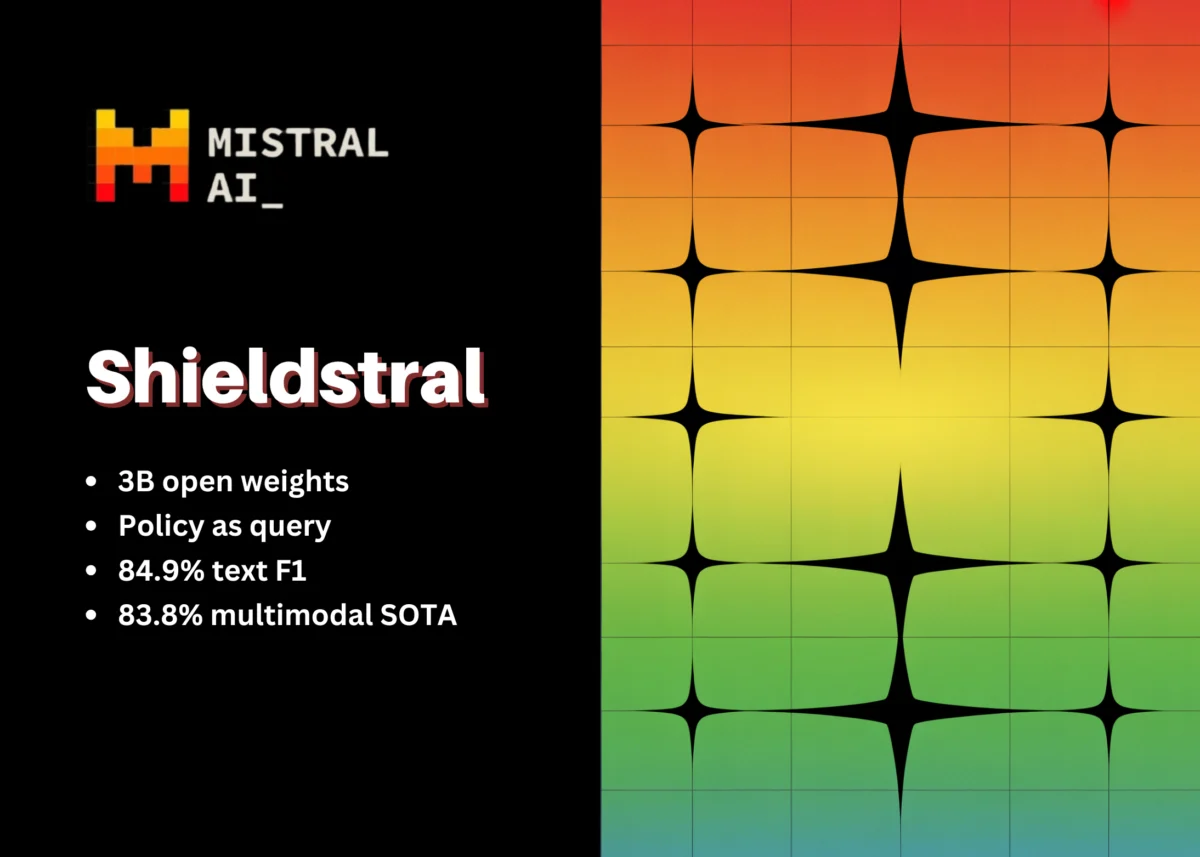
Mistral AI has officially released Shieldstral 1.0 3B, a sophisticated, policy-adaptive multimodal safety classifier designed to streamline and customize the content moderation process for artificial intelligence applications. Unlike traditional safety models that rely on rigid, pre-defined taxonomies of harm, Shieldstral operates on a binary classification logic, treating moderation as a single, context-dependent "yes/no" question. This architecture allows developers and system operators to define safety policies in plain language at the moment of inference, providing a level of flexibility previously unavailable in smaller, open-weights models. By moving away from fixed category weights, Shieldstral addresses a persistent challenge in AI deployment: the fact that content deemed "harmful" is often subjective and varies significantly across different use cases, such as cybersecurity research, mental health support, or general-purpose creative writing.
Technical Architecture and the Shift to Policy-Adaptive Moderation
The core innovation of Shieldstral 1.0 3B lies in its inversion of the traditional moderation pipeline. Most existing guardrail models are trained on specific categories of prohibited content—such as hate speech, self-harm, or illegal acts—and these categories are "baked" into the model’s neural weights. Consequently, changing a safety policy usually requires the costly and time-consuming process of retraining or fine-tuning the model. Shieldstral bypasses this limitation by utilizing a prompt-driven approach where the specific safety criteria are provided as input data rather than hard-coded constraints.
Built upon the Ministral-3-3B-Base-2512 architecture, Shieldstral incorporates a native Pixtral vision encoder, enabling it to process both text and visual data simultaneously. This multimodal capability is essential for modern AI applications that generate or interpret images alongside text. The model is released under the Apache 2.0 license, making it accessible for both commercial and non-commercial research and development.
At the inference stage, Shieldstral utilizes a unique "unembedding" technique. Instead of generating a full sequence of tokens, the model focuses exclusively on the probability of the "yes" and "no" token IDs. These probabilities are then softmax-normalized to produce a continuous safety score. By default, a threshold of 0.5 is applied to determine if a piece of content violates the user-defined policy. This streamlined process allows the model to function as a high-speed classifier for prompt classification, response moderation, and toxicity detection within a single forward pass.
The Data Recipe: Synthetic Innovation and Contrastive Learning
The performance of Shieldstral is attributed more to its sophisticated data curation strategy than to its raw parameter count. Mistral AI utilized a massive dataset of approximately 54.1 million samples to train the model. This dataset is divided into three primary categories: 45.2 million open-source text samples, 4.4 million synthetic contrastive text samples, and 4.5 million multimodal samples.
A critical component of this training regime is the "template-based unification layer." This system converts diverse datasets into a standardized format consisting of three fields: <Instruct>, which provides the evaluation context and strictness; <Query>, which contains the specific safety policy phrased as a binary question; and <Document>, which includes the content to be evaluated.
The use of contrastive generation is perhaps the most significant advancement in Shieldstral’s training. Using larger language models, Mistral AI generated pairs of safe and unsafe text where the unsafe variant violates a specific target category while intentionally avoiding the violation of related categories. This "hard negative" approach teaches the model to distinguish between subtle nuances in policy, ensuring it understands exactly why a piece of content is flagged. For image data, which is harder to synthesize, the team employed general-purpose image datasets as negatives and used a 14-subcategory visual taxonomy to mutate queries, ensuring robust multimodal coverage.
Performance Benchmarks and Comparative Analysis
In head-to-head evaluations, Shieldstral 1.0 3B demonstrates performance that rivals models significantly larger in scale. On text safety benchmarks, the model achieved an average F1 score of 84.9%. This result matches the performance of GPT-OSS-Safeguard-20B, a model nearly seven times its size. Shieldstral showed particular strength on specific datasets, scoring 84.1 on ToxicChat, 99.4 on HarmBench, and 87.2 on the Aegis v2 response dataset.
The multimodal capabilities of the model also set new standards for the 3B parameter class. Shieldstral reported an overall score of 83.8% on multimodal safety tasks, outperforming OmniGuard-7B, which scored 77.6%. It also led in benchmarks like VLGuard (97.7%) and UnsafeBench (81.8%), though it trailed slightly behind LlavaGuard-7B on its specific namesake benchmark.
Perhaps the most impressive metric is the model’s adaptability. On a specialized benchmark designed with a divergent taxonomy of 12 super-classes and 52 leaf categories—none of which were directly mapped during the training phase—Shieldstral achieved a 91.3% F1 score. While this was slightly behind the 94.1% scored by GPT-OSS-Safeguard-20B, Shieldstral achieved its result without the need for a reasoning trace, making it significantly faster and cheaper to run in production environments.
Deployment, Local Execution, and Infrastructure Support
A primary goal for Mistral AI with this release was to ensure that Shieldstral is "deployable" for organizations of all sizes. The model is designed to fit within 16GB of VRAM when using BF16 precision, allowing it to run efficiently on a single consumer-grade or professional GPU. This low hardware requirement makes it an ideal candidate for local deployment, which is often a requirement for privacy-sensitive moderation tasks.
To support immediate integration, Shieldstral is compatible with several major serving frameworks:
- vLLM: Recommended for high-throughput serving (version 0.26.0 or higher).
- llama.cpp: Supported via GGUF conversion with various quantization levels (Q8_0, Q5_K_M, Q4_K_M).
- SGLang and Transformers: Standard integration for research and custom workflows.
- Axolotl: Full support for LoRA fine-tuning, allowing developers to further specialize the model for niche domains.
Because the model only emits a single token to provide its verdict, the latency and operational costs are substantially lower than reasoning-based guardrail models that must "think" through a moderation decision before responding.
Contextual Background and the Evolution of AI Safety
The release of Shieldstral comes at a pivotal moment in the AI industry. As generative AI moves from experimental labs to enterprise-grade applications, the "safety layer" has become as important as the model itself. Historically, companies like OpenAI and Meta have dominated the safety space with tools like the OpenAI Moderation API and Llama Guard. However, many of these tools are either closed-source or rely on fixed categories that do not always align with the specific legal or ethical requirements of different global regions.
Mistral AI’s decision to release Shieldstral under an Apache 2.0 license reflects a broader industry trend toward "open safety." By providing the weights and the methodology, Mistral allows the community to audit the model for biases and adapt it to local regulations. This transparency is increasingly demanded by regulators, particularly under the framework of the European Union’s AI Act, which emphasizes the need for controllable and interpretable safety mechanisms.
Chronology of Development
The development of Shieldstral follows a sequence of strategic releases from Mistral AI throughout 2024 and 2025:
- Release of Ministral-3B: Established the high-efficiency base model for edge and local computing.
- Introduction of Pixtral: Integrated native vision capabilities into the Mistral ecosystem.
- Data Synthesis Phase: Development of the contrastive generation pipeline to create 54 million high-quality safety samples.
- Model Merging: Utilization of the SLERP (Spherical Linear Interpolation) method to merge three distinct training checkpoints (public+generated, public-only, and Ministral-3B-Instruct) to optimize the final weights.
- Official Launch (Current): Release of Shieldstral 1.0 3B as a standalone safety solution.
Market Implications and Stakeholder Reactions
Industry analysts suggest that Shieldstral could significantly lower the barrier to entry for startups looking to implement robust moderation. "The ability to define a safety policy in plain text rather than code or retraining is a game-changer for non-technical compliance officers," noted one AI safety researcher.
From a business perspective, the model reduces "safety tax"—the additional compute cost required to ensure an AI’s output is safe. By using a 3B model instead of a 20B or 70B model for moderation, companies can redirect those savings toward improving their primary service or reducing costs for end-users.
However, Mistral AI has been transparent about the model’s current limitations. Internal testing indicates that while Shieldstral is highly effective in English and major European languages, its performance on prompt classification lags in languages such as Arabic and Indonesian. Furthermore, like all current AI models, it remains susceptible to highly sophisticated adversarial "jailbreaks" or obfuscated inputs designed to bypass detection. The company recommends using Shieldstral as one layer of a multi-tiered defense strategy rather than a sole point of failure.
Future Outlook and Broader Impact
As AI agents become more autonomous, the need for real-time, policy-adaptive safety layers will only grow. Shieldstral represents a shift toward "dynamic alignment," where a model’s behavior can be steered in real-time to match the evolving needs of its environment.
The success of Shieldstral 1.0 3B may encourage other AI labs to move away from rigid safety taxonomies in favor of more fluid, instruction-based architectures. For now, the model stands as a high-performance, cost-effective tool that brings sophisticated multimodal moderation to the open-source community, bridging the gap between high-end proprietary safety APIs and the need for local, customizable control. Through its 32k token context window and support for 12 primary languages, Shieldstral provides a foundational piece of infrastructure for the next generation of responsible AI deployment.