


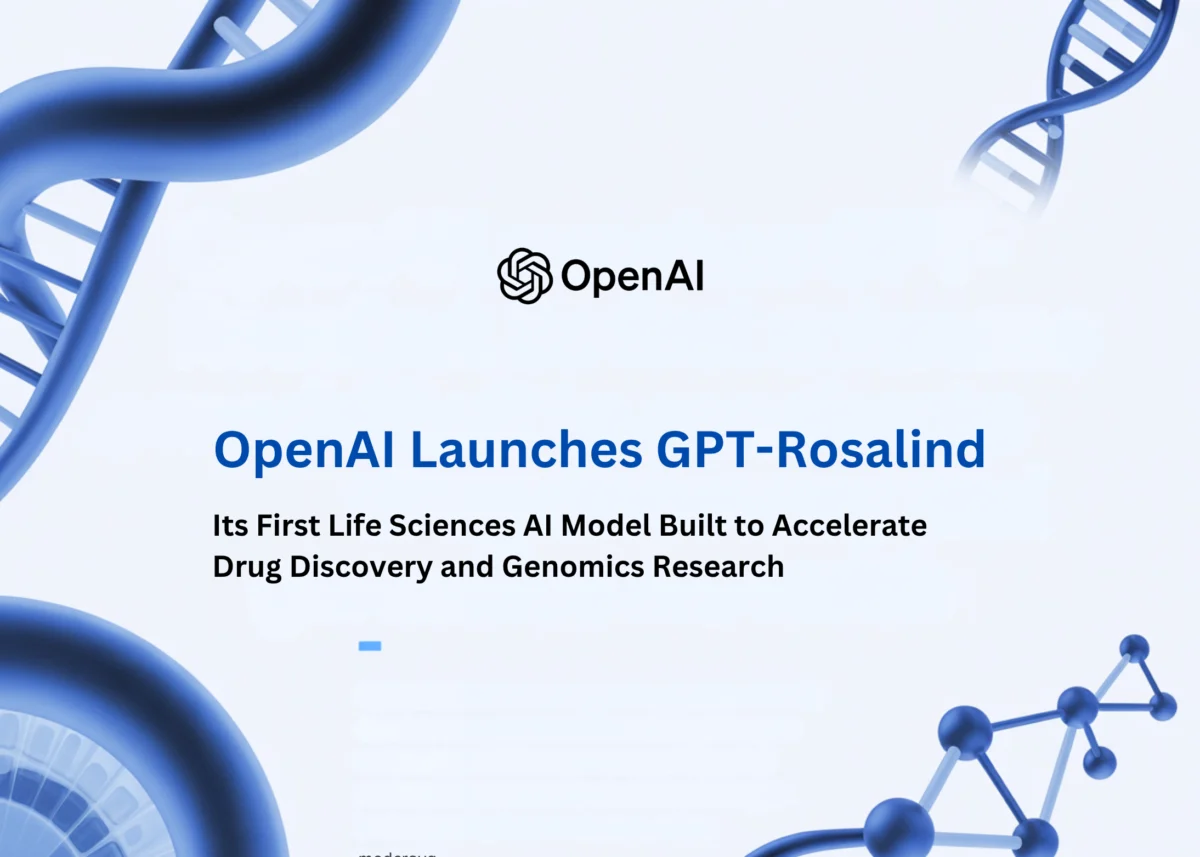
OpenAI has officially announced the launch of GPT-Rosalind, the first installment in a new series of artificial intelligence models specifically engineered for the life sciences sector. Designed to provide advanced foundational reasoning in biochemistry, genomics, and molecular biology, the model represents a significant departure from the company’s previous strategy of developing broad, general-purpose large language models. GPT-Rosalind arrives at a critical juncture for the pharmaceutical industry, where the average cost of bringing a new drug to market now exceeds $2.6 billion, and the timeline from target discovery to regulatory approval remains stubbornly fixed between 10 and 15 years. By automating the more labor-intensive aspects of scientific synthesis and experimental design, OpenAI aims to compress these decades-long development cycles into more manageable timeframes.
The model is named in honor of Rosalind Franklin, the British chemist and X-ray crystallographer whose work was fundamental to the understanding of the molecular structures of DNA, RNA, and viruses. In keeping with this legacy, GPT-Rosalind is built to handle the "painstaking analytical work" that occupies the majority of a researcher’s day. This includes sifting through vast quantities of academic literature, designing complex reagents, and interpreting high-dimensional biological data. OpenAI has clarified that the model is intended to function as a "co-pilot" for scientists rather than a replacement, focusing on the early-stage discovery and planning phases where human bottlenecks are most prevalent.
The Structural Evolution of AI in Biological Discovery
The release of GPT-Rosalind marks a pivot in the AI industry toward domain-specific specialization. While general models like GPT-4 can discuss biological concepts, they often lack the precision required for laboratory applications, such as designing a cloning protocol or predicting the behavior of specific RNA sequences within a cellular environment. GPT-Rosalind has been fine-tuned on specialized datasets that include chemical structures, protein sequences, and genomic data, allowing it to perform "scientific reasoning" rather than mere pattern matching.
In practical research workflows, a scientist might utilize GPT-Rosalind to manage multi-step processes that previously required several disparate software tools. For instance, in the development of a novel gene therapy, the model can simultaneously survey hundreds of recent papers to identify potential delivery vectors, predict how a specific RNA sequence will interact with target proteins, and then generate a step-by-step experimental plan for laboratory validation. This level of integration is further supported by a new Life Sciences research plugin for Codex, which provides the model with programmatic access to over 50 external scientific tools and biological databases.
Chronology of Development and the Rise of AI-Driven Biotech
The emergence of GPT-Rosalind is the latest milestone in a timeline of rapid AI integration within the life sciences. The journey toward specialized biological AI began in earnest with the 2020 release of AlphaFold by Google DeepMind, which solved the "protein folding problem" by predicting 3D structures from amino acid sequences. Following this, the industry saw a surge in generative models for chemistry and molecular design.
In 2023, OpenAI began exploring the limitations of general-purpose models in high-stakes scientific environments. Reports indicated that while GPT-4 was proficient at passing medical licensing exams, it struggled with the "wet lab" logic required for molecular biology. Throughout late 2023 and early 2024, OpenAI engaged in deep-tier partnerships with biotechnology firms to gather "ground truth" data—information that had never been published in the public domain—to train a model that could reason about novel biological phenomena. The culmination of this research was the internal development of the "Rosalind" architecture, which prioritizes evidentiary synthesis and predictive accuracy over conversational fluency.
Empirical Performance and Benchmark Data
To validate the capabilities of GPT-Rosalind, OpenAI published a series of performance metrics against established bioinformatics benchmarks. One of the primary metrics used was BixBench, a benchmark specifically designed to evaluate AI on real-world tasks performed by bioinformaticians, such as processing sequencing data and interpreting genomic outputs. GPT-Rosalind achieved a 0.751 pass rate on BixBench, a score that reflects high reliability in executing complex data analysis tasks that typically require human expertise.
Furthermore, the model was tested on LABBench2, where it was compared against GPT-5.4. The results showed that GPT-Rosalind outperformed its general-purpose counterpart on six out of eleven specialized tasks. The most notable gains were observed in "CloningQA," a category that tests a model’s ability to design end-to-end reagents for molecular cloning. This suggests that the model possesses a superior understanding of the physical constraints and chemical requirements of laboratory experiments.
Perhaps the most compelling evidence of the model’s efficacy came from a collaborative study with Dyno Therapeutics. In this evaluation, GPT-Rosalind was tasked with RNA sequence-to-function prediction using unpublished, proprietary sequences. Because the data was entirely novel, the model could not rely on memorized training data. When evaluated within the Codex environment, GPT-Rosalind’s best-of-ten submissions ranked above the 95th percentile of human experts for prediction tasks. Additionally, it reached the 84th percentile for sequence generation, demonstrating a level of creative scientific synthesis that was previously thought to be the exclusive domain of senior researchers.
Strategic Partnerships and Controlled Deployment
Recognizing the potential risks associated with biological AI—including the dual-use concerns related to pathogen enhancement or the design of harmful toxins—OpenAI has opted for a "gated" launch. GPT-Rosalind is currently accessible only to qualified enterprise customers in the United States through a trusted-access program. This program is limited to organizations that demonstrate a commitment to human health outcomes and maintain rigorous security and governance protocols.
OpenAI has already established a network of high-profile partners to integrate the model into active drug discovery pipelines. These include:
- Amgen and Moderna: Utilizing the model to refine mRNA sequence design and optimize therapeutic delivery systems.
- The Allen Institute: Applying GPT-Rosalind to map complex cellular interactions and neural pathways.
- Thermo Fisher Scientific: Integrating the model into laboratory instrumentation software to assist in real-time experimental troubleshooting.
- Los Alamos National Laboratory (LANL): Partnering on a specialized initiative focused on the AI-guided design of proteins and catalysts, with a specific emphasis on biosecurity and the prevention of biological threats.
These partnerships include the implementation of technical safeguards. OpenAI’s safety systems are programmed to flag any queries that could lead to the creation of biological hazards, and the model’s outputs are subject to continuous monitoring by human oversight committees.
Industry Implications: Reversing Eroom’s Law
The introduction of GPT-Rosalind is seen by many industry analysts as a direct attempt to combat "Eroom’s Law." In pharmaceutical economics, Eroom’s Law (the reverse of Moore’s Law) observes that drug discovery is becoming slower and more expensive over time, despite improvements in technology. The complexity of biological systems often means that as we learn more, the "easy" drugs are already found, leaving only the most difficult and computationally expensive targets.
By providing a model that can synthesize data across genomics, proteomics, and chemistry, OpenAI is betting that AI can identify hidden correlations that human researchers might overlook. If GPT-Rosalind can reduce the failure rate of drugs in the pre-clinical phase by even 10%, it could save the industry billions of dollars annually and bring life-saving treatments to patients years earlier than current methods allow.
Furthermore, the launch signals a broader shift in the AI landscape. The "one-size-fits-all" approach to LLMs is being replaced by a "mixture of experts" or domain-specific fine-tuning strategy. This evolution suggests that the next frontier of AI will not just be about larger models, but about models that are deeper and more specialized in high-dimensional fields like law, engineering, and science.
Regulatory and Ethical Landscape
The deployment of GPT-Rosalind will likely face scrutiny from regulatory bodies such as the U.S. Food and Drug Administration (FDA). While the FDA has been proactive in creating frameworks for AI/ML-based software as a medical device, the use of generative AI in the actual design of therapeutic molecules is a relatively new frontier.
Ethical considerations also remain at the forefront. The "black box" nature of some AI reasoning can be a hurdle in scientific fields where reproducibility and "explainability" are paramount. To address this, OpenAI has emphasized the model’s ability to provide evidence synthesis, meaning it can cite the literature and data sources it used to reach a specific hypothesis, thereby allowing human scientists to verify the logic before proceeding to the lab.
As GPT-Rosalind moves into wider use within the trusted-access group, its success will be measured not just by its benchmark scores, but by its ability to facilitate a breakthrough in a real-world clinical setting. For now, it stands as a testament to the potential of AI to honor its namesake by uncovering the hidden structures of life through the lens of computational reasoning.