

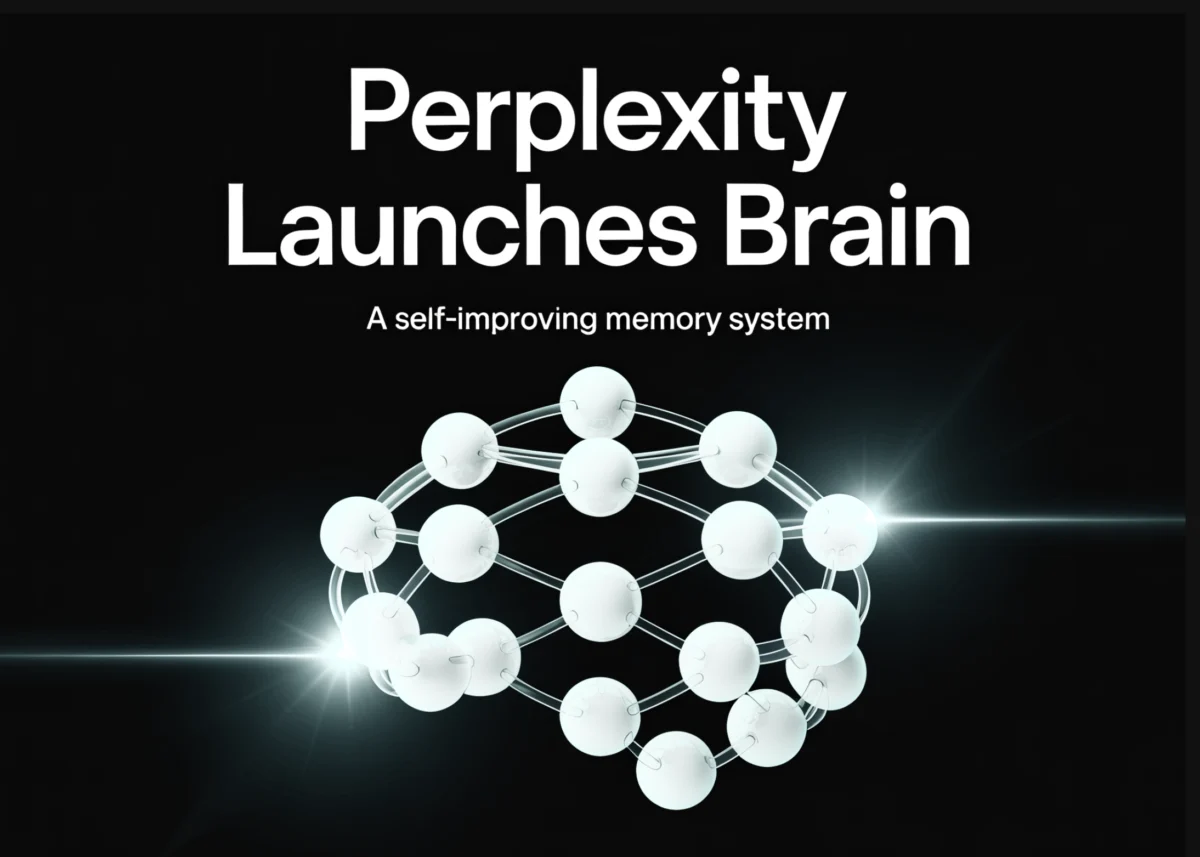
Perplexity, the artificial intelligence search and discovery platform, has officially announced the launch of Brain, a sophisticated self-improving memory system designed specifically for its agentic product, Computer. This release represents a fundamental shift in the conceptualization of AI memory, moving away from traditional user-centric profiles toward a task-oriented "work memory" model. While most contemporary AI assistants focus on remembering a user’s personal preferences, tastes, and communication styles to increase engagement, Perplexity’s Brain is engineered to remember the actions, successes, and failures of the agent itself. By prioritizing performance over personality, Perplexity aims to transform how autonomous agents interact with complex, long-form projects, effectively allowing the AI to "learn on the job" through a recursive feedback loop.
The rollout of Brain began today for subscribers of Perplexity Max and Enterprise Max in a Research Preview capacity. This strategic move follows the company’s recent expansion into agentic workflows, where AI is expected not just to provide answers but to execute multi-step tasks within a sandbox environment. Brain functions as the cognitive backbone of this "Computer" agent, creating a persistent and traceable record of work that allows the system to become more efficient the more it is utilized.
A New Paradigm: Work Memory vs. User Memory
To understand the significance of Brain, it is necessary to examine the two primary axes along which AI memory is currently being developed. The industry has largely focused on the first axis: the user. This involves storing data points such as a user’s professional role, preferred writing tone, contact lists, and past interactions. The primary objective of this type of memory is engagement—making the user feel understood and reducing the need for repetitive instructions.
Perplexity’s Brain occupies the second axis: the work itself. Instead of building a profile of the person, Brain builds a profile of the task. It documents what specific strategies worked, which sources were unreliable, what errors were encountered, and how those errors were corrected. According to Perplexity, the most critical function of memory in an agentic context is not to make the AI more "personable," but to make it more capable. By shifting the focus to performance, Perplexity is positioning Brain as a productivity tool rather than a digital companion.
| Dimension | Traditional User Memory | Perplexity Brain (Work Memory) |
|---|---|---|
| Primary Focus | The User | The Agent’s Work |
| Data Points | Preferences, tastes, role, style | Actions, successes, failures, corrections |
| Objective | User engagement and rapport | Task performance and efficiency |
| Output | User Persona/Profile | Traceable Context Graph |
Technical Architecture: The Context Graph and LLM Wiki
At the heart of the Brain system is a "living context graph." This graph serves as a dynamic map of the user’s digital environment, including projects, people, and data sources. Unlike traditional vector databases that might simply retrieve relevant text snippets, the context graph understands the relationships between different elements of a workflow.
This context layer manifests as an "LLM Wiki," which is automatically generated and loaded into the agent’s sandbox environment. This wiki acts as a specialized knowledge base that reflects the specific nuances of a user’s world. It includes pages dedicated to specific projects, internal terminologies, and frequently used data connectors. As the Computer agent traverses this web of information, it can make more informed decisions about where to look for data and how to interpret it.
The system utilizes an incremental update mechanism that typically runs overnight or at set intervals. During this "synthesis" phase, Brain reviews the previous day’s activities, analyzes user corrections, and integrates new information from connected source documents. This refreshing of the context graph ensures that the agent begins each new session with a more refined understanding of the task at hand than it had the day before.
Performance Metrics and Efficiency Gains
Perplexity has provided early measurement results from internal testing to quantify the impact of Brain on agent performance. The data suggests significant improvements across three key metrics: correctness, recall, and operational cost.
According to the company’s reports, answer correctness increased by 25% on tasks that the Computer agent had encountered previously. This suggests that the system is effectively learning from past iterations rather than treating every task as a "cold start." Furthermore, information recall improved by 16%, indicating that the context graph is more effective at surfacing relevant data than standard retrieval methods.
Perhaps most notably for enterprise users, the cost of executing complex tasks fell by 13%. Perplexity attributes this to a reduction in "model turns." Because the agent already possesses a foundational understanding of the project context through Brain, it requires fewer API calls and fewer tokens to reach a successful conclusion. Perplexity frames current token usage as an investment; by spending tokens now to build the context graph, the system saves a larger number of tokens in the future.
Chronology of Perplexity’s Agentic Evolution
The launch of Brain is the latest milestone in Perplexity’s rapid evolution from a search engine to an agentic platform.
- 2022–2023: Perplexity establishes itself as an "Answer Engine," utilizing Large Language Models (LLMs) to provide cited, real-time answers to search queries.
- Early 2024: The company introduces "Pro Search," which uses multi-step reasoning to clarify user intent and synthesize information from multiple sources.
- Late 2024: Perplexity unveils "Computer," an agent capable of performing tasks within a controlled environment, such as browsing the web, using tools, and managing files.
- Present: The introduction of "Brain" provides the "Computer" agent with a long-term memory, transitioning the system from a stateless tool to a learning entity.
This progression reflects a broader trend in the AI industry where the focus is shifting from "chatting" to "doing." By providing a persistent memory layer, Perplexity is addressing one of the primary limitations of current AI agents: their inability to learn from their own experiences within a specific user’s ecosystem.
Recursive Self-Improvement and Traceability
One of the most innovative aspects of Brain is its capacity for recursive self-improvement. As the agent interacts with projects, it identifies "dead ends"—sources that provide no value or strategies that lead to errors. When a user provides a manual correction, Brain logs that correction as a high-signal event. During the overnight synthesis, these lessons are codified into the LLM Wiki.
This creates a feedback loop where the agent becomes progressively more autonomous. For example, if a user corrects an agent for using an outdated API documentation file, Brain will remember to ignore that file and prioritize the updated version in all subsequent tasks.
To address the "black box" problem often associated with AI, Perplexity has built-in traceability. Every entry in the Brain memory system is linked back to its original source, whether it was a specific chat session, a uploaded file, or a connector result. This allows users to audit the AI’s "thoughts" and understand exactly why it made a specific decision, which is a critical requirement for enterprise-grade security and debugging.
Practical Use Cases in Professional Workflows
The utility of work-focused memory is best illustrated through complex, multi-day professional tasks.
- Software Engineering and Repo Debugging: An engineer might use the Computer agent to debug a large codebase. On the first day, the agent might struggle with cached build issues. Once the user provides a correction, Brain synthesizes this lesson. On the second day, the agent automatically bypasses the cache, saving time and compute resources.
- Marketing and Brand Consistency: A marketing team working on a multi-channel campaign can use Brain to store brand guidelines, past successful ad copy, and project-specific terminology. The agent learns the "voice" of the project through the work it performs, ensuring consistency across newsletters, social posts, and internal reports.
- Research and Knowledge Management: For academic or corporate researchers, Brain acts as an automated librarian. It remembers which journals were most relevant to a specific topic and which data points the researcher previously flagged as important, preventing the need to re-scan thousands of pages of documentation for every new query.
Implications for the AI Industry and Future Outlook
The launch of Brain signals a maturing of the AI agent market. By moving away from the "personal assistant" trope and toward a "digital colleague" model, Perplexity is targeting the high-value enterprise sector where reliability and efficiency are paramount.
While Perplexity has not yet released a public API for Brain, the conceptual model it has established—overnight synthesis of a context graph—is likely to be emulated by other players in the space. The industry is currently grappling with how to handle "infinite context," and Perplexity’s solution is to move away from massive, unwieldy context windows in favor of a curated, self-improving knowledge base.
However, several open questions remain. The system’s reliance on overnight updates suggests a latency in learning that might not suit real-time, fast-paced environments. Additionally, as the context graph grows, managing the density of information without introducing new forms of "hallucination" or "memory interference" will be a significant technical challenge.
As Brain moves out of Research Preview and into general availability, its success will likely be measured by how well it handles the "long tail" of complex human work. For now, Perplexity has set a new benchmark for what AI memory can be: not just a record of who we are, but a blueprint of what we do.