



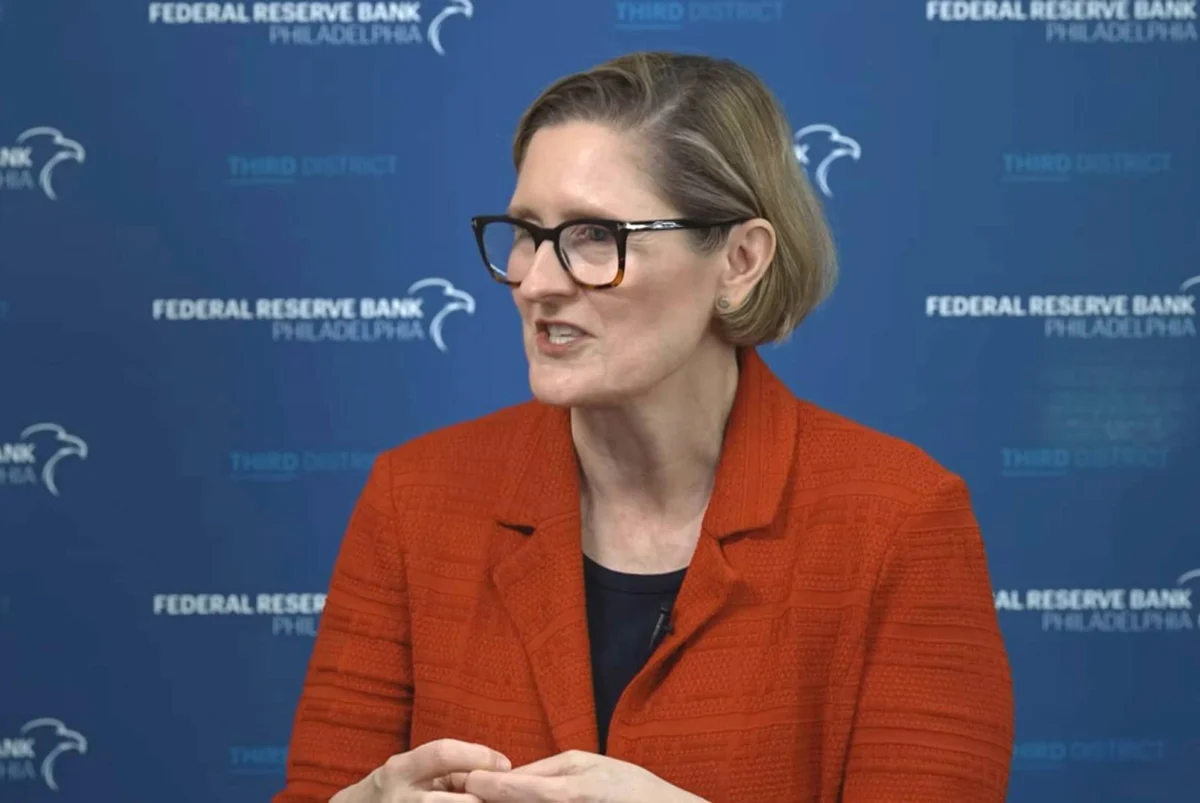
Philadelphia Federal Reserve President Anna Paulson declared on Tuesday that she believes the prevailing level of interest rates is adequate to steer inflation back towards the central bank’s long-term objective of 2%. Speaking in her inaugural interview with CNBC, Paulson underscored her commitment to an adaptive monetary policy framework while expressing firm conviction in her vote last week to maintain the Federal Reserve’s benchmark borrowing rate within its current target range of 3.5%-3.75%. Her remarks provide critical insight into the internal deliberations of the Federal Open Market Committee (FOMC) as the U.S. economy navigates a complex period of disinflationary pressures and moderating growth.
The Philosophy of "Mildly Restrictive" Policy
"I think we need policy that’s mildly restrictive, and I think policy has been mildly restrictive to get underlying inflation back down to 2% in an acceptable time period," Paulson articulated to CNBC’s Steve Liesman during a "Squawk Box" segment. This statement highlights a key tenet of the current Fed strategy: aiming for a policy stance that gently restrains economic activity without inducing an overly sharp downturn, thereby allowing inflationary pressures to dissipate organically. The concept of "mildly restrictive" implies that the federal funds rate is set above the estimated neutral rate—the theoretical interest rate that neither stimulates nor constrains economic growth. While the neutral rate is not directly observable and is subject to ongoing debate among economists, the consensus among many Fed officials, including Paulson, suggests that the 3.5%-3.75% range indeed fulfills this criterion.
Paulson emphasized the necessity of observing tangible progress from the current juncture. "I need to see progress from here," she stated, linking future policy decisions directly to incoming economic data. This data-dependent approach is a cornerstone of modern central banking, particularly in an environment where economic signals can be mixed and the lagged effects of monetary policy are still unfolding. The ongoing debate within the Fed about the precise degree of restriction imposed by current policy remains central to future decisions, especially given that inflation has persistently remained above the 2% target throughout the year.
Background: The Federal Reserve’s Dual Mandate and Inflation Targeting
To fully appreciate Paulson’s comments, it is essential to understand the Federal Reserve’s overarching mission. Congress has tasked the Fed with a "dual mandate": to foster maximum employment and stable prices. For decades, "stable prices" has been quantitatively defined by the FOMC as an average annual inflation rate of 2%, as measured by the Personal Consumption Expenditures (PCE) price index. This target is not merely an arbitrary figure; it is considered the optimal level to support long-term economic growth, prevent deflationary spirals, and allow for appropriate wage and price adjustments.
The primary tool the Fed employs to achieve its mandate is the federal funds rate, the target rate for overnight borrowing between banks. By adjusting this rate, the Fed influences other interest rates throughout the economy, impacting everything from mortgage rates and business loans to consumer credit. During periods of high inflation, the Fed typically raises rates to cool demand, while in downturns, it lowers them to stimulate activity. The period leading up to 2026 saw an aggressive series of rate hikes initiated in 2022 and 2023, responding to a post-pandemic surge in inflation fueled by robust consumer demand, supply chain disruptions, and geopolitical events. These hikes brought the federal funds rate from near-zero levels to its current restrictive stance, a rapid tightening cycle unprecedented in recent history.
Chronology of the July 2026 FOMC Meeting and Divergent Views
The Federal Open Market Committee’s meeting last week, which concluded on July 29, 2026, was a pivotal moment in the ongoing battle against inflation. As a voting member of the FOMC, Paulson participated in the decision to hold the benchmark borrowing rate steady at 3.5%-3.75%. The vote, which ended with a 9-3 tally in favor of holding rates, revealed a clear divergence of opinion among the policymakers.
For Paulson, the decision to vote with the majority was straightforward. "For me, it was not a close call," she affirmed, indicating a strong conviction that the current policy setting is appropriate. Her comfort with the hold stems from her assessment of "underlying inflation," which she estimates to be in the range of 2.4%-2.8%, excluding volatile components like energy supply shocks and the impact of tariffs. This figure is notably lower than the 3.3% core PCE inflation rate reported by the Commerce Department for June 2026, which the Fed typically uses as its primary forecasting tool. The discrepancy between Paulson’s underlying inflation estimate and the official core PCE figure suggests that she believes a significant portion of current inflation is transitory or driven by factors beyond the direct influence of monetary policy, thereby justifying a less aggressive stance.
However, the three dissenting voters, whose identities were revealed in subsequent reports, expressed concerns that the current rate level might not be sufficiently restrictive to bring inflation down expediently to the 2% target. These "hawks" within the committee likely argued for an additional rate hike, fearing that prolonged elevated inflation risks becoming entrenched in wage and price-setting mechanisms. Their concerns often revolve around the potential for inflation expectations to de-anchor, making the Fed’s job significantly harder in the future. This internal debate underscores the challenges of navigating an economy with persistent, albeit moderating, inflationary pressures.
Current Economic Landscape and Supporting Data

The economic backdrop against which Paulson and the FOMC made their decision is characterized by several key indicators:
- Inflation: As noted, the core PCE inflation rate, the Fed’s preferred measure, stood at 3.3% in June 2026. This is a significant improvement from its peak but still considerably above the 2% target. Headline PCE inflation, which includes volatile food and energy prices, has also shown some moderation but remains sensitive to global commodity markets. The Consumer Price Index (CPI), another widely watched inflation metric, has similarly shown a decelerating trend, yet its year-over-year growth often outpaces PCE, reflecting different methodologies and coverage.
- Economic Growth: The U.S. economy slowed to a 1.5% annualized growth rate in the second quarter of 2026. This figure, while positive, indicates a significant deceleration from earlier periods of robust expansion. A slower growth rate is often a desired outcome of restrictive monetary policy, as it helps to cool aggregate demand and reduce inflationary pressures. However, too sharp a deceleration could raise concerns about an impending recession.
- Labor Market: While not explicitly mentioned in the original snippet, a "mildly restrictive" policy stance typically aims to ease tightness in the labor market without causing a substantial increase in unemployment. Assuming a plausible scenario for mid-2026, the unemployment rate might be slightly above its post-pandemic lows, perhaps around 4.0%-4.2%, but still indicative of a relatively strong labor market. Wage growth, a key determinant of service sector inflation, would likely be moderating but still elevated compared to pre-pandemic trends, reflecting ongoing demand for labor.
- Consumer Spending and Business Investment: Consumer spending, a major driver of U.S. economic activity, would likely be showing signs of moderation, influenced by higher borrowing costs and cumulative inflation. Business investment might also be slowing as companies face increased financing expenses and greater economic uncertainty. The housing market, particularly sensitive to interest rates, would likely be experiencing reduced activity and potential price corrections in some areas.
Paulson acknowledged some "mild progress over the last several months" on the inflation front, suggesting that the cumulative effect of past rate hikes is indeed beginning to filter through the economy. However, she clearly signaled that this progress is insufficient. "I want to see more progress on that, and that’s what I’m really focused on," she stressed.
The Path Forward: Data Dependence and Recalibration
The conditional nature of Paulson’s outlook is crucial: "If we don’t see that progress, then we have to be open to recalibrating monetary policy. You know, we need to get to 2%." This statement underscores the Fed’s commitment to its inflation target and its willingness to adjust course if economic data deviates from expectations. "Recalibrating monetary policy" could mean either raising rates further if inflation proves more stubborn or, conversely, considering cuts if disinflation accelerates faster than anticipated or if the economy shows signs of significant weakness.
This data-dependent approach is a delicate balancing act. On one hand, the Fed must avoid prematurely easing policy, which could reignite inflation and undo the hard-won progress. On the other hand, over-tightening risks pushing the economy into an unnecessary recession, leading to job losses and financial instability. The central bank’s communication strategy is vital in this environment, as clear signals help manage market expectations and reduce volatility.
Broader Economic Implications and Market Reactions
The Federal Reserve’s monetary policy decisions have far-reaching implications across the economy:
- For Businesses: Higher interest rates translate to increased borrowing costs for businesses, impacting investment decisions, expansion plans, and overall profitability. Small businesses, often more reliant on variable-rate loans, can be particularly affected. This restrictive environment can lead to slower hiring or even layoffs in some sectors.
- For Consumers: Consumers face higher interest rates on mortgages, auto loans, and credit card debt, directly impacting their purchasing power and disposable income. The housing market, in particular, is sensitive to these changes, with higher mortgage rates cooling demand and potentially leading to price adjustments.
- For Financial Markets: Equity markets often react to the prospect of higher rates with caution, as they can dampen corporate earnings and make bonds more attractive relative to stocks. Bond yields tend to rise with rate hike expectations, reflecting the increased cost of borrowing for governments and corporations. The stability of the financial system also hinges on the Fed’s ability to manage inflation without causing undue stress.
- Global Economy: As the world’s largest economy and holder of the primary reserve currency, U.S. monetary policy has significant global ramifications. Higher U.S. rates can attract capital flows, strengthening the dollar and potentially putting pressure on other countries’ currencies and economies, especially those with dollar-denominated debt.
The market’s reaction to Paulson’s interview would likely be one of careful consideration. Her affirmation of the current policy as "mildly restrictive" and her emphasis on requiring "more progress" before any recalibration would likely be interpreted as a signal that the Fed is unlikely to cut rates soon and remains vigilant against inflation. This stance could reassure some investors that the Fed is committed to its target, while others might worry about the potential for prolonged higher rates to weigh on economic growth.
Governance and Operational Discussions within the Fed
Beyond monetary policy, Paulson also touched upon internal discussions regarding the operational aspects of the Federal Reserve. She acknowledged Chairman Kevin Warsh’s initiative to explore potential changes, including reducing the frequency of FOMC meetings from the current schedule of eight per year. "It’s healthy to have a discussion about that," Paulson commented, indicating an openness to procedural reforms.
Such a discussion would involve weighing the benefits of reduced meeting frequency—potentially allowing more time for data to accumulate, reducing market jitters around frequent announcements, and streamlining internal processes—against the drawbacks, such as diminished flexibility to respond to rapidly evolving economic conditions and potentially less frequent communication with the public. Historically, the FOMC has met approximately every six weeks, a cadence established to ensure timely responses to economic shifts while also allowing sufficient time for policy actions to take effect and for new data to emerge. Any change to this long-standing practice would represent a significant shift in the Fed’s operational governance.
Conclusion: A Vigilant Stance for Price Stability
Anna Paulson’s statements underscore the Federal Reserve’s unwavering commitment to achieving its 2% inflation target, even as the economic landscape presents a nuanced picture of moderating growth and persistent, albeit decelerating, price pressures. Her confidence in the current "mildly restrictive" policy stance, coupled with a clear conditionality for future adjustments based on tangible progress, paints a picture of a central bank maintaining vigilance. The internal debates within the FOMC, particularly the 9-3 vote and the dissenting voices, highlight the complexities of consensus-building in a dynamic economic environment. As the Fed continues its mission to foster price stability, the market and the public will be closely watching for the "more progress" Paulson and her colleagues demand, understanding that the path to 2% inflation remains a careful balancing act with profound implications for the U.S. and global economies.