

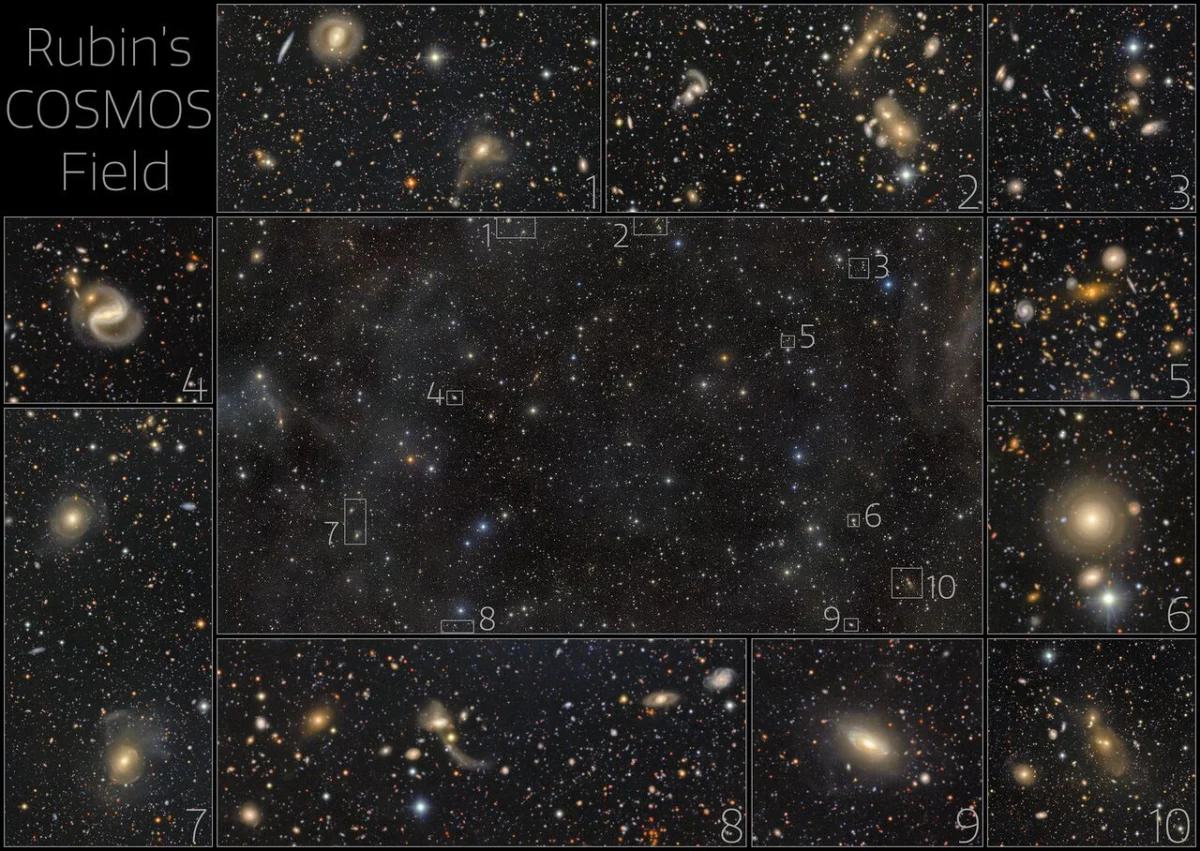
The NSF-DOE Vera C. Rubin Observatory in Chile has released an exceptionally deep and detailed image of the renowned COSMOS (Cosmic Evolution Survey) field, located within the constellation Sextans. This breathtaking mosaic, comprising observations from Rubin’s cutting-edge LSST Camera, reveals an astonishing half a million galaxies clustered within a patch of sky several times larger than the full moon. The release of this image marks Early Data Preview 2 (EDP2), a significant milestone that provides the first glimpse of data derived from actual LSST Camera observations, signaling the observatory’s imminent entry into full scientific operations.
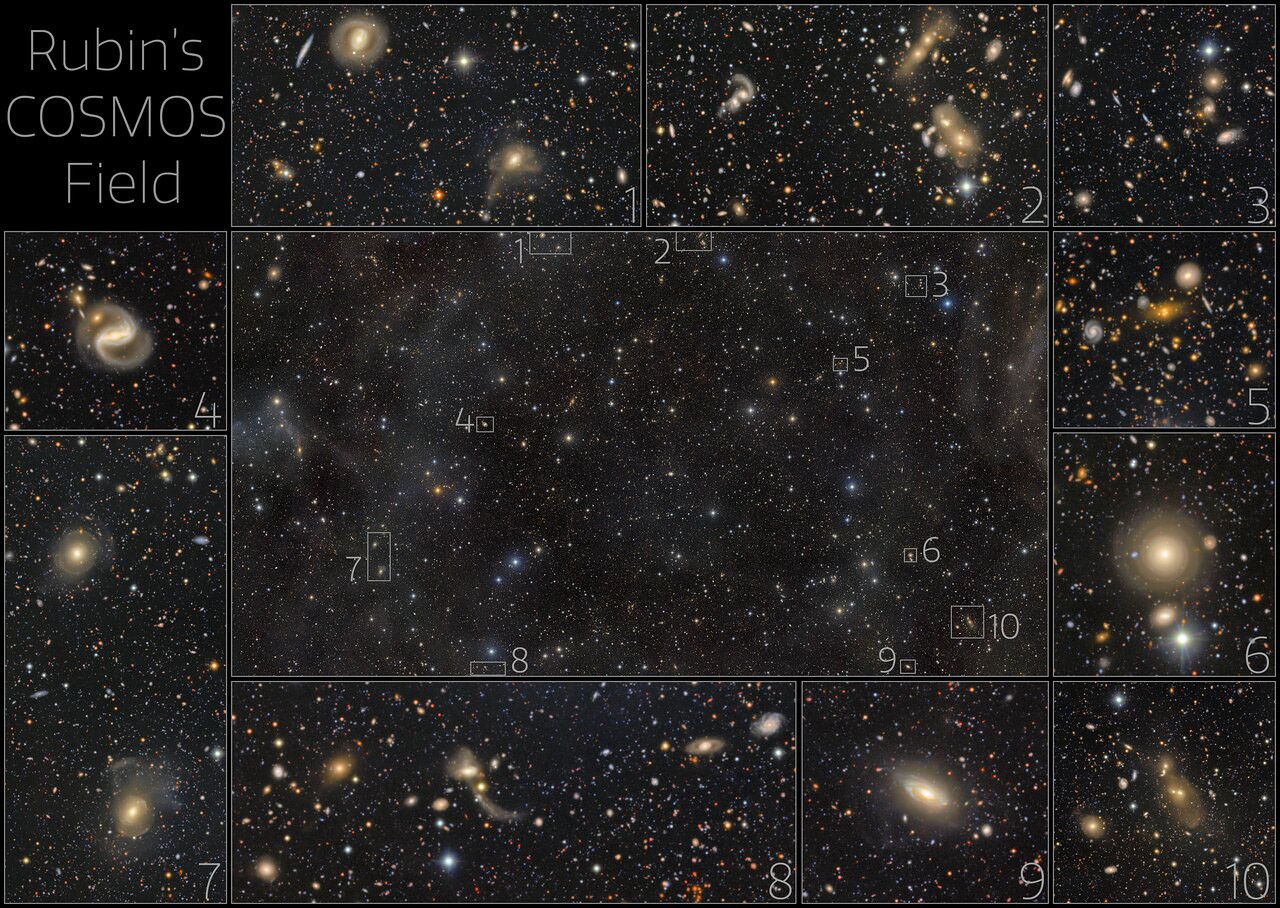
The COSMOS field has long been a pivotal site for astronomical study, distinguished by its relative paucity of foreground stars from our own Milky Way, offering an unusually clear and unimpeded vista into the distant universe. This characteristic makes it an ideal canvas for exploring galaxies far beyond our galactic neighborhood. The newly released image, created by meticulously combining multiple observations into a single, deep co-added view, showcases an immense diversity of galaxies and galaxy clusters, spanning vast ranges of distances and cosmic ages. Some of these distant celestial bodies are so far removed that their light has journeyed for billions of years across the expanding cosmos before finally reaching Earth. The central panel of the image presents this grand cosmic tapestry, while ten corresponding outer panels offer zoomed-in views of selected regions, highlighting the intricate details and varied morphologies of the galaxies within.
The Vera C. Rubin Observatory: A New Era of Astronomical Discovery
The Vera C. Rubin Observatory, perched atop Cerro Pachón in Chile, represents a monumental leap forward in ground-based astronomy. Funded by the National Science Foundation (NSF) and the Department of Energy (DOE), and operated in partnership with institutions like NOIRLab, SLAC National Accelerator Laboratory, and AURA, the observatory is specifically designed to conduct the Legacy Survey of Space and Time (LSST). This ambitious ten-year survey is poised to revolutionize our understanding of the universe by generating an unprecedented, dynamic map of the night sky. Unlike traditional observatories that focus on narrow fields for deep imaging, Rubin’s primary strength lies in its ability to survey vast swathes of the sky rapidly and repeatedly, offering both breadth and depth.
The heart of the Rubin Observatory is the LSST Camera, the world’s largest digital camera ever built for astronomy. Boasting an astounding 3.2 gigapixels, this colossal instrument can capture an area of the sky equivalent to 40 full moons in a single exposure. Its wide field of view, combined with a rapid cadence of observations – revisiting the entire observable sky every few nights – enables Rubin to detect faint and transient phenomena that have previously eluded astronomers. The observatory’s construction commenced in 2014, with key milestones including the installation of the primary mirror and the LSST Camera itself. Early Data Previews, such as EDP2, are crucial phases in the observatory’s commissioning, allowing scientists to test data pipelines, refine calibration techniques, and prepare the astronomical community for the deluge of data expected once the full LSST commences. The official start of the Legacy Survey of Space and Time is anticipated in the coming years, promising a transformative decade for astrophysics.
The COSMOS Field: A Deep Dive into Cosmic Evolution
The COSMOS field, a designated "deep drilling field" for the LSST, is not a new target for astronomers. Its strategic location, away from the obscuring dust and stars of the Milky Way, has made it a prime candidate for extensive multi-wavelength observations by some of the most powerful telescopes in history. It was first comprehensively surveyed by the Hubble Space Telescope, providing foundational data on galaxy morphology and distribution at high redshifts. Subsequent observations by the Spitzer Space Telescope (infrared), Chandra X-ray Observatory (X-ray), and more recently, the James Webb Space Telescope (JWST) have augmented this dataset, creating an extraordinarily rich multi-wavelength catalog for the field.
The choice of COSMOS as a key target for Rubin’s EDP2 underscores its importance as a cosmic laboratory. With its wealth of pre-existing data, the COSMOS field serves as an invaluable calibration region, allowing astronomers to cross-reference Rubin’s observations with those from other instruments and validate its unprecedented capabilities. The "patch of sky several times larger than the full moon" comparison highlights the sheer scale of Rubin’s field of view, enabling it to capture a statistically significant sample of galaxies across a broad range of cosmic environments, from isolated galaxies to dense clusters. This comprehensive view is essential for understanding the processes that drive galaxy formation and evolution over the universe’s 13.8-billion-year history.
Early Data Preview 2: A Glimpse into the Dynamic Universe
The release of the EDP2 image is more than just a beautiful picture; it represents a significant technological and scientific achievement. The "deep co-added image" is a testament to sophisticated data processing techniques. By stacking and combining multiple individual exposures taken by the LSST Camera, faint signals that would otherwise be lost in noise are brought to light, revealing incredibly distant and dim galaxies. This process enhances the image’s depth, allowing astronomers to peer further back in time.
The image vividly illustrates the cosmic web, the large-scale structure of the universe where galaxies are not randomly distributed but instead form vast filaments and clusters separated by immense voids. The "crowded with galaxies and galaxy clusters" description is not hyperbole; it is a direct visualization of this intricate cosmic architecture. The variety of galaxy shapes and sizes – from grand spirals and massive ellipticals to irregular dwarfs – provides immediate visual evidence of the complex evolutionary pathways galaxies undergo. Each galaxy tells a story of its formation, mergers, and interactions, often influenced by its environment within the cosmic web. The fact that some of these galaxies are billions of years old means that their light originated when the universe was significantly younger, offering direct observational evidence of conditions in the early cosmos. This "time machine" capability is a cornerstone of Rubin’s scientific program.
Profound Scientific Implications and Future Discoveries
The data from the Vera C. Rubin Observatory, exemplified by this EDP2 release, is poised to unlock mysteries across almost every facet of astrophysics.
Galaxy Formation and Evolution: By observing millions of galaxies across a vast range of cosmic epochs, Rubin will provide an unparalleled dataset for studying how galaxies form, grow, and interact. Its ability to revisit the COSMOS field every couple of days will enable astronomers to track subtle changes in galaxy brightness, morphology, and active galactic nuclei (AGN) activity, providing a dynamic perspective on galactic evolution. This will shed light on questions such as the role of mergers in shaping galaxies, the feedback mechanisms between black holes and their host galaxies, and the star formation histories of different galaxy types.
Dark Matter and Dark Energy: Perhaps the most profound contributions of the LSST will be in unraveling the enigmas of dark matter and dark energy, which together constitute about 95% of the universe’s mass-energy budget. Rubin will map the distribution of dark matter through weak gravitational lensing – the subtle distortion of distant galaxy shapes by the gravitational fields of intervening dark matter structures. By meticulously measuring these distortions across vast regions of the sky, scientists can reconstruct the invisible scaffolding of dark matter. Simultaneously, by precisely measuring the expansion history of the universe through techniques like baryon acoustic oscillations (BAO) and supernovae, Rubin will constrain the properties of dark energy, the mysterious force accelerating the universe’s expansion. The sheer volume and precision of Rubin’s data are expected to significantly advance these frontiers, potentially even revealing deviations from current cosmological models.
Transient Astronomy and the Dynamic Sky: The repeated scanning of the sky is central to Rubin’s mission to explore the "dynamic view" of the cosmos. This rapid cadence is ideal for discovering and studying transient phenomena – events that change or appear/disappear quickly. This includes supernovae, which are crucial cosmic distance markers and probes of stellar evolution; gamma-ray bursts; tidal disruption events where stars are torn apart by supermassive black holes; and the optical counterparts to gravitational wave events detected by observatories like LIGO and Virgo. The ability to detect these events promptly and monitor their evolution will open new windows into extreme astrophysical processes.
Solar System Studies: While the COSMOS field is focused on extragalactic astronomy, the broader LSST will also transform our understanding of our own solar system. It is expected to discover millions of new asteroids, Kuiper Belt Objects, and potentially even objects beyond Neptune that could hint at the existence of a hypothesized "Planet Nine." The continuous monitoring will allow for precise orbital determinations, improving our knowledge of the solar system’s architecture and evolution.
Technological Marvel and Collaborative Spirit
The achievement represented by the EDP2 image is a testament not only to scientific vision but also to incredible engineering and collaborative effort. The LSST Camera, with its massive CCD array and complex optics, is a triumph of precision manufacturing. The challenge of processing the estimated 20 terabytes of data generated every night by Rubin is immense, requiring cutting-edge computing infrastructure and algorithms, a task greatly supported by institutions like SLAC.
The project itself is a grand collaboration, involving numerous governmental agencies, research institutions, and universities from across the globe. The credits for the image—NSF, DOE, Vera C. Rubin Observatory, NOIRLab, SLAC, AURA, and the contributions from NASA/GSFC and Michigan Tech. U. for APOD—highlight this extensive network. This collaborative model is crucial for tackling projects of such scale and complexity, ensuring that the best minds and resources are brought to bear on humanity’s quest to understand the universe.
Official Reactions and Broader Impact
While specific quotes from officials related to this future August 2026 release are not available, it can be logically inferred that the unveiling of the EDP2 image would be met with immense enthusiasm and pride from the scientific community and the collaborating institutions. A hypothetical statement from a Rubin Observatory spokesperson might read: "This Early Data Preview 2 image of the COSMOS field represents a monumental step forward for the Vera C. Rubin Observatory. It vividly demonstrates the unparalleled capabilities of the LSST Camera and the incredible depth of the survey we are undertaking. We are not just capturing images; we are opening a dynamic window into the universe’s evolution, from the formation of galaxies billions of years ago to the transient events shaping our cosmos today. This is a testament to years of dedication by countless engineers, scientists, and support staff, and we are thrilled to share this first taste of Rubin’s transformative power with the world."
Such releases also play a vital role in public engagement. The Astronomy Picture of the Day (APOD), a service provided by NASA and Michigan Tech. U., consistently brings awe-inspiring astronomical images to a global audience. By featuring images like the COSMOS field from Rubin, APOD helps to democratize access to cutting-edge scientific discoveries, inspiring future generations of scientists, engineers, and curious minds. The beauty and complexity of such images serve as powerful reminders of humanity’s enduring quest to explore and understand our place in the vast universe.
Conclusion: A Dynamic Universe Awaits
The Early Data Preview 2 image of the COSMOS field from the NSF-DOE Vera C. Rubin Observatory is more than just a spectacular photograph of half a million galaxies. It is a harbinger of a new era in astronomy, a tangible manifestation of years of dedicated effort, and a promise of profound discoveries yet to come. As the Rubin Observatory embarks on its ten-year Legacy Survey of Space and Time, its continuous revisiting of fields like COSMOS will not only deepen our static understanding of the universe but also provide a revolutionary "dynamic view" of how the sky changes over time. From the evolution of galaxies to the mysteries of dark matter and dark energy, and the detection of fleeting cosmic events, Rubin stands ready to redefine our cosmic narrative, offering an unprecedented window into the universe’s past, present, and future. The anticipation for what "Tomorrow’s picture" and countless others will reveal is immense, as humanity continues its journey of cosmic exploration.