

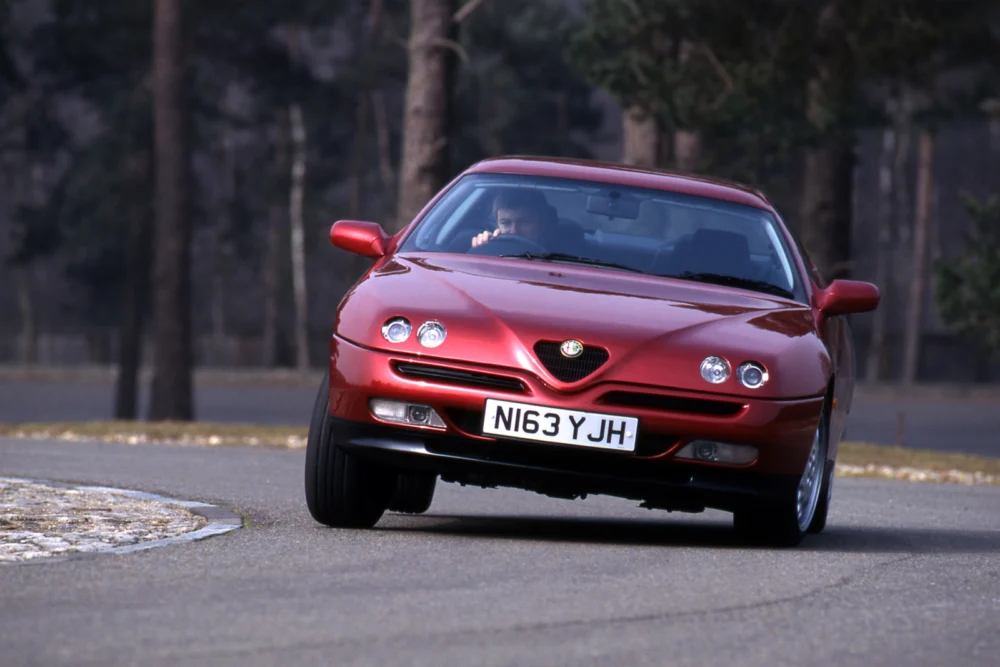
The automotive landscape of the late 1980s and early 1990s was a period of profound transition for Alfa Romeo. Following its acquisition by Fiat in 1986, the storied Milanese marque faced the daunting task of modernizing its lineup while preserving the "Cuore Sportivo" (Sporting Heart) that enthusiasts demanded. The challenge reached a critical juncture with the development of the 916-series Alfa Romeo GTV and Spider. These models were tasked with replacing a legend that had been out of production for seven years, yet they were mandated to utilize a platform that many critics believed was fundamentally unsuited for a premium sports car: the front-wheel-drive architecture of the 1988 Fiat Tipo.
Historical Context: Bridging the Seven-Year Gap
To understand the pressure facing Alfa Romeo’s engineers in the early 1990s, one must look at the vacuum left by the preceding GTV. The outgoing Alfetta-based GTV, a rear-wheel-drive four-seater coupe styled by the legendary Giorgetto Giugiaro, had become a cult classic. Despite its flaws—most notably a propensity for corrosion and a notoriously difficult gearshift linkage due to its rear-mounted transaxle—it possessed a sophisticated mechanical soul.
When production of the original GTV ceased in 1987, Alfa Romeo entered a period of identity crisis. The brand needed a flagship duo—a coupe and a roadster—to re-establish its credentials. However, the Fiat Group’s strategy emphasized platform sharing to ensure financial viability. The decision to use the "Type Two" (Tipo) platform, which also underpinned the boxy, functional Fiat Tipo hatchback and the Lancia Dedra, was met with immediate skepticism from the motoring press. Critics argued that a front-wheel-drive platform derived from a mass-market family car could never replicate the balanced, rear-drive dynamics essential to the Alfa Romeo brand.
The Engineering Turning Point: Giancarlo Travaglio’s Vision
The transformation of the GTV and Spider from a compromised corporate project into a dynamic success story is largely attributed to Giancarlo Travaglio, Alfa Romeo’s chief chassis engineer during the early 1990s. Travaglio and his team rejected the notion that the Tipo platform dictated a mediocre driving experience. Instead, they sought to push the boundaries of front-wheel-drive technology.
In a move that surprised many industry observers, the engineering team selected two specific benchmarks for the 916-series development: the Honda Civic VTi and the front-wheel-drive Lotus Elan (M100). The Civic VTi was lauded for its high-revving engine and sharp handling, while the Lotus Elan was considered the gold standard for front-wheel-drive chassis tuning. Travaglio famously utilized high-speed testing to refine the cars, later recounting his practice of performing drifts at 115 mph to understand the nuances of "chassis equilibrium."
Chronology of Development and Design
The development of the GTV and Spider followed a complex timeline influenced by shifting corporate priorities and international market ambitions:
- 1988: The Fiat Tipo is launched, introducing the flexible Type Two platform.
- Late 1980s: Enrico Fumia at Pininfarina begins work on the styling of the new GTV and Spider, characterized by the distinctive "clamshell" bonnet and quad-projector headlights.
- 1991-1992: Initial prototypes are tested. Early designs featured a narrower track and a simplified rear suspension system inherited from the standard Fiat parts bin.
- 1993: A pivotal shift occurs. Fiat Auto CEO Paolo Cantarella, an enthusiast with a deep appreciation for driving dynamics, intervenes. He deems the initial chassis prototypes insufficient for the Alfa Romeo badge. Simultaneously, plans to relaunch Alfa Romeo in the United States gain momentum, requiring the cars to have a more muscular, wide-body stance.
- 1994: The GTV (Coupe) and Spider (Roadster) make their official world debut at the Paris Motor Show.
- 1995: Commercial launch begins in Europe.
Technical Innovation: The Multi-Link Solution
The most significant departure from the base Fiat Tipo architecture was the rear suspension. To satisfy Cantarella’s demands and Travaglio’s performance targets, the engineering team discarded the simple trailing-arm setup of the Tipo. In its place, they developed an advanced multi-link rear suspension system.
This system was mounted to a dedicated, high-rigidity vacuum-cast aluminum subframe. The geometry was meticulously designed to provide passive rear-wheel steering. Under low to moderate cornering loads, the rear wheels would counter-steer slightly to improve turn-in agility. However, under high-speed cornering or heavy lateral loads, the kinematics shifted to steer the rear wheels in phase with the fronts. This "in-phase" steering provided stability and reduced the tendency for the rear of the car to break traction abruptly, a common trait in high-performance front-wheel-drive vehicles of the era.
Supporting data from the period suggests that this suspension allowed the GTV to achieve lateral acceleration figures that rivaled more expensive rear-wheel-drive competitors. The inclusion of this bespoke engineering increased production costs but was deemed necessary to justify the Alfa Romeo premium.
The Twin Spark Engine: A Masterclass in Four-Cylinder Design
While the chassis was being revolutionized, the powertrain team developed a new generation of engines to match. The 2.0-liter Twin Spark 16-valve engine became the heart of the range. While it shared a block with Fiat’s modular engine family, the cylinder head was pure Alfa Romeo.
The engine featured two spark plugs per cylinder—one primary and one secondary—to optimize combustion efficiency and flame propagation. Key technical specifications included:
- Output: 150 brake horsepower (bhp) and 138 lb-ft of torque.
- Valvetrain: Double overhead camshafts (DOHC) with a variable valve timing (VVT) system on the intake cam.
- Smoothness: The inclusion of twin counter-rotating balancer shafts, driven at twice the engine speed, to eliminate the secondary vibrations inherent in four-cylinder engines.
- Redline: A spirited 7,000 rpm limit, with the electronic governor not intervening until 7,300 rpm.
This engine provided the GTV with a 0-60 mph time of approximately 8.4 seconds and a top speed of 130 mph, figures that were highly competitive for a 2.0-liter naturally aspirated car in 1995.
Market Reception and Comparative Analysis
Upon its release, the GTV and Spider were praised for their "understeer-banishing" obedience. Journalists noted that the car’s ability to tighten its line upon lifting off the throttle mid-corner—a characteristic known as lift-off oversteer—was handled with a level of predictability and composure that was rare for front-wheel-drive cars.
When compared to the Mazda MX-5, the industry benchmark for affordable sports cars, the Alfa Romeo offered a different proposition. While it lacked the "tail-out" playfulness of the rear-drive Mazda, the GTV provided superior high-speed stability and all-weather traction. The stiffness of the GTV’s chassis, particularly the coupe, was significantly higher than its predecessors, leading to a more refined and precise driving experience.
Broader Impact and Implications for Alfa Romeo
The success of the 916-series GTV and Spider had lasting implications for the brand. It proved that the "Tipo" platform strategy could work if sufficient investment was made in the "touchpoints" of driving—suspension, steering, and engine character.
- Platform Validation: The lessons learned from the GTV’s multi-link rear suspension directly informed the development of the Alfa Romeo 156, which launched in 1997. The 156 went on to become a massive commercial success and won the European Car of the Year award.
- Brand Perception: The GTV and Spider successfully bridged the gap between the "old" Alfa Romeo and the "new" Fiat-owned era. They demonstrated that front-wheel drive was not an inherent barrier to creating a true enthusiast’s car.
- Design Legacy: The Pininfarina design remained so contemporary that the cars stayed in production for nearly a decade, receiving only minor aesthetic updates in 1998 and 2003.
In retrospect, the 916-series project was a triumph of engineering over accounting. By refusing to accept the limitations of the base metal provided by the Fiat Tipo, Giancarlo Travaglio and his team ensured that the GTV and Spider were not merely badge-engineered clones, but sophisticated machines that earned their place in the Alfa Romeo pantheon. The car remains a case study in how dedicated chassis tuning and a commitment to mechanical excellence can elevate a humble platform to legendary status.