


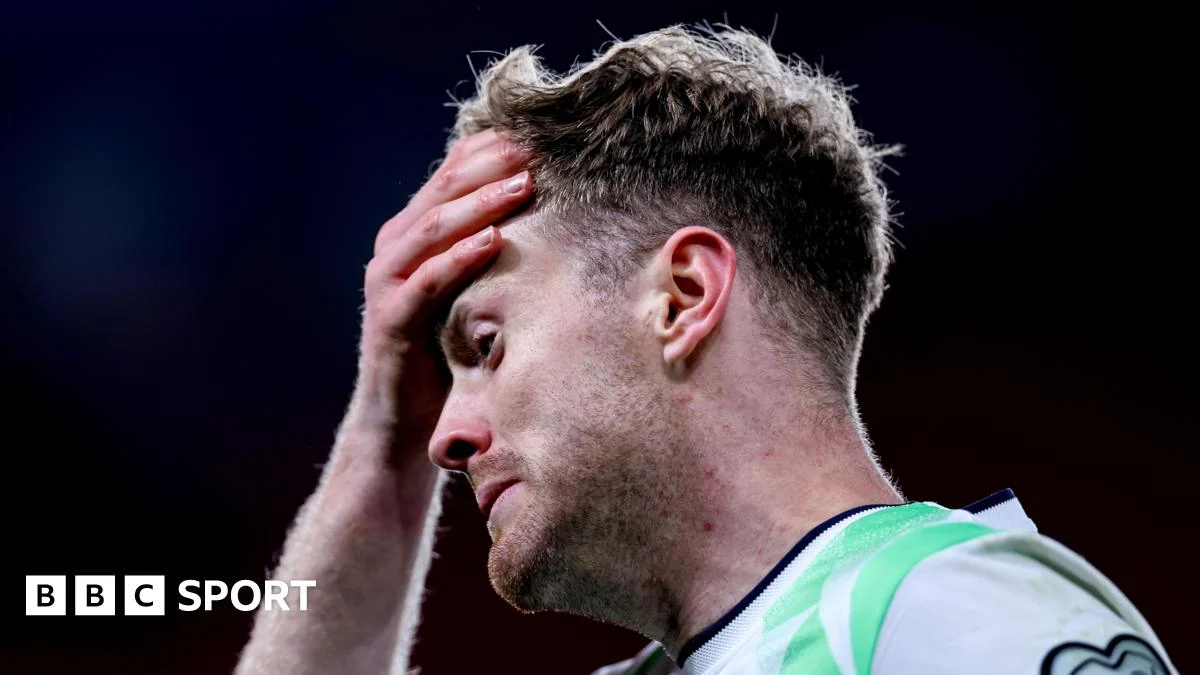
The full gamut of emotions synonymous with do-or-die international football was on display as the Republic of Ireland’s World Cup dream was left in ruins following a devastating penalty shootout defeat by the Czech Republic. This heartbreaking conclusion to a campaign that had ignited fervent hope among the Irish faithful marks another chapter in the nation’s storied, and often painful, relationship with penalty shootouts on the global stage. The loss, confirmed in the early hours of Friday morning, extinguished the Republic of Ireland’s aspirations of returning to the World Cup finals for the first time in 24 years, leaving a nation to grapple with the familiar sting of near-misses and the agonizing "what ifs."
The week leading up to the crucial playoff semi-final had been saturated with an almost palpable sense of anticipation. Thousands of Irish supporters, many without match tickets but driven by an unshakeable belief, descended upon Prague. This influx of green jerseys and buoyant optimism was fueled by a dramatic turnaround in the qualifying campaign. Under the guidance of manager Heimir Hallgrimsson, the team had navigated a turbulent path, culminating in inspiring and hard-fought victories against formidable opponents like Portugal and Hungary. The sight of fans, some humorously clad in Troy Parrott costumes, flooding the historic Czech capital underscored a renewed conviction that this Irish squad possessed the mettle to break a long-standing World Cup drought.
The atmosphere within the raucous Fortuna Arena mirrored this fervent expectation. For significant periods of the match, the narrative seemed poised to replicate the euphoria witnessed in Budapest following Troy Parrott’s dramatic last-gasp winner in November, a moment that had propelled Ireland into this very playoff contention. Indeed, the early stages of the match offered genuine encouragement. Parrott, once again stepping into a pivotal role, calmly converted a penalty to give his side the lead. This was further compounded by an own goal from Czech goalkeeper Matej Kovar, seemingly steering Ireland towards a playoff final to be held in Dublin, a prospect that had been widely discussed and eagerly anticipated. The dream of a home final, a tangible reward for their resurgence, felt within reach.
However, the unpredictable nature of knockout football, particularly in such high-stakes encounters, soon asserted itself. What began as elation swiftly morphed into agonizing frustration. A foul committed by Ryan Manning on Czech captain Ladislav Krejci presented the hosts with a penalty opportunity. Patrik Schick duly converted, a clinical strike that not only halved the deficit but, crucially, injected a seismic shift in momentum. This moment served as a stark reminder of how quickly fortunes can turn when margins are so fine, and how a single lapse can unravel meticulously laid plans.
With the game precariously balanced on a knife-edge, the Republic of Ireland had opportunities to re-establish their commanding position. Jayson Molumby and Troy Parrott both went agonizingly close to restoring a precious two-goal cushion, efforts that would have significantly altered the complexion of the match and the ensuing pressure on the Czechs. Yet, football often punishes missed chances. In the 86th minute, a well-placed header from Krejci found the net, leveling the score and cruelly forcing the tie into extra time. This late equalizer was a body blow to Irish hopes, a moment where the dream began to recede and the specter of a penalty shootout loomed large.
The added 30 minutes brought further drama and a deeply concerning incident. Sammie Szmodics, a key player for Ireland, was stretchered off the field after an aerial collision that left him unconscious. This distressing event undoubtedly impacted the Irish players, testing their resolve and focus in an already emotionally charged environment. Despite this setback, the team managed to regain enough composure to navigate the initial stages of the subsequent penalty shootout, leading 3-2 after six spot-kicks. The prospect of victory, though now through the lottery of penalties, still flickered.
But fate, as it often does in these scenarios, had a crueler twist in store. Failed attempts by Finn Azaz and Alan Browne proved to be the decisive blows. Their missed penalties, coupled with the Czech Republic’s composure, paved the way for Jan Kliment to score the decisive penalty, completing a whirlwind narrative of Irish heartbreak. The Czech Republic, buoyed by their comeback, advanced to the playoff final against Denmark, leaving the Republic of Ireland to reflect on a campaign that promised so much and ended in such agonizing fashion.
A Familiar Echo of Penalty Pain
The Republic of Ireland are, unfortunately, no strangers to the excruciating agony of penalty shootouts. The ghosts of past disappointments, notably the infamous defeat to Spain at the 2002 World Cup and the Euro 2020 playoff loss to Slovakia, undoubtedly cast a long shadow over Thursday’s encounter. However, this particular defeat carries a distinct sting. Unlike previous instances where Ireland found themselves chasing the game, they held a seemingly commanding 2-0 lead in Prague. The subsequent collapse, and the inability to see the game out in regulation time, will lead to profound introspection regarding how control of their destiny was so comprehensively lost.
Captain Nathan Collins, speaking to BBC Sport NI in the immediate aftermath, articulated the profound sense of disappointment. "We were in a good spot," he stated, his voice heavy with emotion. "We were playing really well. We were front-footed, creating chances, our press was working, we were hurting them on the ball. The timing of their first goal probably affects it a bit and knocks the wind out of you. They had a lot to fight for in the second half, but it’s probably the timing of it rather than the performance." This assessment highlights the psychological impact of crucial moments in high-pressure matches, where conceding at pivotal junctures can fundamentally alter the game’s dynamic.
Tactical Decisions and Unanswered Questions
Adding a layer of bitter irony to the outcome was Hallgrimsson’s pre-match revelation that his squad would not be practicing penalties. While this decision may have been made with a strategic rationale, perhaps to avoid undue pressure or over-emphasis on a specific scenario, its ultimate consequence in a penalty shootout loss inevitably invites scrutiny. This approach, or lack thereof, stands in stark contrast to the successful execution of penalties by key players during the match and the shootout itself.
Troy Parrott, the talismanic striker who had already demonstrated his composure from the spot in Budapest, once again proved his mettle. Despite a lengthy delay caused by the Czech Republic’s protests regarding a VAR check on a preceding play, Parrott made no mistake from 12 yards, converting the initial penalty. This coolness under pressure was further evident in the shootout, where he again converted. Adam Idah and Robbie Brady also successfully converted their penalties. However, the crucial misses by Finn Azaz and Alan Browne, both of whom also failed to convert in the Slovakia shootout, proved to be the undoing of the Irish challenge. The weight of expectation, and the psychological burden of past penalty misses, may have played a significant role in these decisive moments.
Collins, who himself struck the crossbar early in the game, a moment that could have further altered the narrative, offered a message of support to his teammates who missed. "They have a lot of thoughts in their head right now," he acknowledged. "There’s not a lot you can say to a person when they’re in that position. But there are not a lot of people that would stand up and take a penalty. It took a lot of bravery for them to do that so there’s no fingers being pointed at them at all." This captain’s response underscores the camaraderie and resilience within the squad, even in the face of profound disappointment.
Looking Ahead: Growth Amidst the Pain
Despite the immediate sting of this devastating defeat, manager Heimir Hallgrimsson, who recently signed a contract extension until 2028, expressed a sense of underlying optimism regarding the future of the Republic of Ireland squad. The immediate focus will shift to a friendly against North Macedonia in Dublin on Tuesday, followed by the resumption of the Nations League in September.
When asked to encapsulate his emotions in the immediate aftermath, the Icelander succinctly stated, "One word, just pain." However, he was quick to highlight the significant "growth" he has witnessed within the squad. This sentiment is rooted in the team’s remarkable recovery from a demoralizing opening loss to Armenia in Yerevan, a setback that many might have expected to derail their campaign. Instead, the team rallied, securing three consecutive wins to reach this crucial playoff stage.
The blend of experience and emerging talent within the current squad also offers a promising outlook. While veteran Seamus Coleman, a stalwart for both Everton and Ireland, is approaching the twilight of his career (though he remained non-committal about immediate retirement), he was the sole player in the starting lineup aged over 30. This suggests a maturing core of players who are entering or are at their peak years, providing a solid foundation for Hallgrimsson’s continued development of the team.
"First of all, we take that with us, that we can play teams higher than us in the Fifa rankings, punch above our weight whether it’s Portugal, Hungary or here, and compete with these teams," Hallgrimsson emphasized, reflecting on the team’s ability to challenge established nations. "We came here with three wins in a row – it’s a long time since that happened for this national team, so there’s growth in the squad, it’s maturing. These have been the biggest games most of these players have played, so that’s encouraging, to know that we are growing." This perspective suggests that while the immediate disappointment is profound, the experience gained in these high-stakes encounters will serve as a valuable stepping stone for the future of Irish international football. The journey may have ended prematurely in Prague, but the lessons learned and the potential displayed offer a glimmer of hope for what lies ahead.