


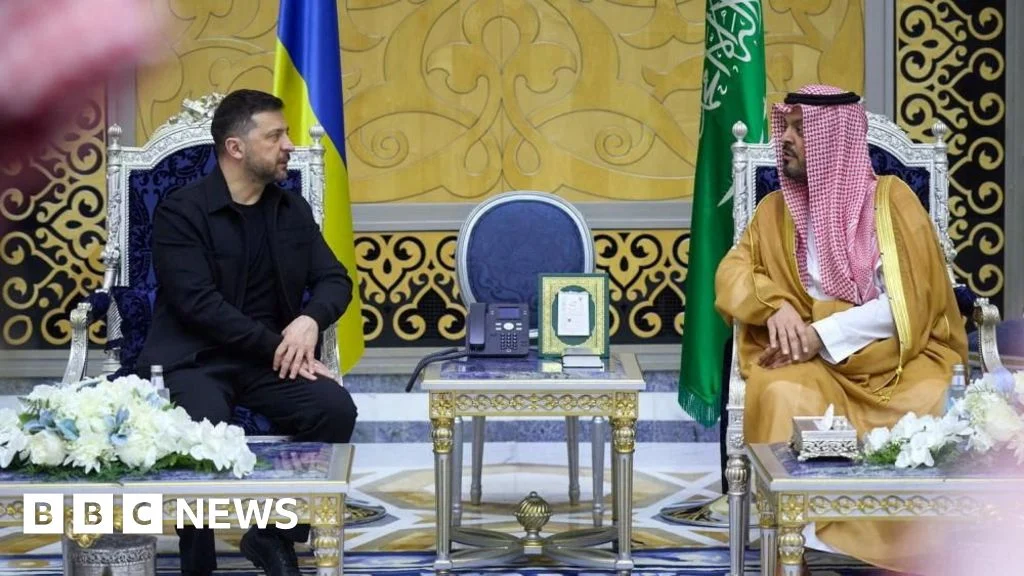
Ukrainian President Volodymyr Zelensky embarked on a strategic visit to Saudi Arabia on Thursday, signaling a robust diplomatic and economic offensive aimed at strengthening Kyiv’s international alliances and securing vital support for its ongoing defense against Russian aggression. The visit followed earlier statements from Zelensky highlighting Ukraine’s rapidly evolving expertise in drone technology and offering it as a potential asset for improving security, particularly within the energy-rich Gulf region. This diplomatic push comes at a critical juncture, as global military aid dynamics face potential shifts, prompting Ukraine to explore diverse avenues for bolstering its capabilities and securing its future.
Zelensky’s Diplomatic Offensive and the Strategic Drone Offer
Upon his arrival in the Saudi capital, President Zelensky underscored the importance of the meetings, stating via social media, "Important meetings are scheduled. We appreciate the support of those who are ready to work with us to ensure security, and we support them too." This statement encapsulates the reciprocal nature of his outreach: Ukraine seeks assistance in its defense, while simultaneously presenting itself as a valuable partner in global security.
Earlier on Thursday, addressing the Joint Expeditionary Force (JEF) summit in Helsinki via video message, Zelensky explicitly positioned Ukraine as a leader in drone warfare innovation. The JEF, a UK-led defense alliance comprising ten Northern European nations, served as a fitting platform for this pronouncement. He argued that Ukraine’s battlefield experience had forged unparalleled expertise in developing and deploying advanced drone systems, which could significantly enhance security worldwide, especially in the volatile Gulf.
"This matters because energy security – and the cost of living, particularly in Europe – depends on their oil, gas and other resources, and stable global markets," Zelensky emphasized. His remarks highlighted the interconnectedness of regional stability and global economic well-being, suggesting that enhancing Gulf security through Ukrainian technology could have far-reaching benefits. He elaborated on the unique value proposition: "The key is not only producing new weapons – especially drones – not just technology, but also real experience in using it, and integrating it with radars, aviation, and other air defense systems. We have this experience." This assertion underscores Ukraine’s transition from a recipient of military aid to a potential provider of cutting-edge defense solutions, forged in the crucible of real-time conflict.
Ukraine’s Emergent Drone Prowess: A Wartime Innovation Hub
The conflict in Ukraine has dramatically accelerated the development and deployment of unmanned aerial vehicles (UAVs) by both sides, transforming drone warfare into a central pillar of modern combat. Ukraine, in particular, has fostered a vibrant ecosystem of drone manufacturers and developers, driven by necessity and innovation. From reconnaissance and target acquisition to direct attack and electronic warfare, Ukrainian-designed and produced drones have proven instrumental in countering the larger, more established Russian military.
This rapid advancement has seen the creation of a diverse range of UAVs, from small, commercially adapted quadcopters used for frontline intelligence to sophisticated long-range attack drones capable of striking deep within enemy territory. Ukrainian engineers and soldiers have become adept at integrating these systems with existing air defense networks, developing countermeasures against electronic jamming, and refining tactics for swarm attacks and persistent surveillance. This practical, real-world application distinguishes Ukraine’s offerings from many theoretical or laboratory-developed systems. The nation’s experience in deploying drones not just as individual units but as integrated components of a comprehensive defense strategy is a powerful selling point.
Companies like Kvertus, a Ukrainian firm specializing in anti-drone electronic warfare systems, and TAF Industries, another manufacturer, represent the burgeoning capacity of Ukraine’s defense industrial base. Their direct engagement with potential Gulf state clients, even while awaiting government approval, signifies the tangible interest these nations hold in Ukraine’s combat-proven solutions.
The Gulf’s Evolving Security Landscape and Defense Needs
The Gulf region, a linchpin of global energy markets, faces complex and persistent security challenges. Countries like Saudi Arabia, Kuwait, Qatar, and the UAE have long been targets of drone and missile attacks, primarily from Houthi rebels in Yemen, often attributed to Iranian backing. These incidents, such as the 2019 attacks on Saudi Aramco oil facilities, have exposed vulnerabilities in traditional air defense systems and highlighted the growing threat posed by asymmetric warfare involving affordable, widely available drone technology.
In response, Gulf states have been actively seeking to modernize and diversify their defense capabilities. While historically reliant on Western suppliers, particularly the United States, there’s a growing impetus to explore alternative sources and technologies that are specifically tailored to counter contemporary threats. Ukraine’s offer of combat-proven drone technology and, crucially, expertise in integrating it into existing air defense architectures, presents an attractive proposition. It offers a chance to acquire cutting-edge, battle-tested solutions that address the specific nature of drone and cruise missile threats, potentially at a more competitive price point than traditional Western systems. Furthermore, cooperation with Ukraine could represent a diversification strategy, reducing over-reliance on a single geopolitical bloc for critical defense needs.
Reciprocal Demands: Ukraine’s Critical Quest for Air Defense
While offering its drone expertise, President Zelensky made it unequivocally clear that Ukraine’s primary objective remains securing its own defense against the ongoing Russian invasion. His visit to Saudi Arabia and outreach to other nations are part of a broader strategy to garner more robust international support, particularly in critical military hardware.
In an interview with the French newspaper Le Monde, Zelensky articulated Ukraine’s reciprocal demand: "We would like Middle Eastern states to also give us an opportunity to strengthen ourselves. They have certain air defense missiles of which we don’t have enough. That’s what we’d like to reach a deal on." This statement underscores Ukraine’s desperate need for enhanced air defense capabilities to protect its cities, infrastructure, and military assets from relentless Russian missile and drone attacks. The Middle East, with its significant investments in advanced air defense systems over decades, possesses inventories that could be crucial for Ukraine. Securing such systems would not only save lives and infrastructure but also free up Ukrainian forces to focus on offensive operations.
Ukrainian Companies Ready, Awaiting Kyiv’s Strategic Nod
The potential for defense cooperation is not merely theoretical. The BBC has reported direct approaches from Gulf states to Ukrainian drone companies. Kvertus, a leading manufacturer of anti-drone electronic warfare systems, confirmed receiving inquiries from Saudi Arabia and Kuwait. Yaroslav Filimonov, the company’s chief executive officer, stated, "We are waiting for approval to export any products. We understand that we need to coordinate with our government because it’s not only about business, about selling drones, it’s about politics."
Similarly, Volodymyr Zinovsky, CEO of TAF Industries, revealed that his company had been approached by representatives from Saudi Arabia, Qatar, the United Arab Emirates, and Kuwait. He, too, directed these inquiries to the Ukrainian government, emphasizing the national priority. "All of us are working to protect Ukraine, to stay with Ukraine and to keep Ukraine alive. This is about survival. And if we need to wait a few months, we will," Zinovsky affirmed, highlighting the collective dedication of Ukraine’s defense industry to the national war effort. This coordination indicates a centralized strategy by Kyiv to leverage its burgeoning defense industry for broader diplomatic and security gains, ensuring that any commercial deals align with Ukraine’s overarching strategic objectives.
Shifting Sands of US Military Aid: A New Urgency for Ukraine
The urgency of Ukraine’s diplomatic and defense-industrial outreach is amplified by recent reports concerning potential shifts in US military aid allocation. The Washington Post quoted sources indicating that the Pentagon is considering diverting weapons originally intended for Ukraine to the Middle East. This potential redirection is reportedly driven by the need to replenish some of the US military’s most critical munitions, which have been drawn down to support both Ukraine and, more recently, to bolster US and allied forces in the Middle East amidst heightened tensions, particularly related to the war in Gaza and Houthi aggression in the Red Sea.
When questioned about the report, President Trump (likely a typo, should be President Biden or a US official, as Trump is not president) commented, "We do that all the time. Sometimes we take from one, and we use for another." This pragmatic view, while reflecting standard US defense resource management, nevertheless signals a potential challenge for Ukraine, which relies heavily on a consistent flow of US military assistance. Such a diversion, even if temporary, could strain Ukraine’s ability to sustain its defense operations, making direct defense deals with other nations, particularly those capable of supplying needed air defense assets, even more critical. It underscores Ukraine’s imperative to diversify its sources of military support and strengthen bilateral defense relationships beyond its traditional Western partners.
Geopolitical Chessboard: Saudi Arabia’s Role and Broader Implications
Saudi Arabia’s role in the Ukraine conflict has been multifaceted. While maintaining ties with Russia as a key OPEC+ partner, Riyadh has also positioned itself as a potential mediator in the conflict, facilitating prisoner exchanges and engaging in humanitarian efforts. Zelensky’s visit fits within this complex diplomatic landscape, allowing Ukraine to engage a significant non-Western power that holds considerable geopolitical sway.
For Saudi Arabia, hosting Zelensky and considering defense cooperation offers several strategic advantages. It reinforces its image as a global player and a potential bridge-builder, diversifying its international partnerships beyond traditional alliances. Acquiring battle-tested Ukrainian drone technology could significantly enhance its defensive capabilities against persistent regional threats, without necessarily increasing reliance on Western suppliers. Furthermore, such a deal could be structured to include technology transfer or co-production, aligning with Saudi Arabia’s Vision 2030 goals for industrial localization and defense self-sufficiency.
The broader implications of such a deal are significant. For Ukraine, it represents a crucial step towards establishing itself as a credible defense exporter, demonstrating the resilience and innovation of its defense industry even under wartime conditions. It could unlock new revenue streams and strengthen its economic ties with strategically important regions. For global security, a successful defense partnership between Ukraine and Gulf states could demonstrate a new model of cooperation, where nations facing similar asymmetric threats pool their expertise and resources. It also highlights the growing importance of non-traditional defense partnerships in a multipolar world, where traditional alliances are being re-evaluated and new strategic alignments are emerging. This diplomatic and technological exchange could reshape regional security dynamics and offer Ukraine a vital lifeline as it continues its fight for sovereignty.
Economic and Strategic Outlook
The potential for Ukraine to export advanced drone technology and import critical air defense systems from the Gulf states represents a sophisticated strategic maneuver. Economically, it offers a pathway for Ukraine’s nascent defense industry to gain international recognition and generate much-needed revenue, which can be reinvested into further research, development, and production for its own war effort. Strategically, it addresses immediate military needs by potentially securing air defense assets while simultaneously building long-term partnerships that could diversify Ukraine’s military supply chain and enhance its geopolitical standing.
This intricate dance of diplomacy, technology, and security needs underscores the adaptive and resourceful nature of Ukraine’s wartime leadership. By leveraging its battlefield innovations and engaging with a broader spectrum of international partners, Kyiv aims to not only sustain its defense but also lay the groundwork for a more secure and prosperous future, positioning itself as a key player in the evolving global defense landscape. The outcome of these discussions in Saudi Arabia and beyond will be closely watched, as they could signify a pivotal shift in Ukraine’s international strategy and its enduring quest for security and self-reliance.