


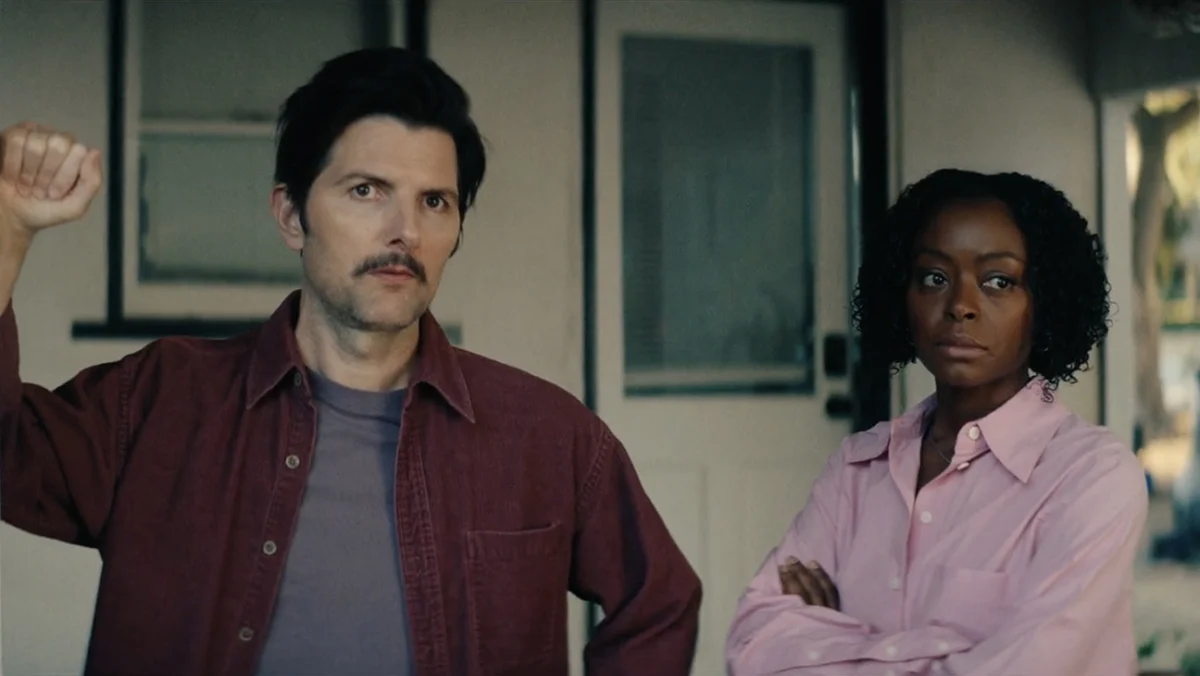
The cinematic landscape is often a mirror reflecting the anxieties and preoccupations of the contemporary world. Kevin Hamedani’s latest directorial effort, "The Saviors," an ambitious genre-bending thriller, attempts to capture the zeitgeist by exploring the perilous consequences of unchecked assumptions and the insidious spread of prejudice. Set against a backdrop of personal marital strife and an escalating sense of unease, the film centers on Sean, portrayed by Adam Scott, a man who insists his intentions are always pure, his aversion to his parents’ far-right leanings a testament to his progressive ideals. His narrative takes a sharp turn with the arrival of new Airbnb guests, Jahan (Nazanin Boniadi) and Amir (Theo Rossi), individuals whom Sean, despite his claims of open-mindedness, begins to view with suspicion. This suspicion, he asserts, stems not from their Middle Eastern heritage, but from an intangible "offness" that permeates their presence.
However, as the film unfolds, it becomes starkly apparent that good intentions, while perhaps a starting point, are insufficient to navigate complex societal issues or craft a compelling narrative. "The Saviors" grapples with themes of xenophobia, the radicalization pipeline, and the ease with which fear can become a unifying force, particularly in a politically charged climate. While the film’s conceptual underpinnings are undeniably relevant, its execution often falters, prioritizing broad thematic strokes over nuanced character development and detailed storytelling. This results in a film that is more intellectually engaging in its premise than viscerally impactful in its realization.
The Genesis of Suspicion: A Marriage in Peril and Uninvited Guests
The narrative’s primary engine is the crumbling marriage of Sean and Kim, played by Adam Scott and Danielle Deadwyler, respectively. The couple is on the verge of divorce, with the rental of their home to Jahan and Amir serving as a desperate measure to meet mortgage obligations. This precarious financial situation underscores the underlying instability in their relationship. Initially, Kim dismisses Sean’s burgeoning suspicions about their guests as the ramblings of an aimless husband, a predictable reaction from someone disengaging from their marital partnership. However, as Sean’s observations intensify – the discovery of strange electrical equipment, unexplained lights, and most crucially, a missing journal and an alarming map – Kim’s skepticism begins to wane. Her own observations of the Razi siblings’ unusual behavior start to align with Sean’s growing unease, pulling her into his orbit of suspicion.
A Shared Obsession: The Unifying Power of a Common Enemy
The film masterfully, albeit at times overtly, depicts how the shared perceived threat of Amir and Jahan inadvertently rekindles Sean and Kim’s fractured relationship. The thrill of investigation – snooping through the guests’ belongings, debriefing each other, even enlisting the services of a private investigator, Jimmy Clemente (a perfectly cast Greg Kinnear), and contemplating a report to the FBI – injects a vital spark into their stagnant marriage. This shared endeavor, fueled by a manufactured common enemy, becomes a perverse form of intimacy. In a particularly striking scene, their rekindled passion is so potent that it intermingles with their surveillance activities, with Kim requesting a positional change during intercourse to maintain their vigil over the backyard.
This almost psychosexual component of their shared paranoia, while an intriguing concept, ultimately remains underdeveloped. The film introduces this compelling dynamic but fails to explore its logical extremities or delve deeper into the psychological motivations behind it. It hints at a broader commentary on how a perceived external threat can forge bonds and distract from internal conflicts, a potent observation about the current sociopolitical climate. However, the execution lacks the finesse and confidence required to truly resonate, leaving the audience with a sense of missed opportunity.
The Contagion of Prejudice: A Vague Portrayal of Motivations
"The Saviors" attempts to illustrate the pervasive nature of prejudice, tracing its transmission from overt bigotry to more subtle forms of suspicion. The film posits that the vitriol found in neo-Nazi newsletters, espoused by Sean’s parents (Ron Perlman and Colleen Camp) and sister (a memorably humorous Kate Berlant), filters down to individuals like Sean, who consider themselves progressive but inhabit a "white bubble." This unexamined privilege, as highlighted by Kim, leads Sean to fail to recognize the inherent discomfort his Middle Eastern guests might experience in a predominantly white community. The contagion then spreads further, influencing even the more left-leaning Kim.
However, this crucial observation is undermined by the film’s tendency to treat its characters as archetypes rather than fully realized individuals. Their motivations often feel dictated by the narrative’s thematic agenda rather than organic character development. This is particularly evident in the portrayal of Sean and Kim. Despite the affable chemistry between Adam Scott and Danielle Deadwyler, their characters remain vaguely drawn. The film offers little insight into what initially brought them together or what is driving them apart, beyond the immediate plot device of their impending divorce. The meta-narrative seems to suggest that Kim’s role as a Black woman is primarily to introduce a racial dynamic, prompting Sean to confront his own insular worldview.
The Enigmatic Guests: A Performance of Subtlety
The ambiguity surrounding Amir and Jahan is a deliberate narrative choice, designed to fuel the film’s central mystery and play on audience expectations. Nazanin Boniadi as Jahan and Theo Rossi as Amir are tasked with portraying characters whose true intentions remain veiled for much of the film. Rossi, in particular, delivers a compelling performance, conveying a depth of emotion in Amir long before the audience grasps the underlying reasons for his actions. Jahan, rendered mostly silent and communicating through lip-reading (as Amir explains early on, she is deaf), adds another layer of enigmatic presence. The script effectively maintains a taut suspense, pitting the audience’s desire to see the siblings exonerated against the gnawing suspicion that they are indeed involved in something clandestine.
The Blunt Instrument of Message Delivery
As the narrative culminates in the revelation of the truth, the film’s thematic purpose becomes glaringly apparent, almost to the point of being didactic. The film presents its central message with a bluntness that can be jarring, including a line of dialogue that feels less like organic exposition and more like a neon sign proclaiming, "This is the theme of the movie." While the message itself – the dangers of prejudice and the ease with which fear can be manipulated – is undeniably important and perhaps more relevant than ever in the current global climate, its delivery lacks the subtlety and nuance required to leave a lasting, profound impact.
The film’s structure, after revealing the truth, effectively stops. It has made its point, loudly and unequivocally, but offers little in the way of further exploration or emotional resonance. The revelation, while intended to reframe the audience’s perception of the past events from the siblings’ perspective, feels like a concluding punctuation mark rather than a springboard for deeper reflection.
Contextualizing "The Saviors" in the Contemporary Film Landscape
"The Saviors" premiered at the SXSW Film Festival, a venue known for showcasing independent and innovative cinema. Its inclusion in the Narrative Spotlight section indicated the festival’s recognition of its thematic ambition and genre-bending approach. The film’s cast, featuring established actors like Adam Scott and Danielle Deadwyler alongside strong supporting performances from Theo Rossi, Nazanin Boniadi, Ron Perlman, Colleen Camp, Kate Berlant, and Greg Kinnear, promised a level of gravitas. The ensemble cast, with their combined experience in drama, comedy, and thriller genres, provided a solid foundation for a film aiming to explore complex human emotions and societal issues.
However, the film’s performance at the festival and subsequent critical reception highlight a recurring challenge in contemporary filmmaking: the difficulty of translating timely and important social commentary into a compelling cinematic experience. The narrative’s reliance on broad strokes and thematic pronouncements, while addressing critical issues, often sacrifices the intricate character work and subtle storytelling that can truly engage an audience and foster empathy.
Broader Implications: The Unfulfilled Potential of a Relevant Message
The implications of "The Saviors’" approach are significant. In an era saturated with content, films that aim to tackle complex social issues must do so with a degree of sophistication to stand out and resonate. The film’s core message about the dangers of prejudice and the manufactured nature of common enemies is a vital one. The ease with which fear and suspicion can be weaponized, both on a personal and societal level, is a phenomenon that warrants critical examination.
The film’s exploration of how these anxieties can manifest in domestic disputes and interpersonal relationships offers a relatable entry point for discussing these larger themes. The way in which Sean and Kim’s marital problems become intertwined with their paranoia about their guests suggests a deeper psychological interplay between personal dissatisfaction and external scapegoating. This connection, while present, could have been explored with greater depth.
The "contagion of prejudice" concept, as depicted in the film, is particularly relevant. The idea that biases can spread through social networks, from overt expressions of hate to more insidious forms of suspicion, is a well-documented phenomenon. The film’s attempt to map this transmission, from Sean’s parents to Sean himself, and then to Kim, is a laudable goal. However, the execution feels more like a schematic illustration than an organic unfolding of character arcs.
Ultimately, "The Saviors" stands as a testament to the enduring relevance of its themes. The need to critically examine our assumptions, to resist the urge to demonize the "other," and to recognize the manipulative forces that seek to divide us remains paramount. While the film’s narrative framework may not fully realize its ambitious thematic potential, its core message is one that continues to demand attention and reflection in an increasingly complex and polarized world. The film serves as a reminder that while the intentions behind tackling such weighty subjects may be noble, the execution demands a level of artistry and insight that can truly elevate a message from a mere statement to a profound cinematic experience. The critical consensus, often summarized by a sentiment like "A worthwhile message, flatly conveyed," reflects this gap between thematic importance and narrative effectiveness. The film’s runtime of 1 hour and 30 minutes suggests a concise narrative, but the review indicates that this conciseness may have come at the expense of depth and character exploration. The film’s performance at the SXSW Film Festival, while an indicator of its initial reception within the industry, ultimately underscores the challenge of translating potent social commentary into a universally impactful cinematic work.