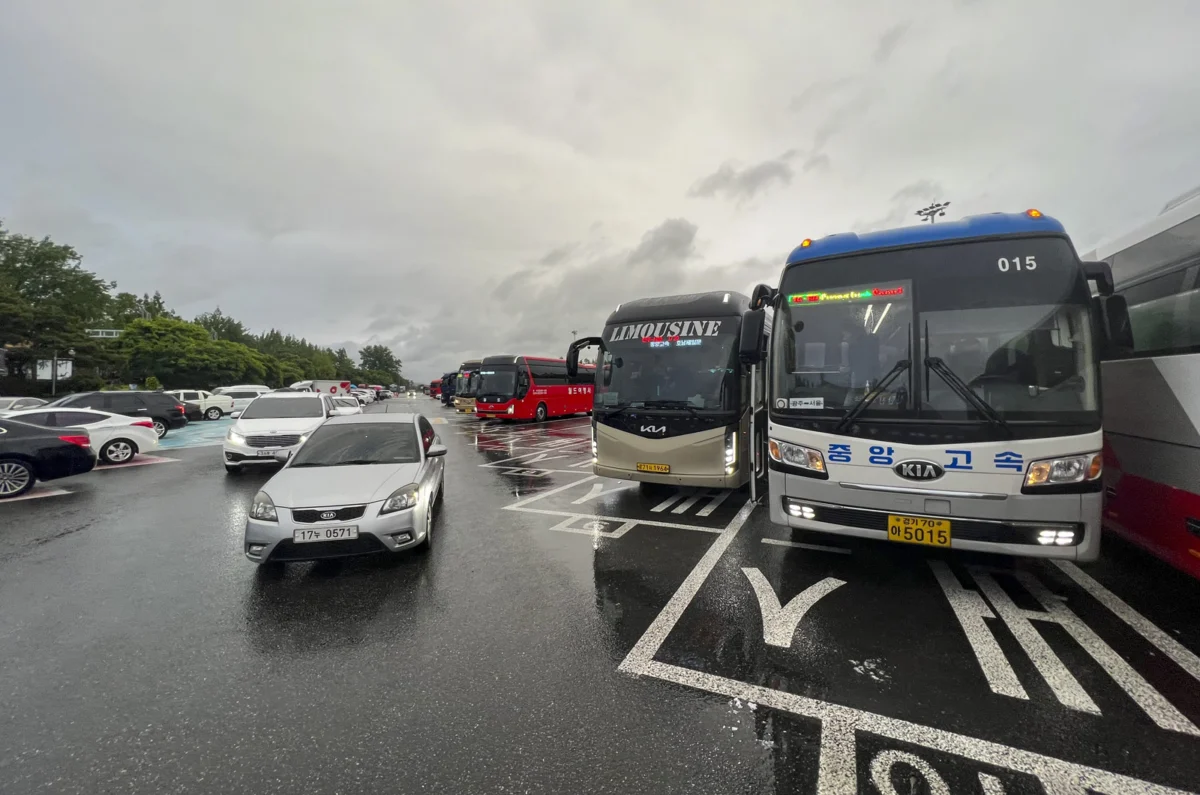
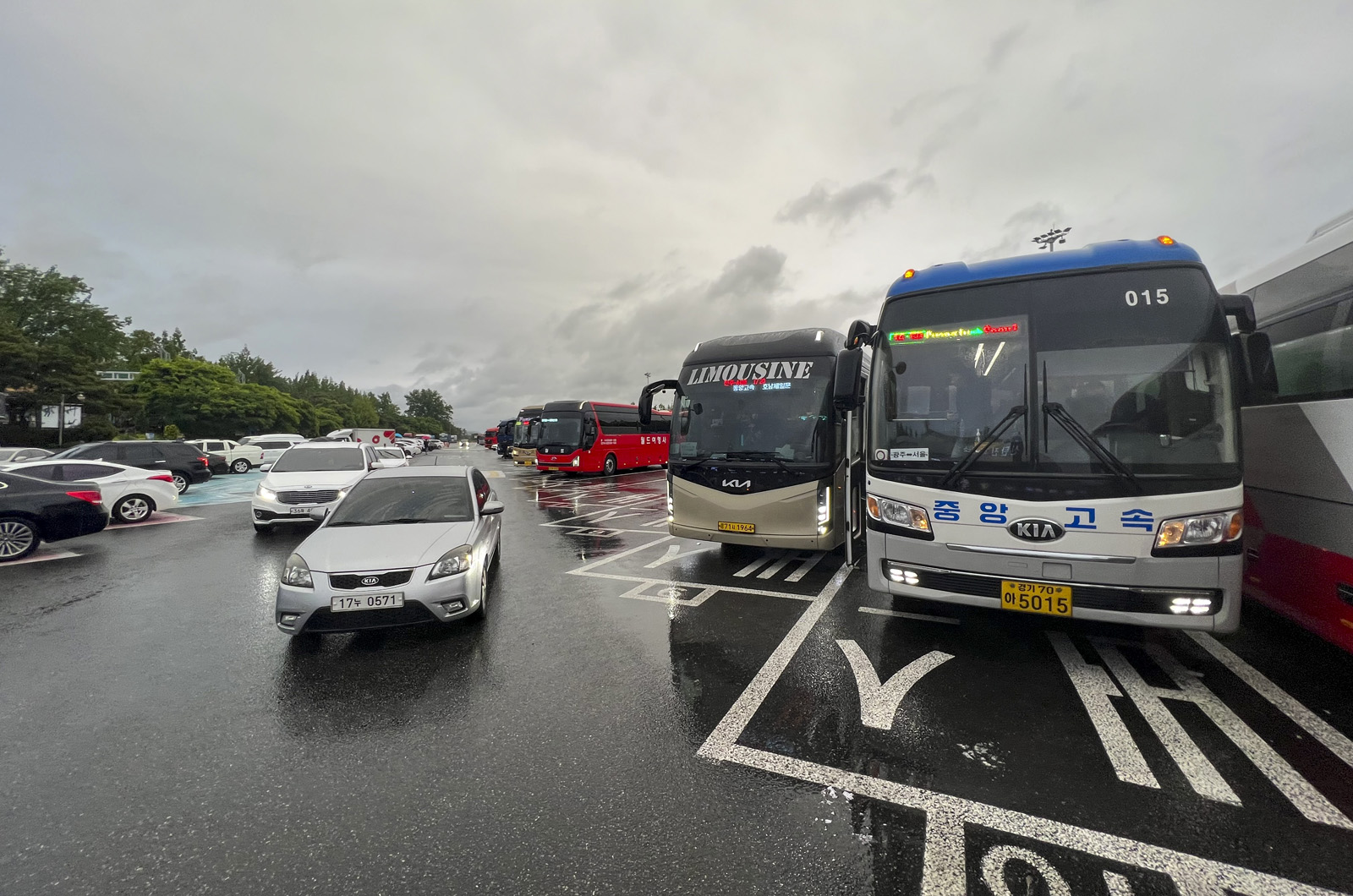
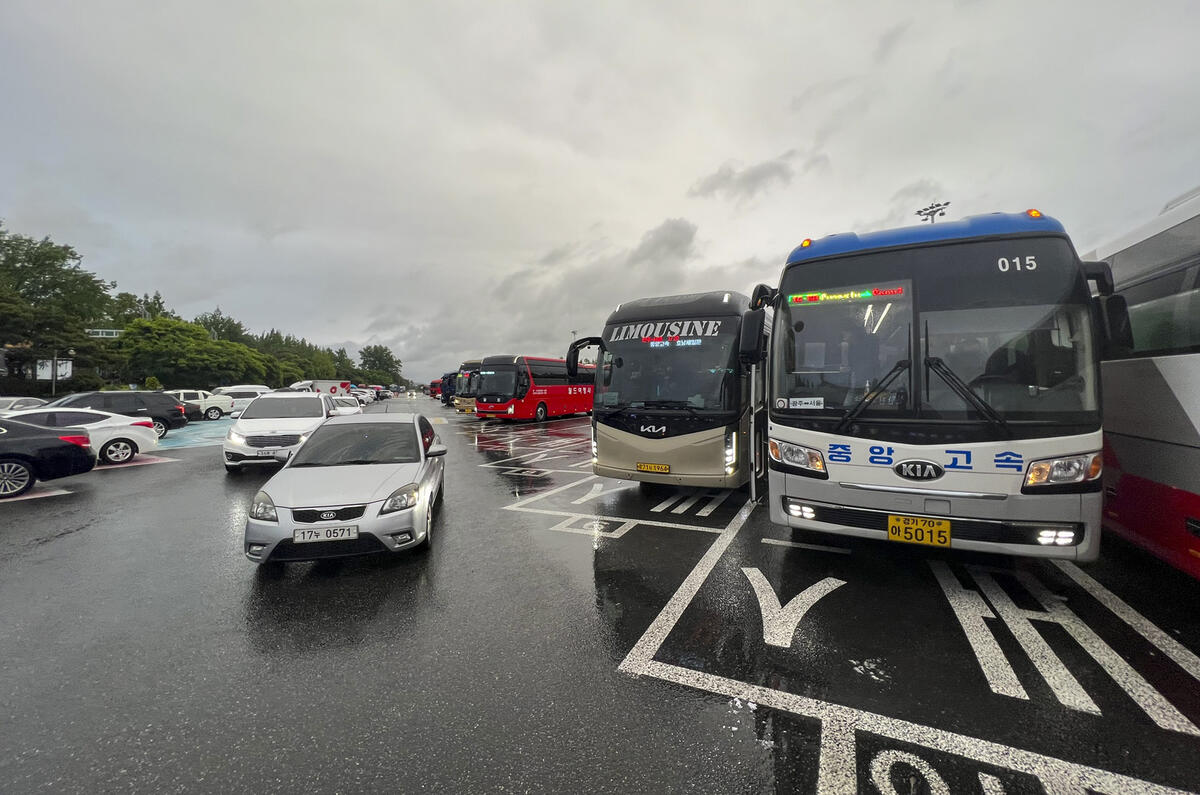
Standing on the periphery of Seoul’s bustling transport hubs, one might be forgiven for mistaking the looming silhouette on the horizon for the brand’s flagship electric SUV, the EV9. The sharp, "Opposites United" design language, characterized by vertical headlamps and a clean, architectural snout, has become a hallmark of Kia’s modern identity. However, as the vehicle draws closer, the scale shifts from the substantial to the gargantuan. This is not a passenger SUV, but the Kia Granbird—a 47-seat, 12.7-litre luxury coach that serves as a rolling testament to the sheer industrial might of South Korea.
While Western consumers primarily associate Kia with nimble hatchbacks, family-oriented crossovers, and pioneering electric vehicles, the domestic reality in South Korea is vastly different. Here, Kia is not merely a car manufacturer; it is a foundational pillar of an industrial complex that moves nations. The Granbird, particularly in its latest iteration, represents more than just a logistical solution for intercity travel. It is a metaphor for the rapid, uncompromising ascent of Korean industry—from the ruins of the mid-20th century to a position of global technological dominance.
The Engineering of a Titan: Technical Specifications
At the heart of this behemoth lies a powertrain that stands in stark contrast to the silent, battery-powered future Kia is marketing globally. The Granbird is powered by the Powertech D6HB engine, a 12.7-litre inline-six turbodiesel. This engine is a marvel of heavy-duty engineering, designed to provide the relentless torque required to propel a fully loaded, 12.5-meter coach across the mountainous terrain of the Korean Peninsula.
The engine produces upwards of 440 horsepower and a staggering 1,500 lb-ft of torque, ensuring that even with 47 passengers and their luggage, the vehicle maintains effortless cruising speeds. This mechanical heart is mated to a sophisticated transmission system, often a ZF-sourced 6-speed automatic or a 12-speed automated manual, optimized for fuel efficiency and passenger comfort.
The interior of the Granbird Silk Road—the top-tier trim of the model—rivals the business class cabins of international airlines. The 47-seat configuration is the standard high-capacity layout, but luxury variants often reduce seating to 21 or 28 "prestige" seats, featuring full-recline capabilities, individual infotainment screens, and integrated leg rests. The presence of such a vehicle highlights a specific Korean nuance: the "Limousine Bus" culture, where high-end ground transportation is preferred over short-haul flights or rail for its door-to-door luxury.
A Chronology of Industrial Transformation
To understand why a 12.7-litre bus is a metaphor for a nation, one must look at the timeline of Kia’s evolution. The company’s trajectory mirrors the "Miracle on the Han River," the period of rapid economic growth that followed the Korean War.
- 1944–1950s: The Humble Beginnings. Founded as Kyungsung Precision Industry, the company originally manufactured steel tubing and bicycle parts. In 1952, it produced Korea’s first domestic bicycle, the Samchuly.
- 1960s–1970s: Internal Combustion and Integration. Under government-led industrialization mandates, Kia shifted to motorcycles and three-wheeled trucks. By 1974, the company opened the Sohari Plant—Korea’s first integrated automobile manufacturing facility—and produced its first passenger car, the Brisa.
- 1980s: Forced Specialization. Due to the "Automobile Industry Rationalization" policy enforced by the military government, Kia was forced to give up passenger cars and focus entirely on light trucks and commercial vehicles. This period, though restrictive, allowed Kia to master the heavy-duty engineering that would eventually lead to the Granbird.
- 1997–1998: The Asian Financial Crisis. On the brink of bankruptcy, Kia was acquired by Hyundai Motor Company. This merger created the Hyundai Motor Group, a "Chaebol" (conglomerate) entity that allowed for massive R&D sharing and global scaling.
- 2020–Present: The Global Powerhouse. Kia rebranded, dropping "Motors" from its name to signify a shift toward "Movement that Inspires." It launched the E-GMP platform, positioning itself as a leader in the EV transition with the EV6 and EV9.
The Granbird sits at the intersection of this history. It retains the heavy-industrial DNA of the 1980s while adopting the sophisticated design and tech-forward philosophy of the 2020s.
The Chaebol Ecosystem: Integration and Influence
The Granbird is a product of the "Chaebol" system, a uniquely South Korean form of industrial organization where large, family-owned conglomerates dominate the economy. When a passenger boards a Kia bus, they are likely stepping onto a vehicle built with steel from Hyundai Steel, powered by components from Hyundai Mobis, and insured by a subsidiary of a related financial wing.
This vertical integration provides a level of agility and resource-sharing that few Western manufacturers can match. It allows Kia to produce a niche, high-luxury coach like the Granbird for a relatively small domestic market while simultaneously competing for the top spot in the global electric SUV market.
Industry analysts point out that the Granbird serves as a "halo" product for Kia’s commercial division. "The Granbird isn’t just a bus; it’s a demonstration of reliability," says Dr. Lee Sang-hyun, a senior analyst at the Korea Automotive Technology Institute. "In the commercial world, downtime is the enemy. By proving that they can build a 12.7-litre engine that runs for a million kilometers without failure, Kia builds the brand equity that allows them to sell EVs to skeptical consumers in Europe and North America."
Supporting Data: Market Dominance and Export Reach
The scale of Kia’s industrial output is reflected in the data. As of 2024, the Hyundai-Kia Group stands as the third-largest automaker in the world by volume, trailing only Toyota and the Volkswagen Group.
- Domestic Market Share: In South Korea, Kia and Hyundai combined hold over 80% of the domestic passenger vehicle market. In the heavy coach segment, the Granbird and its cousin, the Hyundai Universe, effectively form a duopoly.
- Export Statistics: While the Granbird is a staple on Korean highways, it is also a significant export product. Thousands of units are shipped annually to markets in Southeast Asia, the Middle East, and Eastern Europe. In these regions, the Kia badge is synonymous with "attainable luxury" and mechanical robustness.
- R&D Investment: Kia’s parent group invested approximately $18 billion in 2023 alone toward the development of future mobility solutions, including hydrogen fuel cell technology for heavy-duty applications. This suggests that while the current Granbird uses a 12.7-litre diesel, a hydrogen-powered successor is likely already in testing.
Official Responses and Strategic Vision
In recent press briefings, Kia executives have emphasized that the company’s commercial vehicle arm is integral to its "Plan S" strategy—a multi-billion dollar roadmap for electrification and diversification.
"Our commercial vehicles, including the Granbird, represent the backbone of public mobility," a Kia spokesperson stated during the Seoul Mobility Show. "As we move toward 2030, our goal is to transition these large-scale platforms to carbon-neutral powertrains without sacrificing the space, comfort, and reliability that our customers expect. The design cues seen on the Granbird today—influenced by the EV9—are a visual promise of that high-tech future."
This sentiment is echoed by government officials. The South Korean Ministry of Trade, Industry, and Energy has frequently cited the automotive sector as the "engine of the nation’s exports." The ability to manufacture everything from micro-chips for EVs to massive 12.7-litre engines for coaches is seen as a strategic national asset, protecting the country from supply chain shocks that might cripple more specialized economies.
Broader Implications: A Metaphor for Resilience
The Granbird is a metaphor for Korean industry because it refuses to be neatly categorized. It is a vehicle of contradictions: it is massive yet sleek; it uses an "old-world" internal combustion engine of immense displacement, yet it looks like a prop from a science-fiction film.
This reflects the broader South Korean economic strategy of "fast-following" turned "pioneering." For decades, Korean companies were seen as makers of cheap, functional goods. Today, they are the trendsetters in electronics, automotive design, and pop culture. The Granbird, looming over the horizon like a Godzilla-sized EV9, symbolizes a nation that has outgrown its humble origins to become a global architect of modern life.
The 47-seat coach is a reminder that while the world looks toward a future of small, shared autonomous pods and electric city cars, the heavy lifting of society—moving 50 people at a time across a country in total comfort—still requires the kind of industrial muscle that Kia has spent eighty years perfecting. Whether powered by 12.7 litres of diesel or a future hydrogen fuel cell, the "Big Kia" remains an enduring icon of a nation that thinks, builds, and moves on a scale that the rest of the world is only beginning to fully appreciate.