On August 12, 2026, a rare astronomical event will unfold as the Sun, Moon, and Earth align to produce a total solar eclipse, offering a breathtaking celestial spectacle to a limited number of viewers in the Northern Hemisphere. Western Iceland and northern Spain are poised to be among the few land-based locations within the narrow path of totality, where observers will witness the Moon completely obscure the Sun, revealing its ethereal corona. This event follows the widely observed total solar eclipse of April 8, 2024, which traversed North America, captivating millions. However, the 2026 eclipse presents a more exclusive viewing opportunity, primarily over oceanic expanses before making landfall in these distinct European regions.
The Astronomical Phenomenon: Understanding a Total Solar Eclipse
A total solar eclipse is a cosmic ballet, a precise alignment of three celestial bodies: the Sun, the Moon, and Earth. It occurs when the Moon passes directly between the Sun and Earth, casting its darkest shadow, known as the umbra, onto the Earth’s surface. For those positioned within this narrow umbral path, the Moon completely blocks the Sun’s bright disk, plunging the immediate surroundings into a temporary twilight. This rare moment allows for the visibility of the Sun’s magnificent corona—its outermost atmosphere—a pearly white halo of superheated plasma that is normally hidden by the Sun’s overwhelming brightness. Outside the path of totality, a broader region experiences a partial solar eclipse, where the Moon covers only a portion of the Sun.
The mechanics behind an eclipse are fascinating. The Moon’s orbit around Earth is tilted by about five degrees relative to Earth’s orbit around the Sun. This tilt is why eclipses don’t happen every new moon. Eclipses only occur when the Moon crosses the plane of Earth’s orbit at the same time it is in its new phase, aligning precisely with the Sun. Furthermore, because the Moon’s orbit is elliptical, its apparent size in the sky varies. A total solar eclipse requires the Moon to be close enough to Earth in its orbit (near perigee) to appear large enough to completely cover the Sun. The precise geometry of the 2026 event will allow for a substantial duration of totality, estimated to last over two minutes in its prime viewing locations, with the maximum duration exceeding four minutes over the Atlantic.
Historically, solar eclipses have inspired awe, fear, and scientific inquiry. Ancient civilizations often interpreted them as omens or divine interventions. Today, they serve as powerful reminders of the dynamic cosmic environment we inhabit and offer invaluable opportunities for scientific research, from studying the Sun’s corona to observing atmospheric changes on Earth during the sudden drop in temperature and light.

The Path of Totality: A Northern Trajectory
The journey of the Moon’s shadow on August 12, 2026, begins far to the north, originating over the Arctic Circle in northern Russia. From there, it will track along the eastern side of Greenland, a vast, ice-covered landmass, before making its first significant landfall in Western Iceland.
Iceland: Land of Fire and Ice Under Eclipse
At approximately 5:45 p.m. local time in Iceland (17:45 Universal Time), the country’s western fringes will begin to experience the onset of totality. The Snæfellsnes peninsula, a dramatic finger of land jutting into the North Atlantic, will be a prime viewing location. This region, often dubbed "Iceland in Miniature" due to its diverse geological features, is expected to draw a significant influx of eclipse chasers and astronomers. The greatest eclipse, where the Moon appears largest and offers the longest period of totality, will occur near this sparsely populated peninsula.
The Snæfellsnes peninsula is dominated by the majestic Snæfellsjökull volcano, an ice-capped stratovolcano that last erupted approximately 1,800 years ago. This iconic peak is the centerpiece of a national park bearing its name, renowned for its dramatic landscapes, including black sand beaches, basalt columns, and diverse birdlife. The volcano also holds a special place in literature, serving as the entry point to the Earth’s core in Jules Verne’s classic novel, A Journey to the Center of the Earth. In 2025, a broader area of the peninsula was officially designated a UNESCO Biosphere Reserve, recognizing its unique ecological significance, which encompasses over 70 percent of Iceland’s flora alongside an agglomeration of volcanic landscapes, wetlands, and grasslands. Local authorities and tourism operators on Snæfellsnes are already preparing for the anticipated surge in visitors, with accommodations and viewing sites being organized to ensure a safe and memorable experience for all. The remote nature of the peninsula, while adding to its allure, also presents logistical challenges in managing large crowds, requiring careful planning for traffic, waste management, and emergency services.
Across the Atlantic to Spain: Sunset Totality
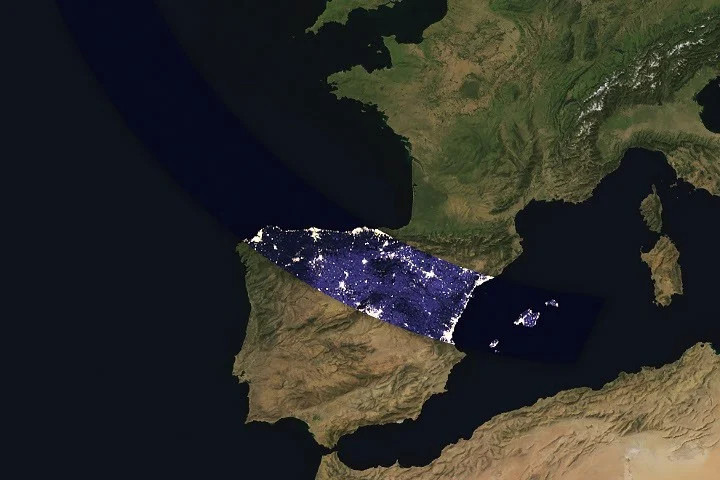
Following its Icelandic passage, the Moon’s shadow, or umbra, will traverse the vast expanse of the North Atlantic Ocean. After approximately an hour and a half, it will reach the Iberian Peninsula, making landfall in northern Spain shortly before sunset. The eclipse path will then run east-southeast across the country, remarkably mirroring the course of the Ebro River (Río Ebro), one of Spain’s most significant waterways.
The Ebro River originates in the rugged terrain of the Parque Natural de Montes Obarenes-San Zadornil, where it carves impressive canyons and gorges through the eastern foothills of the Cantabrian Mountains. As the eclipse shadow progresses, it will sweep over regions like La Rioja, globally celebrated for its vineyards and exquisite wines. The path will continue for approximately 400 kilometers (250 miles) across the country, eventually reaching the Mediterranean coast between Barcelona and Valencia, where the Ebro forms a rich delta.
Viewers in Spain have a statistically higher likelihood of experiencing clear skies for the eclipse compared to their counterparts in Iceland. Decades of satellite measurements of cloud cover in August indicate more favorable conditions over the Spanish mainland. This enhanced probability, combined with the region’s existing tourism infrastructure and cultural attractions, is expected to draw a substantial number of domestic and international visitors. Towns and cities along the path, particularly in regions like La Rioja and Aragón, are likely to host viewing events, educational programs, and local festivals to celebrate this extraordinary natural phenomenon. The timing of the eclipse near sunset will offer a uniquely dramatic visual, with the darkened Sun potentially silhouetting against the horizon, creating a truly unforgettable spectacle.
Broader Viewing Opportunities: The Partial Eclipse
While the total solar eclipse is confined to a narrow corridor, a much wider area will experience a partial solar eclipse. This includes the rest of Europe, significant parts of Africa, Canada, and the northern and northeastern United States. In these regions, observers will see the Moon cover only a portion of the Sun’s disk, creating a crescent-shaped Sun. While not as dramatic as totality, a partial eclipse is still a notable event that requires proper eye protection (certified solar filters or eclipse glasses) to observe safely. Educational institutions and science centers across these continents are expected to organize public viewing sessions and provide guidance on safe observation practices.
Economic and Scientific Implications
The 2026 total solar eclipse, despite its limited land path, is poised to generate significant economic activity for the host regions. In Iceland, particularly the Snæfellsnes peninsula, the influx of tourists will boost local businesses, including hotels, guesthouses, restaurants, and tour operators. Similarly, in northern Spain, regions like La Rioja, already popular for wine tourism, anticipate a substantial increase in visitors, leading to economic benefits for local communities. Governments and tourism boards in both countries are actively promoting their regions as prime eclipse destinations, highlighting not only the astronomical event but also the unique cultural and natural attractions available.
Beyond tourism, the eclipse presents a valuable opportunity for scientific research. Teams of astronomers and solar physicists from around the world are expected to deploy instruments along the path of totality. The brief period of darkness allows for unparalleled observations of the Sun’s corona, a region that remains one of the greatest mysteries in solar physics. Scientists aim to study its temperature, density, and magnetic field structures, which play a crucial role in space weather phenomena that can impact Earth. Observing the corona during an eclipse provides a unique perspective that complements data from space-based solar observatories, as ground-based instruments can often achieve higher spatial resolution and capture subtle details close to the Sun’s surface. Atmospheric scientists may also study the effects of sudden solar dimming on Earth’s atmosphere, observing changes in temperature, wind patterns, and cloud formation.
Planning for the Celestial Spectacle
For individuals planning to witness the 2026 eclipse, early preparation is crucial, especially given the limited viewing areas. Accommodation in prime locations like the Snæfellsnes peninsula and towns along the Ebro River in Spain is expected to book up rapidly. Travel arrangements, including flights and local transportation, should be secured well in advance.
Safety during eclipse viewing cannot be overstated. Looking directly at the Sun, even during a partial eclipse, can cause permanent eye damage. Only during the brief period of totality, when the Sun’s disk is completely covered by the Moon, is it safe to look directly at the eclipse with the unaided eye. Before and after totality, and throughout a partial eclipse, certified solar eclipse glasses or viewers that meet the ISO 12312-2 international safety standard must be used. Telescopes, binoculars, and cameras require specialized solar filters to protect both the equipment and the observer’s eyes. Public awareness campaigns and educational materials will be vital in disseminating these safety guidelines to ensure that everyone can enjoy the eclipse responsibly.
The total solar eclipse of August 12, 2026, promises to be an unforgettable event, uniting science, nature, and human wonder. From the dramatic landscapes of Iceland to the historic vineyards of Spain, those fortunate enough to stand within the Moon’s shadow will bear witness to one of nature’s most profound and beautiful displays, a testament to the intricate and predictable dance of our solar system.