


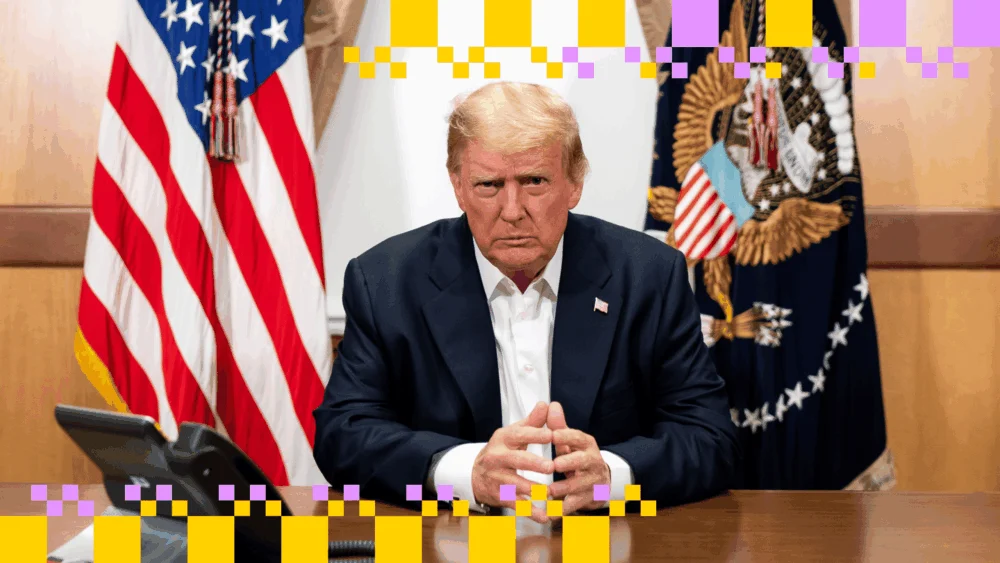
U.S. President Donald Trump issued a stern warning to the American banking sector on Tuesday, accusing financial institutions of orchestrating a campaign to sabotage the GENIUS Act and obstructing the passage of critical follow-up cryptocurrency legislation. In a series of posts on Truth Social, the President claimed that traditional banks are attempting to protect their "record profits" by undermining the stablecoin framework he signed into law last year, while simultaneously holding the proposed Market Structure and Clarity Act "hostage" in the Senate. The President’s remarks come at a volatile moment for his administration, which is currently balancing a domestic economic agenda centered on digital assets with an escalating military engagement in the Middle East.
The President’s comments specifically targeted the ongoing legislative impasse in Washington, where the Clarity Act—a comprehensive bill designed to provide a definitive regulatory framework for crypto market structures—has remained stalled for months. "The U.S. needs to get Market Structure done, ASAP. Americans should earn more money on their money," Trump stated in his post. He further warned that failure to pass the legislation would result in the migration of the digital asset industry to foreign competitors, specifically citing China. "The Banks are hitting record profits, and we are not going to allow them to undermine our powerful Crypto Agenda that will end up going to China, and other Countries if we don’t get The Clarity Act taken care of."
The Core of the Conflict: The Stablecoin Yield Debate
At the heart of the current friction between the White House, the banking industry, and the cryptocurrency sector is a dispute over the ability of third-party platforms to offer yield on stablecoin deposits. While the GENIUS Act (Global Electronic Network for Infrastructure and Ultra-Secure Stability), signed by President Trump in 2025, established the initial federal oversight for stablecoin issuers, it left several technical questions regarding secondary market activities to be resolved in subsequent legislation.
The banking sector, led by influential figures such as JPMorgan Chase CEO Jamie Dimon, has argued that if cryptocurrency exchanges like Coinbase or Kraken are permitted to offer interest-bearing stablecoin accounts, they are essentially performing the functions of a bank without being subject to the same stringent capital requirements and regulatory oversight. Bankers fear a "deposit flight," where consumers move their traditional savings into digital dollar equivalents to chase higher yields, potentially destabilizing the traditional fractional-reserve banking system.
Conversely, the crypto industry maintains that the GENIUS Act was intended to democratize finance and that preventing users from earning yield on their assets is an anti-competitive move designed to protect the legacy banking monopoly. This tension has led to a legislative stalemate in the Senate Banking Committee, which indefinitely postponed a crucial markup hearing in January 2026. The committee, tasked with debating amendments to the Clarity Act, has reportedly been unable to find a compromise on the "yield provision" that satisfies both the powerful banking lobby and the burgeoning crypto constituency.
Chronology of the Legislative Stagnation
The path to the current confrontation began shortly after the passage of the GENIUS Act in early 2025. That legislation was hailed by the Trump administration as a landmark achievement that brought stablecoins into the federal fold. However, by late 2025, it became clear that the act required a companion bill to address the broader market structure, including exchange registrations and the jurisdictional boundaries between the Securities and Exchange Commission (SEC) and the Commodity Futures Trading Commission (CFTC).
In November 2025, the Clarity Act was introduced with bipartisan support in the House, eventually passing and moving to the Senate. In January 2026, the Senate Banking Committee was scheduled to vote on the bill, but the hearing was canceled at the eleventh hour. Reports at the time suggested that intensive lobbying from the American Bankers Association (ABA) had successfully sowed doubt among lawmakers regarding the systemic risks of stablecoin-based interest accounts.
Throughout February 2026, the White House facilitated a series of closed-door negotiations between banking executives and crypto industry leaders. While the administration had set a target of February 28 to reach a consensus, that deadline passed without a deal. As of early March, draft language is reportedly circulating among staff members, but no formal agreement has been reached to move the bill to the Senate floor.
The Role of World Liberty Financial and USD1
The President’s forceful defense of the crypto industry is viewed by some analysts through the lens of his family’s personal involvement in the sector. World Liberty Financial, a decentralized finance (DeFi) venture associated with the Trump family, recently launched its own stablecoin, USD1. The firm has been active in seeking a trust charter under the Office of the Comptroller of the Currency (OCC) for an affiliated entity, a move that would grant it significant legitimacy and operational flexibility within the federal banking system.
The OCC, a primary regulator for national banks, recently waded into the debate with a rule proposal issued in late February. The proposal suggested that contracts between stablecoin issuers and third-party associates must be transparent regarding the nature of their offerings. Crucially, however, the OCC stopped short of a total ban on yield payouts, providing a narrow window of hope for the crypto industry while maintaining a cautious stance on consumer protection.
Geopolitical Distractions and the 2026 Election Cycle
The timing of President Trump’s Truth Social post is notable, as it represents a sudden pivot back to domestic financial policy following a period of intense focus on foreign affairs. Over the past week, the U.S. military has conducted a series of strikes against Iranian targets in what the administration has labeled a "special combat operation." These hostilities have had immediate global repercussions, disrupting international air travel and causing significant volatility in the energy markets due to threats to shipping lanes in the Strait of Hormuz.
Critics of the administration suggest that the pivot to crypto policy may be an attempt to re-engage his core political base as the 2026 midterm election cycle begins to accelerate. With control of both the House and Senate potentially at stake, the President is under pressure to deliver on his "Crypto Agenda," which was a cornerstone of his economic platform. The legislative calendar is rapidly shrinking; if the Clarity Act does not pass before the summer recess, it is unlikely to see movement until after the November elections.
Industry and Regulatory Reactions
The reaction to the President’s comments has been polarized. Digital asset advocacy groups, such as the Blockchain Association, praised the President for his "unwavering commitment to American innovation." In a statement released shortly after the Truth Social post, the association noted, "The banking industry should not be allowed to gatekeep the future of finance. The Clarity Act is essential for ensuring that the United States remains the global leader in digital assets."
In contrast, representatives for the banking sector have doubled down on their calls for "same activity, same regulation." A spokesperson for a major banking trade group, speaking on the condition of anonymity, stated, "Our concerns are not about competition, but about the safety and soundness of the financial system. Allowing unregulated entities to offer bank-like products without bank-like safeguards is a recipe for a 2008-style crisis."
Market analysts at firms like JPMorgan have noted that while the legislative uncertainty is currently weighing on prices—with Bitcoin and other major assets remaining "stuck in a rut"—the passage of the Clarity Act could serve as a massive catalyst for institutional adoption. A recent research note suggested that the bill could provide the "ultimate spark" needed to transition digital assets from a speculative niche into a core component of the global financial infrastructure.
Implications and Future Outlook
As the White House continues to push for a "good deal" between the two warring sectors, the stakes for the American economy are high. If the Clarity Act fails to materialize, the U.S. risks a fragmented regulatory landscape where individual states attempt to fill the void, creating a "patchwork" of laws that could drive major firms to relocate to more crypto-friendly jurisdictions like Hong Kong, Singapore, or the European Union.
Furthermore, the President’s rhetoric suggests a growing willingness to use the bully pulpit to pressure the banking industry, a sector that has historically wielded immense influence in Washington. Whether this populist approach will break the legislative logjam in the Senate remains to be seen. For now, the "Crypto Agenda" remains a hostage of the ongoing battle between the old guard of Wall Street and the emerging forces of the digital economy, with the 2026 elections serving as the ultimate ticking clock for both sides.